
USGIF Mission Focus: It’s About Automation, Not AI
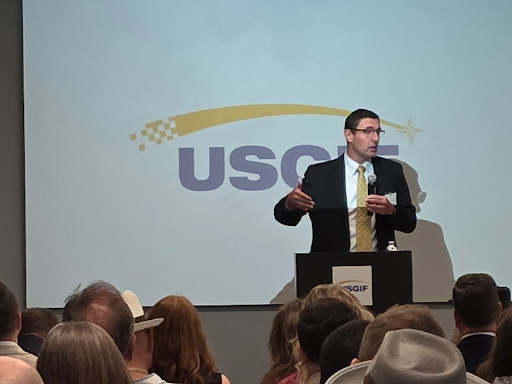
Dr. Steve Hall giving his presentation at the USGIF Event on 2026 July 28, at the Trajectory Center in Herndon Va
Reflections on Dr. Steve Hall’s Vision for the Future of GEOINT Analysis
Walking into the USGIF Mission Focus event, I expected to hear another discussion centered on artificial intelligence. Instead, Dr. Steve Hall, NGA’s Deputy Director of Analysis, delivered a message that challenged many of the assumptions surrounding AI in the GEOINT community. His central theme was surprisingly simple: the future is not just about AI. It’s about automation.
That distinction resonated with me.
Throughout the evening, Dr. Hall described a future where automation removes repetitive, time-consuming tasks so analysts can focus on what humans do best: applying judgment, context, and critical thinking. Rather than replacing analysts, automation should empower them to spend more time solving problems that require experience and expertise. As someone who appreciates both operational efficiency and the value of human decision making, I found this perspective both practical and encouraging.
One point that particularly stood out was the sheer volume of structured geospatial data now available across the enterprise. After years of collecting information, the challenge has shifted from gathering data to making sense of it. Dr. Hall humorously described this moment by saying, “The dog has caught the car.” That analogy captured the reality perfectly. We have the data. Now we need better ways to extract meaningful insights from it.
Interestingly, much of the discussion focused less on generative AI and more on big data analytics, automation, and mathematical modeling. Predictive analytics, anomaly detection, spatial correlations, and statistical validation may not generate the same headlines as large language models, but they have the potential to fundamentally improve intelligence production. It was refreshing to hear a senior leader emphasize that not every challenge requires AI. Sometimes the right answer is building better data pipelines and more efficient automated processes.
Another message I appreciated was Dr. Hall’s acknowledgment that trust must be earned. Intelligence professionals are trained to question information, evaluate sources, and challenge assumptions. That same mindset naturally extends to AI. Rather than expecting analysts to accept automated recommendations at face value, Dr. Hall advocated for greater transparency by providing confidence levels and explaining how systems arrive at their conclusions. In my opinion, this approach will be essential for responsible AI adoption across the intelligence community.
The conversation also reinforced that modernization is about more than adopting new technology. It requires rethinking how intelligence is produced and delivered. Moving away from static reports toward machine-readable data, automated workflows, and real-time dissemination reflects the operational speed required to support today’s decision makers.
Perhaps the most encouraging takeaway for me was hearing that human expertise remains the intelligence community’s greatest competitive advantage. While technology will continue to evolve, decades of target knowledge, operational context, ethical judgment, and critical thinking cannot simply be automated. Those qualities will continue to define exceptional analysts.
As someone building my own career in the GEOINT community, I left the event optimistic about where the profession is heading. Success in the years ahead will require more than understanding emerging technologies. It will require professionals who can connect people, processes, data, automation, and AI to improve mission outcomes. I believe that balance between innovation and human expertise will ultimately define the next generation of GEOINT.
Thank you to USGIF for hosting another engaging Mission Focus event and to Dr. Steve Hall for sharing a candid and thought-provoking perspective on where our community is headed. I look forward to seeing how these ideas continue to shape the future of geospatial intelligence.