


GEOSPATIAL FRONTIERS
A Publication by Project Geospatial
LOOKING BEYOND
THE MAP
Geospatial Frontiers, a new publication from Project Geospatial, brings together leading voices and experts from across the geospatial ecosystem to tackle the industry's most pressing challenges. Through in-depth articles and discussions, Geospatial Frontiers aims to explore innovative solutions and spark critical conversations that will shape the future of geospatial technology and its applications.
Contributing Authors






The Algorithmic Tradecraft: Synthesizing Artificial Intelligence and Automation in Modern Geospatial Intelligence Workflows
As artificial intelligence and end-to-end automation fundamentally reshape the national security apparatus, the traditional "human-in-the-loop" intelligence cycle is rapidly becoming obsolete. This article explores the profound paradigm shift in modern geospatial intelligence (GEOINT), detailing how algorithmic machine learning models are replacing foundational analysis workflows and forcing human tradecraft to evolve from basic object detection to high-stakes algorithmic auditing. Discover the hard operational truths behind the data deluge, impending workforce displacement, and the critical future of human-machine symbiosis at mission speed.
USGIF Mission Focus: It’s About Automation, Not AI
Discover why NGA’s Deputy Director of Analysis, Dr. Steve Hall, believes the future of GEOINT is driven by automation rather than just artificial intelligence. In this recap of the recent USGIF Mission Focus event, explore how big data pipelines and automated workflows are empowering intelligence analysts to focus on their greatest competitive advantage: human expertise, critical thinking, and complex problem-solving.
Talk to the Map: Is Natural-Language GIS the Next Public Geoportal Interface?
Discover how Natural-Language GIS (NL-GIS) is revolutionizing the civic sphere by transforming complex geographic information systems into intuitive, conversational interfaces. For decades, valuable municipal data has been locked behind steep technical barriers, requiring advanced programming or specialized desktop software. Now, by merging large language models (LLMs) with GIScience, a new paradigm allows community advocates, local journalists, and emergency responders to execute advanced spatial analysis, run real-time network routing, and generate custom cartography using plain English commands.
"Agentic" GEOINT: The Autonomous Shift in Satellite Collection Orchestration
Discover how Agentic GEOINT is revolutionizing the geospatial intelligence industry by shifting from manual satellite dashboards to autonomous, AI-driven orchestration. This comprehensive article explores the mechanics of automated "tip-and-cue" workflows, in-orbit edge computing, and the critical transition to a "Human-on-the-Loop" operational model. Read on to learn how agentic AI eliminates costly human bottlenecks to create a real-time, unified sensing network for commercial and defense applications.
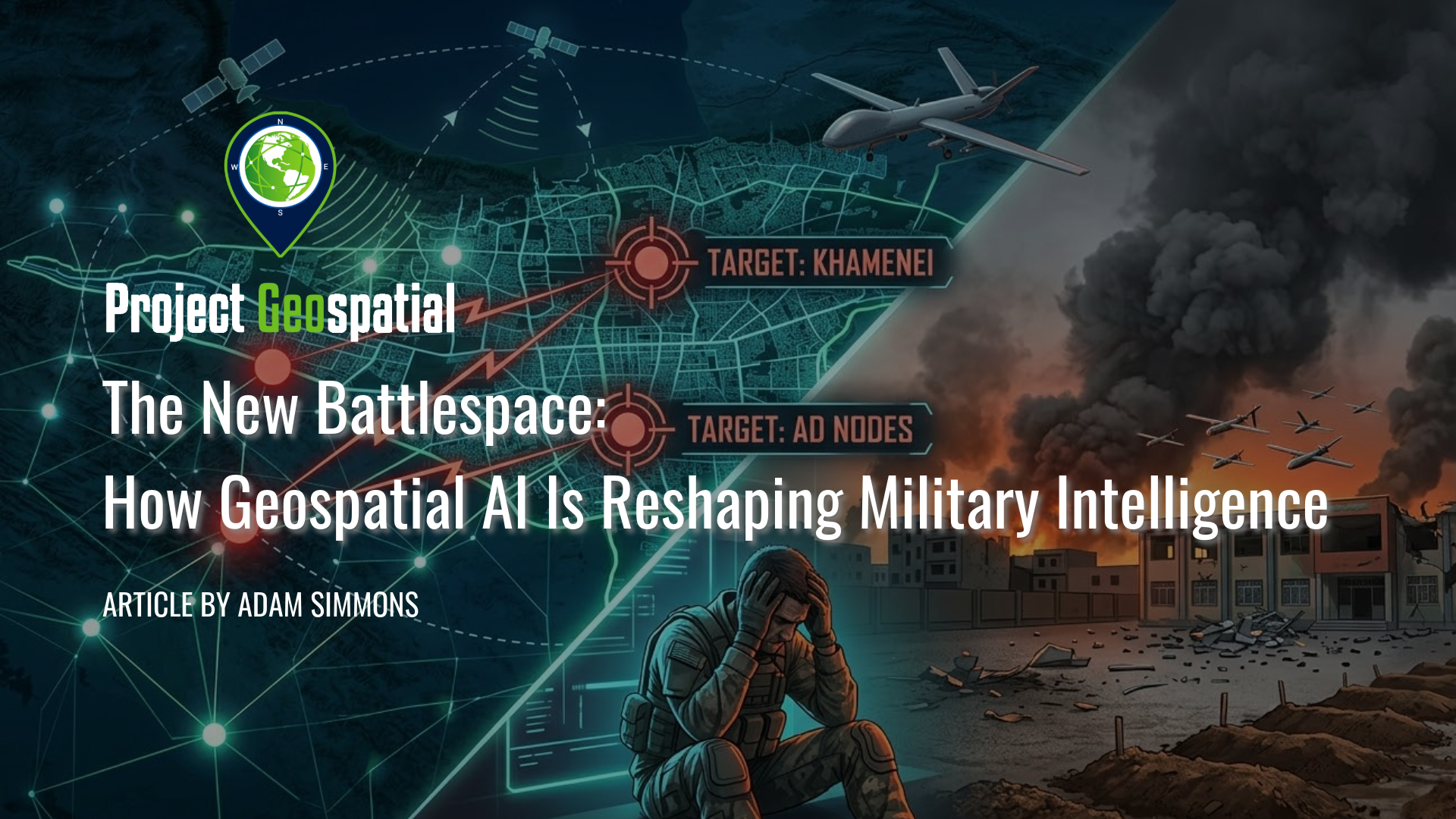
The New Battlespace: How Geospatial AI Is Reshaping Military Intelligence
The 2026 conflict in Iran marks a terrifying turning point in military history: the birth of the algorithmic battlespace. Through Operation Epic Fury, the United States and Israel have deployed a "kill web" driven by Geospatial AI, compressing decision-making from weeks to mere seconds. While systems like Project Maven and autonomous drone swarms offer unprecedented tactical precision, the human cost remains devastatingly high, evidenced by the tragic Minab school bombing and the growing psychological toll on remote operators. As Silicon Valley giants like Anthropic and Palantir clash over the ethics of AI-driven warfare, the world faces a fractured global economy and a new reality where machine-speed violence outpaces human thought.
The Death of the Map: A Post-Mortem on Geography 2050
The "Geography 2050: The Future of GeoAI" symposium, held in late 2025, captured a discipline at a violent tipping point. This post-mortem analysis of the event explores the "death of the map" and the rise of the graph, highlighting a growing identity crisis as traditional location science is hollowed out by raw engineering. By examining the tension between academic theory and the unbridled scale of AI compute, the article dives into why the geospatial community must bridge the gap between automated optimization and human-centric truth. It is a critical look at whether the industry can maintain its "geographical conscience" or if it is destined to become a mere subset of data science.

The Artificial Intelligence and Machine Learning Imperative: Filtering the Noise
Today's intelligence, surveillance, and reconnaissance (ISR) community faces a critical crisis: analysts are drowning in exponential volumes of sensor data from the expanding Internet of Battle Things (IoBT), leading to severe cognitive overload and missed threats in contested environments. The imperative solution is the rapid integration of Artificial Intelligence (AI) and Machine Learning (ML) to filter noise and automate multi-source sensor fusion. This article explores how leveraging edge processing and AI-driven workflows—exemplified by DARPA programs and innovations from BAE Systems, Esri, and Palantir—can transform overwhelmed analysts into agile decision-makers, securing information dominance against increasingly sophisticated adversaries.

The GeoAI Revolution: Charting the 2030 Geospatial Workforce Landscape
Artificial intelligence is rapidly redrawing the boundaries of the geospatial industry, unlocking powerful new insights and efficiencies at an unprecedented scale. Yet, beneath the veneer of technological marvel and the often-touted narrative of 'AI augmentation,' a more profound and unsettling transformation is underway for its workforce. This investigation delves into the stark realities of how AI and machine learning are not just reshaping, but in many cases, actively replacing traditional geospatial roles, forcing a critical reevaluation of skills, careers, and the very future of human expertise in mapping and understanding our world. As the AI wave crests, the line between assistant and successor is becoming increasingly, and for some, alarmingly, clear.