
The Artificial Intelligence and Machine Learning Imperative: Filtering the Noise
How Artificial Intelligence and Machine Learning Can Transform ISR Analysis from Data Drowning to Decision Dominance
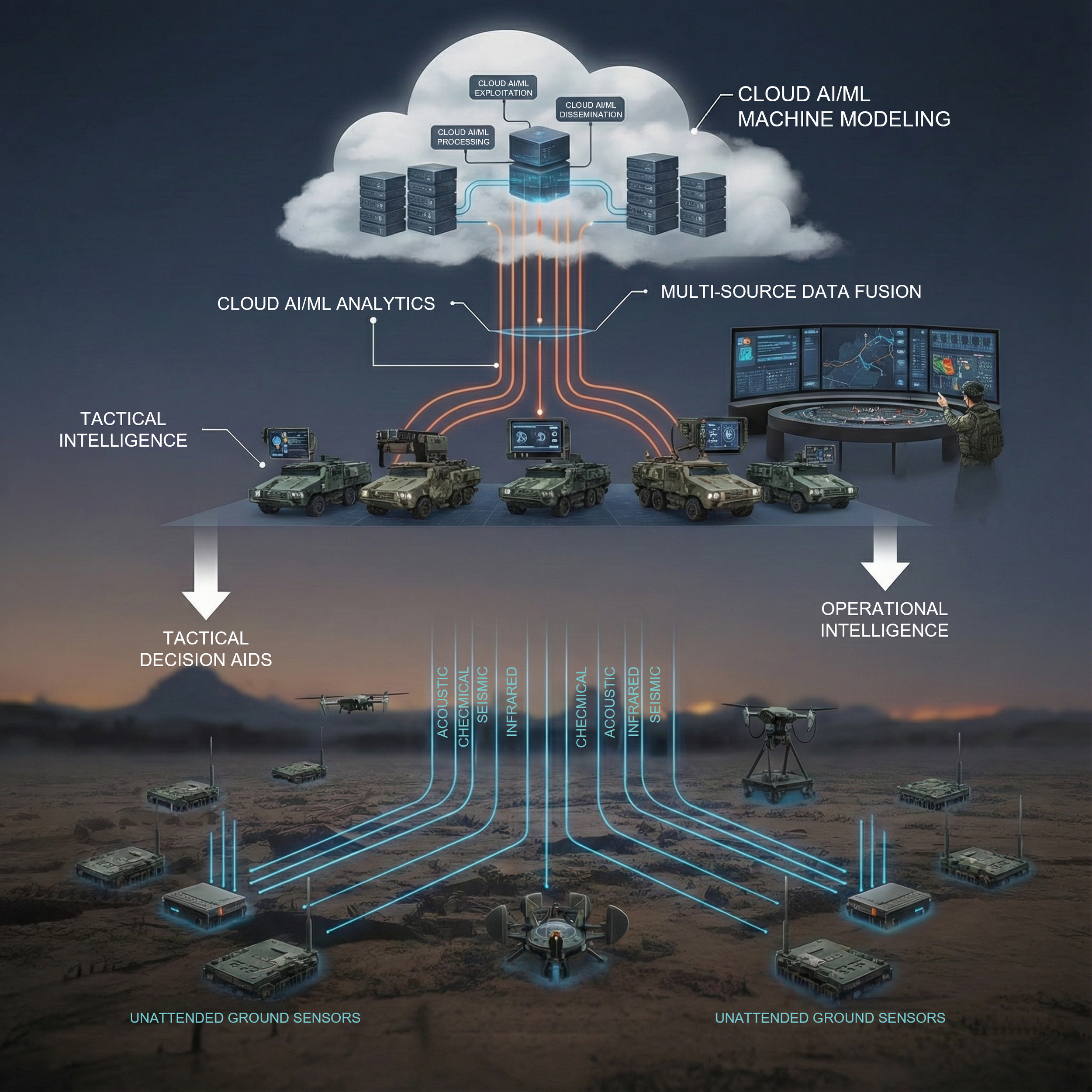
When More Data Means Less Intelligence
ISR analysts face the same reality: the volume and velocity of information to process, exploit, and disseminate is overwhelming. Defense and intelligence organizations worldwide face this dilemma with current processes, let alone the workforce required to analyze the expected volume of sensor data, including full-motion video, air and spaceborne imagery, and present and future Internet of Battle Things (IoBT) data over the next 20 years. Processing, exploiting, and disseminating sensor data isn't just a staffing problem; it's a fundamental crisis in how we process intelligence.
The Scenario
Meet Sarah, a senior all-source intelligence analyst at a forward operating base in U.S. Central Command’s (USCENTCOM’s) area of responsibility (AOR) and equipped with the latest IoBT architecture. Her mission is to fuse data from Northrop Grumman’s SCORPION II unattended ground sensors with their seismic, magnetic, and passive infrared (PIR) detection capabilities; L3Harris Silent Watch and Falcon Watch systems provide acoustic, magnetic, and PIR detection across perimeter chokepoints; Textron Systems’ Tactical Unattended Ground Sensor (T-UGS) network collect intelligence through multi-modal seismic, acoustic, radiological nuclear, and electro-optic sensors; These sensors include: Elbit Systems’ “Lonely Rider” sensors monitor urban, forested, and underground environments; McQ’s RANGER® systems delivers sophisticated seismic-acoustic-magnetic fusion with unmanned aerial system (UAS) detection capabilities; and emerging quantum sensors provide magnetic field variations and ground vibration data.
These interconnected UGS nodes autonomously correlate with DCGS-A to create a comprehensive Common Operational Picture (COP). Additionally, the UGS data is used to detect improvised explosive device (IED) emplacements via seismic signatures, track personnel movement using acoustic arrays, identify vehicle types through magnetic classification algorithms, and cue intelligent Remote Imagers for identification. When SCORPION II’s thermal cameras detect movement, the system automatically cross-references with Bertin Technologies’ FlexNet acoustic sensors. Then it triggers McQ RANGER’s speech-detection algorithms to parse keywords and descriptions.
Instead, Sarah spends 80% of her time manually correlating alerts from 15+ disparate UGS platforms, each with different data formats, communication protocols, and user interfaces. The Textron T-UGS gateway nodes that should automatically fuse multi-INT data require her to manually query separate databases. Her most experienced team members, who should be conducting sophisticated pattern-of-life analysis from the IoBT sensor mesh, are instead working as “cleaners,” reformatting detection alerts from Falcon Watch’s RF-5405 Intelligent Gateway, troubleshooting SCORPION II’s beyond line-of-sight (BLOS) communication links, and manually correlating acoustic signatures from the RANGER system with thermal imagery from Remote Imagers.
Sarah represents hundreds of intelligence analysts who want seamless IoBT integration that enables real-time sensor fusion and autonomous threat correlation. They need quantum sensor networks to automatically disseminate detection data across all intelligence disciplines, using AI-driven algorithms to identify critical patterns from the expanding UGS mesh. At the same time, streamlined workflows translate persistent surveillance into actionable intelligence. Instead, analysts are drowning in sensor alerts, while tactical commanders operate with intelligence gaps that leave them missing the very threats and opportunities this UGS market was designed to eliminate.
The Five Eyes (FVEY) have the foundational technology to solve this problem. The Defense Advanced Research Projects Agency (DARPA) and Defense Contractors worldwide have demonstrated how wireless sensor networks (WSNs) can provide persistent, 24/7 situational awareness across denied areas. Additionally, these networks, using advanced electronic protection (EP), anti-jamming techniques, and highly resistant, multi-domain architectures, can maintain functionality even when 90 percent of standard communications and sensor networks are jammed by sophisticated electronic warfare (EW).
Interconnected Problems are Crippling Analysis
We must now address the next critical step: using artificial intelligence and machine learning (AI/ML) to transform this data deluge into a competitive advantage.
Cognitive Overload from Data Tsunamis
Information overload leads to increased stress, indecisiveness, and less effective decision analysis. According to the Harvard International Review (https://hir.harvard.edu/too-much-information), “…excessive information collection leads to information overload on both the individual and institutional levels, impairing the US intelligence community’s ability to do its job.” Information overload is the reality today: analysts using primitive search tactics and tradecraft often miss critical information when dealing with large datasets under tight deadlines. The human brain cannot process the exponential flow and velocity of available data, creating a data tsunami. The ISR community uses only a fraction of the data it collects, forcing analysts to make life-or-death decisions based on incomplete, fragmented, or truncated information.
System Integration Chaos
Military operations involve tens or hundreds of different data formats requiring hundreds of transformation rules for data integration. Poor system, data, and architecture interoperability, limited communications bandwidth, and inconsistent data management processes create inefficient workflows that prevent effective multi-source intelligence fusion. Current geospatial intelligence (GEOINT) platforms such as BAE Systems' GXP ecosystem, Esri's ArcGIS Pro stack, and Palantir exhibit varying capabilities for processing real-time streaming data. SOCET GXP excels at processing static imagery snapshots from satellite and aerial sources for detailed exploitation and analysis; however, analysts use GXP InMotion for real-time motion imagery to track vehicles and personnel. ArcGIS Pro evolved from databases of structured and unstructured data to include real-time streaming capabilities through stream layers, ArcGIS GeoEvent Server, and ArcGIS Velocity, enabling real-time data visualization and analysis from multiple sensor sources, including IoBT sensors. In contrast, Palantir's Maven Smart System is architected explicitly for real-time multi-source data integration. In comparison, all platforms face technical challenges related to the volume, velocity, and variety of streaming data sources; their capabilities for handling real-time data vary significantly based on their architectural design and intended use cases for processing, exploiting, and disseminating intelligence information and analytics.
Collection Without Context
Multi-Int analysts and collection managers may not have sufficient understanding of ISR capabilities and assets to assess the feasibility of data-collection requirements. This results in poorly coordinated collection efforts and suboptimal support for operational commanders. The reliance on nonpersistent open-source intelligence (OSINT) from Janes and other sources, and the lack of credible, first-person human intelligence (HUMINT), are drivers of intelligence gaps that prevent continuous battlespace awareness.
These problems feed into each other: inadequate requirements management leads to the collection of more data than can be processed, which overwhelms analysts, who then struggle with outdated, manually/operationally intensive integration tools, including "sneaker-net."
AI/ML as the Force Multiplier, ISR Analysts Desperately Need
The solution isn't to hire more analysts; it's fundamentally changing how we process intelligence using AI/ML. Just as wireless sensor networks must evolve for contested environments, ISR analysis must evolve beyond human-only processing to achieve the decision advantage our adversaries are already pursuing.
The evidence is already emerging in operational environments. Ukrainian forces deployed Sky Fortress acoustic sensors that use AI/ML models trained on thousands of sound samples to identify drone acoustic signatures. They process and analyze data locally while transmitting only actionable intelligence, exactly what overwhelmed ISR analysts need.
Defense and intelligence leaders recognize this imperative. DARPA's Insight program aims to develop an adaptable, integrated system for ISR data that augments intelligence analysts' support for time-sensitive operations through automated back-end processing capabilities, including behavioral learning and prediction algorithms. DARPA is requesting $13.8 million for the Rapid Experimental Missionized Autonomy program to enhance military drones with autonomous decision-making capabilities.
Defense and intelligence industry partners are responding with concrete solutions. Lockheed Martin leads the defense AI market with an 11.21% market share, developing integrated platforms that support sensor fusion, predictive maintenance, and computer-vision-enabled targeting. Additionally, Lockheed Martin's Skunk Works demonstrated anomaly-detection capabilities for ISR platforms that significantly improve the detection of changes in physical features by reducing the number of scans required. Palantir launched the Artificial Intelligence Platform (AIP) in April 2023. AIP integrates large language models (LLMs) and generative AI into operational workflows, driving explosive growth and securing major government contracts.
In-Q-Tel is accelerating this transformation. The CIA's venture capital arm has invested in 476 companies, with 28% focusing on AI infrastructure for hosting or deploying models, including successful investments in Databricks (valued at $43 billion) and maintaining 35 companies on the NATSEC100 list. Recent In-Q-Tel investments include GetReal Labs for deepfake detection and Cerabyte for long-term data storage, addressing the need for permanent, immutable records in the age of AI.
From Data Overload to Decision Advantage
Implement AI-Powered Data Filtering at the Edge
Defense forces and intelligence agencies should deploy ML algorithms to process, classify, and prioritize streaming data from IoBT sensors. Following the hybrid approach demonstrated by the Ukrainian Sky Fortress system, edge processing with on-device AI models can be individualized for IoBT sensor applications based on mission requirements. For example, UGSs can be deployed with on-device AI models to perform real-time threat classification and initial processing, while simultaneously feeding data to analyst workstations for network-wide fusion, triangulation, and coordination. One example is Sky Fortress, which uses on-device AI models that perform real-time classification, identifying acoustic signatures such as "Shahed" or "quadrotor..." (https://skyctrl.com/cuas-academy/sky-fortress-acoustic-anti-drone-system). Simultaneously, the cloud-based server aggregates detections from multiple alerts, confirms the target type and speed, and uses neural networks to compute trajectory data to eliminate false positives (https://www.missiledefenseadvocacy.org/wp-content/uploads/2024/07/Team-6-Acoustic-Lily-Pads-Final-Report.pdf). The distributed intelligence approach, used by Sky Fortress, reduces bandwidth requirements and improves response times while maintaining centralized situational awareness.
BAE Systems' GXP ecosystem uses AI/ML and traditional algorithmic techniques for automatic object detection and leverages AI/ML to fuse imagery, documents, signals, maps, and video into a single picture. (https://www.geospatialexploitationproducts.com/content/socet-gxp/)
Esri's ArcGIS Enterprise platform, with its real-time event-based data-stream integration capabilities through GeoEvent Server, demonstrates the technical feasibility of integrating real-time sensor data streams with spatial analysis.
Lastly, MITRE is pioneering edge AI solutions through frameworks that enable processing at the point of collection. MITRE's solutions help put intelligence analysts back in the business of analysis, not data hunting, while dramatically reducing communications burden on surviving network nodes.
Automate Multi-Source Intelligence Fusion
Use AI to automatically correlate data across HUMINT, SIGINT, GEOINT, MASINT, and OSINT sources. DARPA's Oversight program with BAE Systems aims to track up to 1,000 targets of interest through the autonomous management of space-domain resources. ML will be used to identify patterns and connections that would take human analysts hours or days to uncover, while maintaining audit trails to manage analytical confidence and reduce verification fatigue.
BAE Systems' SOCET GXP provides the geospatial foundation for multi-source fusion, while SAIC's innovation capabilities enable the integration of emerging technologies. Palantir's Foundry platform already demonstrates seamless data integration and advanced analytics across multiple intelligence disciplines.
Enable Predictive Collection Management
ISR application developers should implement AI systems that understand collection capabilities and automatically optimize sensor tasking based on Priority Intelligence Requirements (PIR). DARPA's Blackjack program (https://www.darpa.mil/research/programs/blackjack) deploys AI-enabled autonomous mission management across proliferated low-Earth-orbit (LEO) satellite constellations via its Pit Boss system. This demonstrates how ML can autonomously task sensors, process data on-orbit, and deliver prioritized intelligence directly to operators without human intervention, ensuring analysts receive relevant, time-sensitive information aligned with mission-critical PED requirements.
ESRI's GeoEvent Server and Velocity platforms provide real-time processing infrastructure, and their open architecture enables AI/ML integration with established C4ISR frameworks, such as DCGS, to support operational deployment.
What's at Stake? Intelligence Dominance vs. Operating in the Dark
Imagine Sarah starting her shift. When she arrives, she knows the AI/ML-powered intelligence system processed sensor feeds overnight, automatically correlating suspicious activity in a denied area, identifying patterns across multiple intelligence disciplines, and presenting her with three high-priority targets requiring immediate human-in-the-loop analysis. Instead of spending hours searching, processing, and then exploiting the data, she focuses on what humans do best: contextual analysis, creative problem-solving, and strategic assessment. Her insights reach commanders within minutes, not hours or days.
The goal is not to remove analysts and human analysis. The goal is to enable analysts to perform their analyses faster, with greater precision and accuracy. This capability is the force multiplier that wireless sensor networks, combined with AI/ML, can provide continuous, intelligent, automated processing that enables human analysts to operate at the speed of decision, not the speed of data discovery.
The Cost of Inaction: Mission Failure in Contested Environments
Without this transformation into AI/ML-powered intelligence processing and initial exploitation, the consequences are catastrophic. FVEYE's ISR capabilities are increasingly under attack as our adversaries’ ISR capabilities rapidly advance. For example, China has launched approximately 360 ISR satellites into orbit as of January 2024, more than triple the number in 2018. When paired with AI/ML to rapidly identify objects and networked communications systems, the People’s Liberation Army is quickly closing its own sensor-to-shooter kill chains across the Indo-Pacific.
“Bad Actor” countries and factions are not waiting. These bad actors understand that the combination of persistent sensing and AI/ML-enabled processing provides a decisive advantage. While we debate implementation timelines, they deploy integrated solutions that turn the data problem into an asymmetric weapon.
The window for action is closing rapidly. Global AI adoption in the defense and intelligence markets is projected to grow from $12.55 billion in 2024 to $178.14 billion by 2034, with a compound annual growth rate of 30.38%. Every day we delay AI/ML integration is a day our adversaries gain ground in the race for decision superiority.
The technology foundation exists. The operational requirement is clear. The strategic imperative is urgent. What’s missing is the institutional velocity to bridge these capabilities into operational reality.
Defense contractors must partner with organizations already demonstrating AI/ML integration. For example, BAE Systems’ proven GXP ecosystem integration, Palantir’s operational AIP deployment, Lockheed Martin’s edge processing solutions, and SAIC’s innovation platforms. The technical risk is mitigated; the challenge is cooperation among integrators, contractors, and developers as deployment scales.
Program managers should leverage existing DARPA programs such as Insight and Blackjack to enable commercial-off-the-shelf software manufacturers to integrate and develop new tools and automation that enhance analyst capabilities and performance, and to validate technical approaches. Build on In-Q-Tel’s portfolio companies that have proven AI/ML capabilities in operational environments. The path forward requires systematic development, testing, and validation within existing acquisition frameworks.
Intelligence analysts need to demand AI/ML augmentation tools that address the specific problems they face daily. The technology must serve operators, not replace them. Their expertise in identifying, processing, exploiting, and disseminating actionable intelligence is critical to training AI systems that enhance, rather than complicate, their mission.
The AI/ML imperative for ISR is not about technology for technology’s sake—it’s about ensuring that intelligent systems amplify analysts’ capabilities.
In contested environments where sensor networks may degrade by 90%, data volumes grow exponentially, and adversaries deploy integrated AI-enabled ISR systems, filtering noise isn’t just an operational improvement; it’s mission survival.
The choice is clear: transform ISR analysis through AI/ML integration now or operate in the dark as decision velocity determines mission success.
This article is part four of a series examining the evolution of intelligence, surveillance, and reconnaissance capabilities. Previous articles covered wireless sensor networks as the missing link, deploying networks in contested environments, and network resilience in spectrum-denied battlespaces.
-
Harvard International Review - For the statement about information overload leading to stress, indecisiveness, and less effective analysis. URL: https://hir.harvard.edu/too-much-information
Sky Control: Sky Fortress: Ukraine's Innovative Acoustic Drone Defense System. URL: https://skyctrl.com/cuas-academy/sky-fortress-acoustic-anti-drone-system
Missile Defense Advocacy: Acoustic Lily Pads: Innovation at the Speed of Deterrence. URL: https://www.missiledefenseadvocacy.org/wp-content/uploads/2024/07/Team-6-Acoustic-Lily-Pads-Final-Report.pdf
BAE SYSTEMS, SOCET GXP Solutions: SOCET GXP® v4.6. URL: https://www.geospatialexploitationproducts.com/content/socet-gxp
DARPA Blackjack: Global high-speed network in low Earth orbit (LEO). URL: https://www.darpa.mil/research/programs/blackjack
ResearchGate - Research showing analysts using primitive search tactics miss critical information under deadline pressure. URL: https://www.researchgate.net/publication/2806982_Aiding_The_Intelligence_Analyst_In_Situations_Of_Data_Overload_A_Simulation_Study_Of_Computer-Supported_Inferential_Analysis_Under_Data_Overload
RAND Corporation/Air University - Statement that the ISR community uses only a fraction of the data it collects. URL: https://www.airuniversity.af.edu/Portals/10/ASPJ/journals/Volume-35_Special_Issue/F-Cook.pdf