The Geospatial Crossroads: Mission, Maintenance, and the Future of Open Source Governance
In the first week of November 2025, the Hyatt Regency Reston was a hive of activity. Inside, a diverse and passionate community of users and developers gathered for FOSS4G North America. While the halls certainly held representatives from federal agencies and the titans of Silicon Valley, the heartbeat of the event was found in the independent practitioners, academic researchers, and regional advocates who came to learn, share, and sustain their local chapter. It was a picture of a thriving, professionalized industry that views open source not just as a cost-saving measure, but as a critical infrastructure requirement for the modern era.
The atmosphere was that of a regional "town square", a place where the developers of the tools met the people who rely on them to map everything from local utility grids to national emergency responses. Attendees shared stories of local impact: a small city in the Midwest using QGIS to modernize its water infrastructure on a shoestring budget; a non-profit leveraging PostGIS to track environmental changes in the Amazon in real-time. In the hallways, talk focused on "The Stack", not as an abstract concept, but as the literal plumbing of the modern world. For the North American community, open source has moved past its "rebellious" phase; it is now the establishment, and with that status comes a demand for professional-grade stability, predictable governance, and localized accountability.
Less than twelve days later and 8,000 miles away, another successful gathering took place. The "Global" FOSS4G in Auckland, New Zealand, was by all accounts a triumph for those in attendance, well-organized, vibrant, and celebrated by the Oceania community. It served as a vital reminder of the movement's international reach, proving that the appetite for open-source geospatial tools remains truly global. Yet, separated by 8,000 miles and a scheduling conflict that forced many to choose between local and global loyalties, the two events highlighted a growing ideological chasm.
The success in Auckland was an isolated triumph, restricted by the sheer logistical and financial friction of intercontinental travel during a period of global economic tightening. For a developer in Washington D.C. or a project manager in St. Louis, the Auckland trip required a $2,500 flight, a three-day travel commitment each way, and a significant carbon footprint, a luxury few organizations could justify when a robust regional equivalent sat just a short train ride away. This physical distance reinforced a growing reality: a single, centralized foundation is increasingly struggling to bridge the gap between a distributed global community and the specific, high-velocity needs of its most robust regional chapters.
As OSGeo approaches its twentieth anniversary, an investigation into the foundation reveals an organization in the throes of an existential crisis. Discussion and interviews with community leaders with several chapters paint a picture of a "hollowed-out" center, a global foundation that is "under-funded" and, by its own admission, "suffering from the success" of its own independent chapters. The tension isn't merely about scheduling; it is about the fundamental evolution of a community that has outgrown its parent.
The Institutional Trap: When the Entity Outlives the Mission
The story of OSGeo is a classic study in the lifecycle of a non-profit. Founded in 2006 with a mission to support the open-source geospatial technology stack, the foundation was initially a vital catalyst. It provided a home for fragmented projects and established common governance. But as the movement succeeded, a subtle and dangerous shift occurred: the goal moved from supporting the technology to maintaining the organization itself.
In organizational theory, this is known as the "Institutional Trap." It is the stage where the "cathedral" begins to care more about the masonry than the parishioners. When an organization begins to view the success of its independent branches as a threat to its own financial viability, the social contract is broken. The catalyst for the current tension is a controversial discussion paper titled "The Future of OSGeo," which contains a startling admission: the global foundation is at risk of becoming "irrelevant." It describes a foundation that has failed to adapt to the scale of the multi-billion dollar geospatial industry it helped spawn, focusing more on internal survival than external enablement.
"The mission was to support the software stack across the entire ecosystem, not the board's travel budget," says one regional advocate. "But when the strategy pivots toward 'revenue sharing' and 'brand control' to plug holes in a central budget, you’ve moved from serving the cause to serving the institution. This is how non-profits diverge from their core purpose, they become obsessed with the machinery of the organization rather than the impact of the mission. They begin to see the growth of their own community not as a success to be celebrated, but as a resource to be harvested to pay for a legacy structure that no longer provides a tangible service."
This drift toward institutional maintenance creates a fundamental friction. For a global body, the preservation of the "brand" and the "structure" becomes paramount, often at the expense of the agile, messy, and localized innovation that defines open source. The foundation is no longer acting as a shield for its projects; it is acting as a gatekeeper for its own survival. One core developer of a high-profile project, who requested anonymity, put it bluntly: "I don't need a 'Software Steward' to tell me how to write secure code; I need a stable fiscal sponsor who understands that my code runs the world's most critical maps. When the foundation starts acting like a landlord rather than a library, the builders start looking for a new neighborhood."
A House of Cards: The Structural Disconnect
To understand the friction, one must look at the increasingly fragile architecture of OSGeo. On paper, OSGeo is a global federation. At the top sits the International Board, a volunteer body intended to provide strategic oversight. Below them are the "Local Chapters", autonomous groups that range from informal meetups to legally incorporated non-profits.
In practice, the link between the international center and the regional chapters has become purely ceremonial. The international foundation holds moral authority and control over the foss4g.org domain, but it lacks any formal legal or financial command over the chapters. This has led to a situation where the most successful chapters have outgrown the parent organization. While the international foundation remains a cash-poor volunteer effort, regional chapters have become robust, independent entities capable of signing six-figure contracts and managing complex logistics.
The "Do-ocracy" model, once the foundation's greatest strength, has become its primary point of failure. In the early days, "doing" meant contributing code or organizing a local meetup. Today, "doing" means signing multi-year venue contracts, managing multi-million dollar liability insurance, and ensuring compliance with complex international tax laws. A volunteer board, meeting once a month via video call, is fundamentally unequipped to manage the operational needs of these "super-chapters." The result is a house of cards where the foundation at the bottom is smaller and weaker than the structures it is supposed to support. The desperate attempt to tax the chapters to build the center’s strength is seen by many as a final, futile attempt to reassert control over a community that has already moved on.
The Brand Vacuum: Who Owns FOSS4G?
Central to this conflict is a surprising legal reality: OSGeo does not actually own the "FOSS4G" trademark. In an early move toward radical openness, the name was essentially left in the public domain. Unlike the Open Geospatial Consortium (OGC), which aggressively protects the "OpenGIS" brand, or the United States Geospatial Intelligence Foundation (USGIF), which owns the "GEOINT" trademark, OSGeo sits in a brand vacuum.
This lack of ownership means the international foundation has no legal standing to prevent any group from organizing a "FOSS4G" event, nor can it legally compel them to pay a licensing fee. The current Board's attempt to enforce "revenue sharing" is, therefore, a request for tribute based on a moral obligation that many chapters feel is no longer being reciprocated. "You can't tax a brand you don't own," says a legal expert familiar with non-profit IP. "The board is relying on the hope that the community values the domain foss4g.org enough to pay for it, but in the era of social media and direct marketing, a domain is a weak anchor." By claiming authority over a brand it doesn't legally own, the foundation has exposed its own strategic vulnerability, inviting chapters to simply walk away and rebrand under their own terms.
The "Anorexic" Center: A Forensic Financial Analysis
For a foundation that represents projects powering critical infrastructure, GDAL, QGIS, PostGIS, the financial reality is staggering. OSGeo operates on a shoestring administrative budget of approximately $7,000 and employs no professional staff. It relies on a "meritocratic" model where volunteers handle everything from website maintenance to global partnership negotiations.
To put this in perspective, if projects like QGIS or PostGIS were proprietary products, their combined market capitalization would reach into the billions. They are the backbone of Google Earth, Apple Maps, and the internal systems of nearly every major intelligence agency on earth. Yet, the organization tasked with their global governance operates on less than the cost of a single high-end workstation. This "operational anorexia" is not a sign of efficiency; it is a structural failure. Without professional management, the foundation is unable to execute complex strategic initiatives, perform deep legal advocacy, or manage the intricate tax and regulatory burdens of a global community. "We are asking volunteers to play the role of high-stakes corporate executives in their spare time," says a former board member. "It's not just unsustainable; it's a liability to the projects that rely on that governance for their own legitimacy."
The Economics of Extraction and the "Tax Threat"
To fill this operational vacuum, North American organizers established a U.S.-based 501(c)(3) non-profit. This status allows for tax-deductible donations, a vital requirement for U.S. corporate giving.
In sharp contrast, the International OSGeo Foundation operates as a 501(c)(4) "Social Welfare Organization." Unlike a 501(c)(3), contributions to a 501(c)(4) are generally not tax-deductible for the donor. This legal distinction acts as a financial ceiling, significantly curtailing support from philanthropic grants and corporate CSR (Corporate Social Responsibility) budgets that require a charitable deduction. While a 501(c)(4) offers more flexibility for political lobbying, a privilege OSGeo rarely exercises, it leaves the foundation perpetually cash-strapped compared to the agile, tax-advantaged regional entities it attempts to oversee.
Organizing a rotating conference across the United States introduces the "tax threat." Moving an event from Baltimore to St. Louis to San Diego triggers complex state-level tax nexus liabilities. When a non-profit holds a major event in a new state, it may establish a "nexus" for sales tax and income tax purposes. This is not merely paperwork; it is a legal and financial gauntlet. Failure to collect sales tax on a $600 ticket in a state like California or New York can lead to audits and penalties that could bankrupt a small organization. Managing this requires professional accountants and legal counsel, services that OSGeo International does not provide.
Local organizers also face the "Attrition Clause" risk. A hotel contract for a conference like FOSS4G can carry penalties as high as $200,000 for low attendance. If the conference fails, the entity that signed the contract is responsible for every empty room and unconsumed meal. "We spent 500 hours building a community treasury so we wouldn't go bankrupt if a disaster hit our venue," says a regional volunteer. "Now, the international board wants that 'profit' to pay for their travel expenses. They see a surplus; we see an insurance policy. If we give them that money, who pays the hotel when the next event underperforms?"
The global OSGeo Board’s proposed solution is a "revenue sharing" mechanism where profits from successful regional events "flow up" to the global pot. This "tax" isn't being reinvested into the software; it is being diverted to sustain a central bureaucracy that admits it can no longer support its own projects. It is a model of extraction that penalizes regional success to subsidize global stagnation.
The "Path of a Dollar": Global vs. Regional
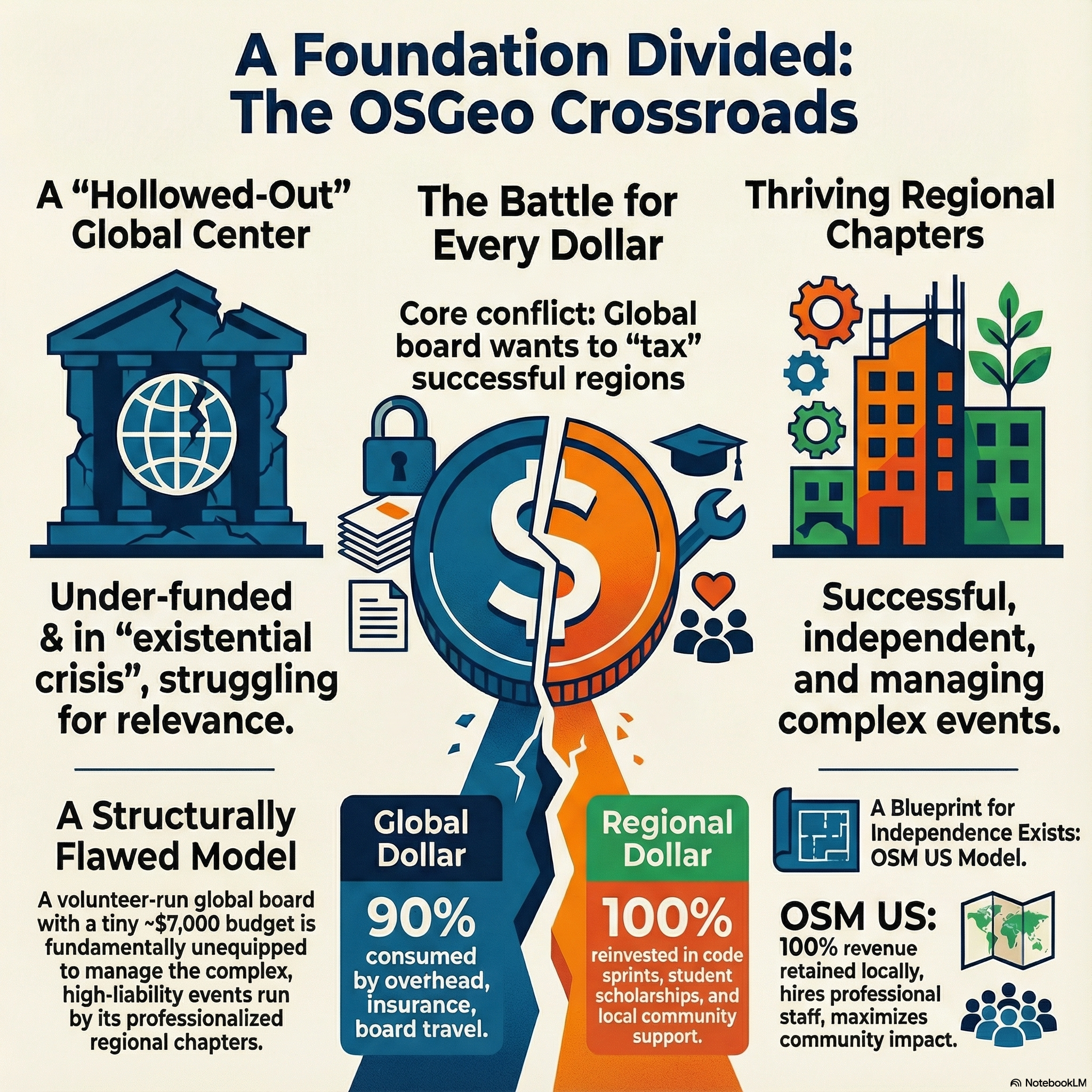
When analyzing the flow of funds, the divergence in priorities becomes clear. The contrast between how a dollar is spent at the global level versus the regional level is the heart of the "sovereignty" argument.
The Global Dollar: Out of every dollar sent to OSGeo International, roughly 90 cents is consumed by administrative overhead, liability insurance, and international board travel. The foundation's budget documents reveal that funds are often prioritized for "representation" at other global events rather than direct project support. Only a negligible fraction reaches project infrastructure or developer grants. The "global" dollar is spent on maintaining the institution's existence.
Ideally, The Regional Dollar: In an optimal decentralized model, every dollar retained by a chapter like FOSS4G NA is maximized for local impact. Roughly 40 cents is reinvested in local code sprints and technical workshops, events that actually result in new features and bug fixes. 30 cents funds student scholarships and diversity travel grants, ensuring the next generation of developers is invited into the tent. The remaining 30 cents is held in a "rainy day" safety fund to protect against contract liability. While actual event expenses can often run close to cost, this allocation represents the strategic priority of regional autonomy: putting resources directly into the mission rather than the bureaucracy.
The Geopolitical "Red Zone": FedGeoDay and Sovereign Open Source
The landscape is further complicated by the emergence of events like FedGeoDay, which focuses specifically on the open-source technology stack within the U.S. Federal Government. These gatherings navigate a fraught legal and political minefield. In today's heightened geopolitical climate, there is significant concern regarding "foreign influence" within the federal ecosystem.
Federal agencies are increasingly sensitive to Supply Chain Security (CISA/NIST). They are looking for "Software Bill of Materials" (SBOMs) and clear provenance for the code that runs their defense and intelligence systems. If the "steward" of critical software is a Delaware-based entity with an international board governed by foreign consensus, it creates a potential conflict of interest.
For federal users, the concept of "Sovereign Open Source", where the technology is supported by domestic entities that understand U.S. security requirements, is becoming a prerequisite for trust. A procurement officer at the NGA or USGS needs to know that the organization managing the software stack is accountable under U.S. law and is not susceptible to foreign regulatory mandates that might conflict with U.S. security interests. The global board's push for centralized control risks alienating the very government users who require a domestic partner to navigate compliance and security audits. To these users, "Global" isn't a benefit; it's a risk factor.
The European Liability Trap: Regulatory Contagion
The European Union’s Cyber Resilience Act (CRA) introduces the role of a "Software Steward." OSGeo’s leadership has signaled a desire to embrace this role to secure "Institutional Memberships" from corporations desperate for a compliance shield. But for North American chapters, this is a liability trap.
The CRA is European law. It mandates strict cybersecurity policies and reporting for any open-source project used in a "commercial activity" within the EU. By remaining legally integrated with OSGeo Global, North American chapters expose themselves to "regulatory contagion." Under the CRA, a steward must document cybersecurity policies and handle vulnerability reporting to EU standards. If the global foundation accepts the role of Software Steward and fails to meet a reporting deadline or a documentation requirement, a near-certainty without professional security staff, the regional assets in the U.S. could be drained to pay fines or legal fees in Europe. Independence creates a firewall, ensuring that regional assets cannot be seized to satisfy a foreign regulator or to fund a compliance bureaucracy that provides no benefit to the U.S. ecosystem.
The Blueprint for Independence: OpenStreetMap US
OpenStreetMap US (OSM US) stands as the definitive counter-example to the OSGeo centralization model. OSM US operates on a "No Flow" principle: "There is no flow of money from local chapters to OSMF or vice versa." This financial sovereignty has allowed OSM US to achieve what OSGeo Global has failed to do in two decades: hire professional staff, including an Executive Director who can write grant proposals and manage professional relationships with federal agencies like the National Park Service.
By employing an Executive Director and professional staff, OSM US can write grant proposals, manage multi-year federal partnerships, and provide fiscal sponsorship for projects like MapRoulette. Because OSM US is not required to tithe its revenue to a global foundation, it retains 100% of its fundraising for its community. This model demonstrates that a strong, independent regional entity is far more effective at supporting global software than a weak, underfunded global foundation trying to maintain a "rotating" facade. It proves that a "Federation of Equals" can support a global mission through cooperation without the need for a global tax. OSM US represents the "distributed effectiveness" model, where each region focuses on its own strengths while sharing a common vision.
The Anatomy of Sponsor Fatigue
"Uncoordinated solicitations" are the final straw for corporate partners. In 2025, companies are bombarded with requests from the global foundation, the global event, the regional event, and individual projects. This fragmentation creates "sponsor fatigue." A marketing director has a finite budget; when they receive four different prospectuses for the same "brand," they see inefficiency and chaos.
A sponsor pays for a North American event because they want to reach that specific community. The OSGeo proposal to centralize sponsorship, asking a company to pay the global foundation which then trickles funds down, is a misreading of intent. Corporate sponsors aren't donors; they are buyers of access and influence. Independence allows for targeted, high-value propositions that justify the marketing spend, keeping funds focused on the market and the community the sponsor actually serves. The current confusion isn't just a nuisance; it's a threat to the financial lifeblood of the entire ecosystem. It raises a simple question: why fund a foundation's deficit when you can fund a community's growth?
2026: Questions on the Horizon
As the year sets on 2025, the geospatial community finds itself at a crossroads. The events of the past year, the strategy papers, the overlapping conferences, and the looming regulatory shifts, have brought long-simmering tensions to the surface. But where those tensions lead is a question only the community itself can answer.
Observers are now left to grapple with the implications of this growing divide. It is a question being asked not just in North America, but in meeting rooms and code sprints across Europe, Oceania, and South America. Is the era of the centralized global foundation coming to a close, to be replaced by a more resilient, distributed federation of local sovereignty? Can a global entity adapt its model to better serve high-functioning regions, or is the pull toward centralization an inevitable sign of an organization shifting from mission to maintenance?
How will the developers of the open-source geospatial stack navigate a world where the institutions designed to protect them are increasingly focused on their own survival? And perhaps most critically, how will the community strike a balance that preserves global cooperation while respecting the legal, political, and financial realities of its local chapters? As 2026 begins, the map of the future remains unwritten, and the answers to these questions will determine the future of the technology stack we all share. The tremors of 2025 have passed, but the foundation they shook is still settling.