
Wireless Sensor Network Resilience in Spectrum-Denied Battlespaces
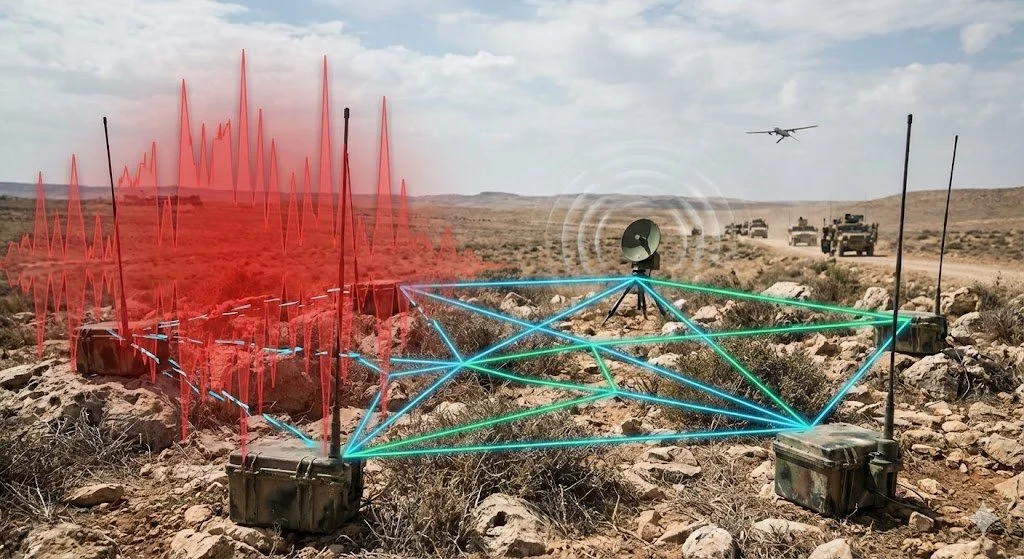
At the beginning of operations in Afghanistan and Iraq, U.S. Central Command (CENTCOM) thought it maintained dominance of the electromagnetic (EM) operational environment (EMOE). This advantage enabled the introduction of modern networked systems. However, radio-controlled improvised explosive devices (RCIEDs) and commercial-off-the-shelf (COTS) Global Positioning System (GPS) jamming devices forced the U.S. military to realize that they did not actually own the spectrum. The U.S. Military's response to RCIEDs and GPS jamming was the inflection point that pivoted the EMOE operational paradigm, shaping how the U.S. conceptualized and deployed systems and devices such as unattended ground sensors (UGS) and wireless sensor networks (WSNs).
The reality of spectrum susceptibility uncovered a strategic blind spot, a contested EMOE. Current UGS deployment doctrine and technology development must assume that contested environments, where enemy forces actively challenge, degrade, or deny the use of the EM spectrum, are present and evolving. This assumption should drive the development of sensor networks optimized for contested EMOE operations, including continuous data throughput, and integration with existing command, control, communications, computers, cyber, and intelligence (C5ISR) systems to ensure survivability and mission capability in contested EM environments.
The Contested Reality
Analysts noticed that the war in Ukraine has uncovered that the Ukrainian adversary possesses electronic warfare (EW) capabilities that can overwhelm systems built for permissive operating conditions. Russian forces demonstrated the ability to establish broad EM denial zones, disrupting up to 90 percent of standard communications and sensor networks. As reported in “Task & Purpose”, "They are jamming everything their systems can reach," an unnamed official with a civilian organization that provides the Ukrainian military with intelligence, surveillance, and reconnaissance told the Associated Press. "We can't say they dominate, but they hinder us greatly."
This level of EM spectrum denial represents an underlying shift from the asymmetric warfare environments where U.S. forces have operated for the past two decades. Advisories are deploying multiple EW operations, including unmanned aerial systems (UASs), EM spectrum jammers (GovInfo reports), and positioning, navigation, and timing (PNT) spoofing. The deployment of EW capabilities to tactical levels means that even small-unit operations may face sophisticated jamming and spoofing that can disable conventional sensors and systems.
The challenge becomes particularly acute when considering projected Chinese anti-access/area denial (A2/AD) scenarios. The Chinese government views EW as a force multiplier and will likely employ it to support all military operations. The Chinese EW units have conducted jamming and anti-jamming operations, testing the military's understanding of EW weapons, equipment, and performance (C4ISRNet). China’s electronic warfare capabilities are highly advanced, with the potential to shape electromagnetic conditions in which traditional networked systems cannot function effectively.
Network Persistence Under Extreme Degradation
The operational challenges experienced by CENTCOM in Afghanistan and Iraq and Ukraine during the Russo-Ukrainian conflict expose a key issue with existing UGS and WSN architectures that development efforts have failed to deal with properly: How can mesh networks maintain operational effectiveness when broad-spectrum EW eliminates fifty to ninety percent of the nodes, UGSs? The challenge extends beyond mere technical survivability to operational utility; can a sensor network provide actionable intelligence when many of its components are rendered inoperative by adversary jamming and spoofing?
The answer to this question has profound implications for future military operations. The U.S. Army Research Laboratory Development Command (ARL-DEVCOM) created the Internet of Battle Things Collaborative Research Alliance (IoBT-CRA), a collaborative environment between the government, industry, and university researchers to use ML and other technologies in the battlespace, intending to keep up with technological advances in the commercial space to better prepare for EW by adversaries such as China and Russia (ARL DEVCOM and Wikipedia, IoBT-CRA). The research is in line with the broader concept of Mosaic Warfare, developed by the Defense Advanced Research Projects Agency (DARPA), where, “Like the ceramic tiles in mosaics, these individual warfighting platforms are put together to make a larger picture, or in this case, a force package.” (DARPA Tiles Together a Vision of Mosaic Warfare)
The challenge is whether UGSs or any WSNs can function and survive in a contested EM environment. If a deployed WSN is ineffective, U.S. forces will be forced to rely on increasingly vulnerable manned platforms and clandestine operations for intelligence gathering, or to operate with significantly degraded situational awareness (SA) in environments where intelligence dominance is most critical for survival.
Network Self-Healing
The solution lies in understanding and implementing true network self-healing capabilities that go far beyond conventional redundancy measures, ensuring the functional persistence of WSNs. The WSN/UGS systems need to be designed not for the survival of the individual sensor but for the persistence of the network function despite the loss of over fifty percent or more of its nodes and uplink capability. However, even this threshold may be insufficient for the spectrum-denial environments demonstrated in Ukraine and projected for Chinese A2/AD scenarios.
Statistical Detection and Adaptive Response
Modern mesh networks must employ sophisticated detection mechanisms to identify and respond to EW attacks in real-time. Network-centric systems may employ statistical models, such as Exponentially Weighted Moving Average (EWMA), to smooth out noise and quickly adapt and monitor packet inter-arrival times across the mesh network, enabling real-time detection of a localized Denial-of-Service (DoS) jamming attack. This approach can enable surviving network nodes to differentiate between natural network degradation and deliberate jamming, enabling appropriate countermeasures.
The operational significance of EW resilience is profound and cannot be overstated. Counter EW (CEW) must be engineered into the UGS nodes to dynamically reconfigure themselves, such as to morph communication and intelligence-gathering functions while maintaining mission support. CEW transforms the UGS network from a passive victim of EW attacks into an adaptive system capable of supporting operational effectiveness under extreme EW and other conditions, such as weather and solar flares.
The operational significance of EW resilience is profound and cannot be overstated. Counter EW (CEW) must be engineered into the UGS nodes to dynamically reconfigure themselves, such as to morph communication and intelligence-gathering functions while maintaining mission support. CEW transforms the UGS network from a passive victim of EW attacks into an adaptive system capable of supporting operational effectiveness under extreme EW and other conditions, such as weather and solar flares.
Frequency Agility and Low Probability of Intercept
Technical implementation of CEW requires sophisticated RF management and auto-configuration capabilities. The UGSs must quickly and synchronously change frequencies across the available military bands to prevent dedicated spot jamming. This frequency-hopping spread spectrum (FHSS) approach while combined with low probability of intercept/detection (LPI/LPD) techniques, enables surviving network nodes to maintain communications even in heavily jammed environments.
CEW is effective by transmitting short bursts of highly compressed, encrypted alerts, while using edge processing, the WSN nodes minimize the time and power spent radiating RF signatures, making the EM signal more challenging to detect and track. This approach is particularly relevant in contested environments where adversaries deploy direction-finding equipment to locate and target EM transmissions and pulses.
Edge Computing and Autonomous Decision-Making
The integration of artificial intelligence and machine learning (AI/ML) capabilities at the network edge represents a critical capability for maintaining UGS network function under extreme degradation of the EM spectrum. The scenario of edge computing with embedded AI/ML capabilities, is where the embedded low-power microcontroller (MCU) wakes the high-power radio only to transmit when a classified event, a measurement and signature intelligence (MASINT)-derived event, e.g., seismic signature matching a vehicle, not a deer, or a chemical agent signature is detected, thus optimizing battery life and maintaining persistence. This ensures that the WSN remains effective when the EM spectrum is heavily contested.
This capability extends beyond power management to operational intelligence. Individual sensors, UGSs, can be programmed to process and analyze data locally, transmitting only actionable intelligence rather than raw data. This dramatically reduces the communications burden on surviving network nodes while maintaining intelligence collection capabilities even when most of the network is compromised.
Operational Adaptations
Recent field experience in Ukraine shows that networks need more than just technical fixes to work in combat zones. Ukraine's war offers real examples of how sensor systems can keep functioning when the enemy jams everything electronic.
Ukrainian troops deployed passive acoustic sensors called Sky Fortress that do not produce radio-frequency (RF) emissions. Sky Fortress listens for drone acoustic signatures and compares them to known airborne threats using AI/ML models trained on thousands of sound samples, rather than tracking radio signals. Early iterations used COTS Android phones for processing and networking. In contrast, current third-generation units use tailored hardware with custom CPUs, sound cards, and network communications specifically designed for this task (UNITED24 Media). The system transmits data either through short-range radio-linked mesh networks or via Global System for Mobile Communications (GSM) connections to cloud-based situational awareness systems (Missile Defense Advocacy Alliance). The system does not emit a signal, making it exceptionally resilient to EW and difficult for adversaries to target, providing crucial redundancy if radar and RF sensors are saturated (Sky Control). The communication infrastructure utilizes mesh networking capabilities that provide resilience against adversarial threats (Military Embedded Systems).
This acoustic approach represents a different way of thinking about the problem. Instead of trying to force signals through jamming, these systems sidestep it altogether; the sensors produce no EM signatures to be targeted, while communication resilience is factored through redundant mesh networking pathways.
Integration with Advanced EW Capabilities
The development of resilient mesh networks must integrate with broader spectrum dominance capabilities. Spectrum dominance employs anti-jam resiliency techniques to mitigate electronic attack. For example, MANET Interference Cancellation (MAN-IC) uses multiple-input and multiple-output (MIMO) technology to employ sophisticated spatial signal processing techniques that nullify the interfering signal without suppressing the user's signal (Silvus Technologies). Combining MIMO technology with time-domain anti-jamming methods, such as millisecond bursts and time-of-day variability, enhances RF jamming resilience. The combination of resilient network architectures with advanced anti-jamming capabilities provides a comprehensive approach to maintaining sensor network functionality in contested environments.
Embracing the Contested Environment Reality
The EM spectrum dominance that has characterized U.S. military operations in the past is now being replaced by the expectation of evolving EMOE challenges and the need to counter them, such as through Mosaic Warfare, frequency hopping, and AI/ML. Peer adversaries and rogue regimes have proven they can impose spectrum‑denied battlespaces that disable up to 90 percent of conventional networked systems. This reality compels a fundamental shift in how sensor networks are designed, deployed, and operated to ensure survivability and mission effectiveness.
The answer is not to abandon networked sensor capabilities, such as IoBT, but to embrace network architectures designed for contested environments and to use CEW from the outset. Self-healing mesh networks, employing statistical detection, frequency agility, edge computing, and attritable design philosophies, can maintain operational effectiveness even under extreme EM attacks.
The operational imperative is clear: military forces must transition from networks designed for permissive environments to networks designed for spectrum-denied battlespaces. This transition requires not just technical innovation but fundamental changes in operational doctrine, tactics, techniques, and procedures (TTPs), acquisition priorities, and strategic thinking about the role of networked IoBT sensors in contested environments.
The surviving ten percent of a resilient sensor network may provide more operational value in a contested environment than 100% of a network designed for permissive conditions. This paradigm shift marks the difference between maintaining intelligence dominance and operating in the dark in the contested EM environments that are defining conflict today.
#AI #EdgeAI #ElectronicWarfare #DefenseTech #IoBT
-
Task & Purpose: "'Assume you can be jammed' — What US troops are learning about electronic warfare in Ukraine." June 7, 2022 - https://taskandpurpose.com/news/russia-ukraine-electronic-warfare-us-troops
C4ISRNET - "Breaking down China's electronic warfare tactics." March 22, 2017, https://www.c4isrnet.com/c2-comms/2017/03/22/breaking-down-chinas-electronic-warfare-tactics
DoD Electromagnetic Spectrum Superiority Strategy 2020 - https://media.defense.gov/2020/Oct/29/2002525927/-1/-1/0/ELECTROMAGNETIC_SPECTRUM_SUPERIORITY_STRATEGY.PDF
SkyControl - CUAS Academy - Sky Fortress: Ukraine's Innovative Acoustic Drone Defense System. https://skyctrl.com/cuas-academy/sky-fortress-acoustic-anti-drone-system
United24 Media - Sky Fortress—Ukraine’s Acoustic Detection System That Tracks Drones Cheap and Fast - Acoustic detection system: Ukraine’s low-cost air defense model — UNITED24 Media
Missile Defense Advocacy Alliance - https://missiledefenseadvocacy.org/wp-content/uploads/2024/07/Team-6-Acoustic-Lily-Pads-Final-Report.pdf
Military Embedded Systems - Anti-jamming radios used in Ukraine drones to be showcased at XPONENTIAL 2024 - Military Embedded Systems
U.S. Army Research Laboratory (ARL) DEVCOM – Internet of Battle Things (IoBT) CRA - Internet of Battlefield Things (IoBT) CRA - DEVCOM Army Research Laboratory
IoBT-CRA Wikipedia: https://en.wikipedia.org/wiki/IoBT-CRA
Silvus Technologies: https://www.linkedin.com/pulse/spectrum-dominance-providing-secure-ew-resilient
Wikipedia, MIMO - https://en.wikipedia.org/wiki/MIMO