
The Red Shield: A Chronicle of the Soviet Missile Defense Architecture
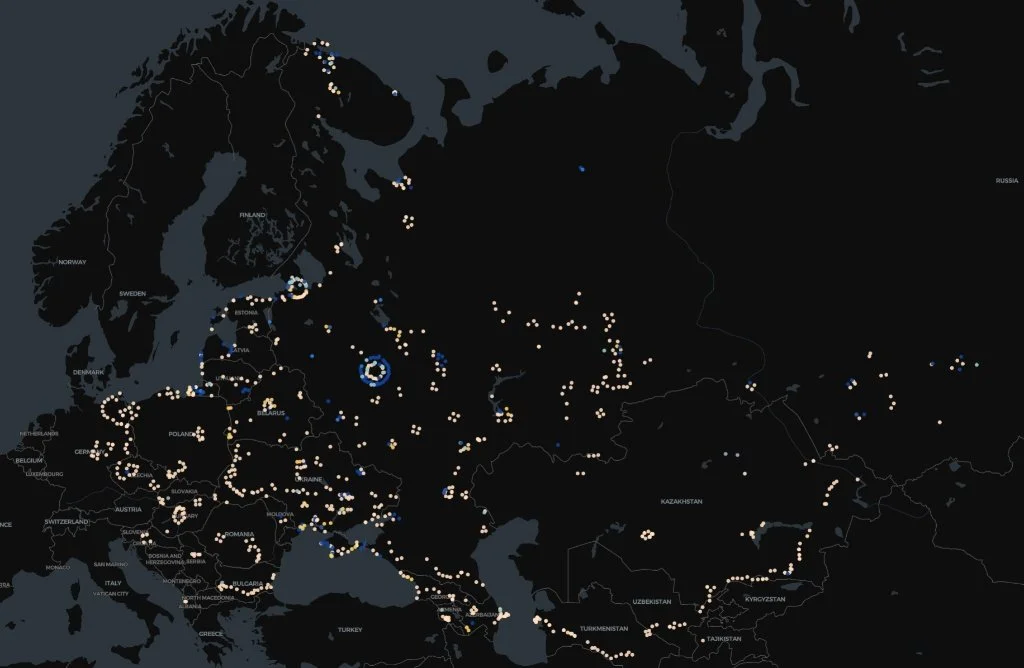
Overview Map of Soviet Era Missile Defense Locations during the Cold War
Series Note: This is the third installment in our "Geospatial Frontiers" series, excavating the physical legacy of the Cold War through historical GIS analysis. Following our exploration of the American homeland in The Concrete Archipelagos and the NATO frontline in The Silent Front, we now turn our digital lens eastward. We cross the Iron Curtain to map the mirror image of Western paranoia: the sprawling, monolithic defense network of the Soviet Union.
The Architecture of Paranoia: Inside the PVO Strany
If "The Concrete Archipelagos" revealed the fragmented, desperate point-defenses of American cities, and "The Silent Front" exposed the linear tension of the European divide, the GIS data of the Soviet Union reveals something fundamentally different: a fortress state.
The history of the Soviet Union’s missile defense is not merely a catalog of radars and interceptors; it is a physical manifestation of a geopolitical psyche defined by existential dread. For nearly half a century, the USSR constructed the largest, most integrated, and most expensive air defense network in human history. This network, operated by the Voyska Protivovozdushnoy Oborony (PVO Strany), or the Air Defense Forces of the Country, was a distinct military branch ranking third in prestige only behind the Strategic Rocket Forces and the Ground Forces. It was a kingdom of concrete and vacuum tubes, spanning from the frozen archipelagos of the Arctic to the sun-scorched steppes of Kazakhstan, designed with a singular, terrifying purpose: to detect the end of the world and, perhaps, to survive it.
The strategic logic driving this colossal infrastructure was the "Ring of Steel." Unlike the United States, which largely dismantled its Project Nike rings in the 1960s to rely on the threat of counter-strike (Mutually Assured Destruction), the Soviet Union remained obsessed with the physical defense of the Motherland. This obsession birthed a landscape of "strategic geography" where remote locations like Olenegorsk, Pechora, and Sary Shagan became the nerve centers of global survival. To understand this network is to understand the Soviet view of the Cold War: a siege mentality solidified into reinforced concrete.
To fully grasp this 'strategic geography,' one must contrast it with the findings from our previous excavations. The American strategy, detailed in The Concrete Archipelagos, was fundamentally democratic and economic: it prioritized the protection of major population centers and industrial hubs, creating 'islands' of defense around voters and factories. The NATO strategy, mapped in The Silent Front, was political and linear: a continuous 'belt' of Nike and Hawk batteries running parallel to the Iron Curtain, designed to physically halt a ground invasion.
The Soviet strategy was neither an island nor a line; it was a funnel. The PVO Strany did not distribute defenses based solely on population density. Instead, it concentrated its most advanced assets in two specific zones: the 'entry vectors' (the Arctic and Baltic approaches) and the 'command citadel' (Moscow). This explains why a desolate Arctic radar station might be better defended than a mid-sized industrial city in the Urals. The logic was grim but rational: while the US architecture was built to save the population, the Soviet architecture was built to save the state—specifically, the leadership’s ability to issue a retaliatory order. In the Soviet calculus, the survival of the command structure was worth more than the survival of the periphery.
The PVO Strany was not just a military force; it was a technological empire. It commanded interceptor aircraft, surface-to-air missile (SAM) batteries, anti-ballistic missile (ABM) systems, and a vast array of early warning radars. At its zenith, this network consumed a staggering portion of the Soviet military budget, maintaining thousands of SAM sites and hundreds of airbases. The geographical distribution of these assets reveals a layered philosophy: a dense crust of defenses along the western borders to catch NATO bombers, a "missile warning" belt looking over the poles for ICBMs, and a concentrated "citadel" defense around Moscow, the heart of the state.
The Evolution of the Threat
The evolution of this network mirrors the evolution of the threat. In the 1950s, the fear was high-altitude American bombers like the B-52 and the B-70 Valkyrie. This led to the deployment of the S-25 and S-75 (SA-2) systems. By the 1960s, the threat shifted to Intercontinental Ballistic Missiles (ICBMs), necessitating the construction of the "Hen House" early warning radars and the A-35 ABM system. In the 1980s, the threat morphed again into low-flying cruise missiles and stealth technology, driving the development of the S-300 and the towering Daryal radars.
The Bureaucracy of Defense
It is critical to understand that the PVO Strany was not merely a collection of weapons but a bureaucratic entity with immense political clout. Unlike the US Air Defense Command, which was subordinate to the Air Force, the PVO was an independent service. It had its own academies, its own intelligence directorates, and its own industrial procurement channels. This independence fostered a culture of technological maximalism. If a threat existed, a counter-system had to be built, regardless of cost. This led to the deployment of systems like the S-200 "Angara" (NATO: SA-5 Gammon), a missile the size of a fighter jet designed to shoot down spy planes that, ironically, ceased flying over the USSR by the time the missile was operational. The PVO's existence was justified by the threat; therefore, the threat was always portrayed as imminent and overwhelming.
This internal logic created a "defense in depth" that was physically dense. The western border of the USSR was lined with thousands of S-75 and S-125 sites, creating overlapping fields of fire that Western planners dubbed the "dense western border". Every major city, every industrial hub, and every military district had its own PVO commander responsible for the sky above their head. This decentralized responsibility, coordinated by a central command in Moscow, meant that the Soviet Union was effectively a fortress state, covered by a dome of radar energy that hummed 24 hours a day, 365 days a year.
The Eyes of the Motherland: The Early Warning Radar Network
If the nuclear missile was the muscle of the Cold War, the early warning radar was its nervous system. These immense structures, often located in the most inhospitable corners of the Soviet periphery, were responsible for the "first contact" with an incoming strike. The Soviet early warning doctrine relied on a network of Over-the-Horizon (OTH) radars and Line-of-Sight ballistic missile detection radars designated by NATO with evocative names like "Hen House" and "Peep Marie".
The genesis of this network lay in the terrified realization of the late 1950s: the bomber age was ending, and the missile age had begun. A bomber took hours to cross the pole; an ICBM took thirty minutes. This compression of time demanded a technological leap. The Soviets responded with the "Dnestr" and "Dnepr" radars, colossal phased-array systems that could look thousands of kilometers into space.
The "Hen House" Network (Dnepr/Dnestr)
The backbone of the Soviet early warning system from the 1960s through the 1990s was the Dnestr (and its upgraded variant, Dnepr), known to NATO as the "Hen House." These were massive, A-frame structures, hundreds of meters long, housing phased array antennas capable of tracking objects thousands of kilometers away in space.
The geography of these radars tells the story of Soviet anxiety, mirroring the NATO radar chains mapped in The Silent Front, but facing outward:
RO-1 Olenegorsk (Murmansk Region): Watching the North Atlantic and the Norwegian Sea for submarine-launched ballistic missiles (SLBMs).
RO-2 Skrunda (Latvia): Covering the North Atlantic gap and Western Europe.
RO-4 Sevastopol (Crimea) & RO-5 Mukachevo (Ukraine): Watching the Mediterranean and Southern Europe.
RO-30 Pechora (Komi Republic): Watching the polar approach.
Balkhash-9 (Kazakhstan) & Mishelevka (Siberia): Watching China and the Pacific.
The Olenegorsk Watch: Life on the Arctic Edge
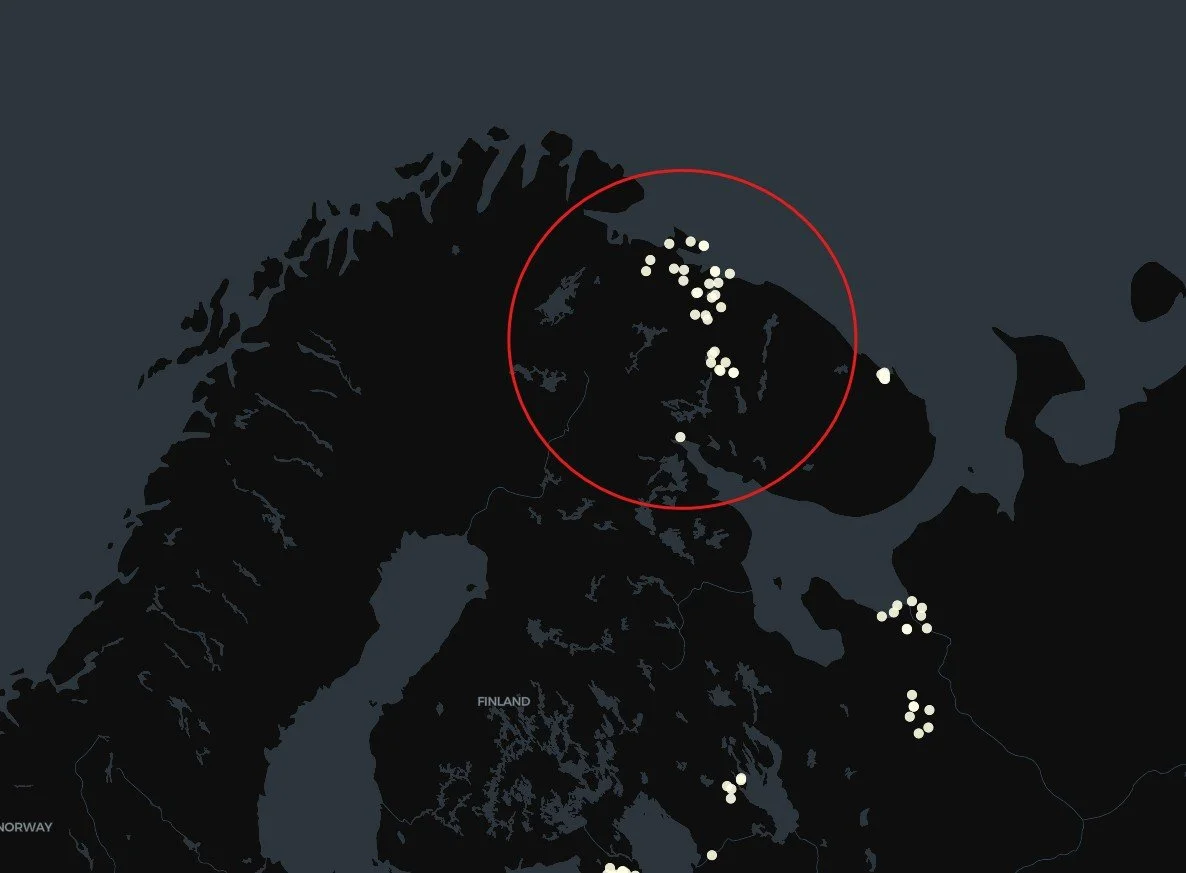
Located north of the Arctic Circle on the Kola Peninsula, the Olenegorsk station (RO-1) remains one of the most critical nodes in the Russian defense architecture. This station, built in 1963, operates a Dnepr radar alongside a newer Daugava receiver.5 The psychological pressure on the operators here cannot be overstated. For decades, they stared at green screens, waiting for the tell-tale blips that would indicate a Trident missile launch from a US submarine hiding under the Arctic ice.
The station at Olenegorsk is a study in isolation. The nearby military townlet of Olenegorsk-1 (Protoki) was a closed community, existing solely to service the radar. Life here was dictated by the rhythm of the "watch." The operators knew that in the event of a real war, they were primary targets. Their survival time was measured in the minutes it would take for a US warhead to impact the Kola Peninsula. Yet, their duty was to ensure that the retaliatory order could be given before they were vaporized.
The reality of this pressure manifested violently on January 25, 1995. A scientific rocket, the Black Brant XII, was launched from Norway to study the aurora borealis. The Olenegorsk radar crew detected the launch immediately. To the automated systems and the tense operators, the rocket’s trajectory and stage separation mimicked the flight profile of a US Trident missile—specifically, a high-altitude EMP blast intended to blind Russian radars before a main strike.
For several minutes, the Olenegorsk station fed data to Moscow that the Motherland was under attack. President Boris Yeltsin’s "Cheget" (nuclear briefcase) was activated—the first and only known time a nuclear leader has opened the briefcase in response to a real-time alert. The operators at Olenegorsk were not merely technicians; they were the trigger men for the apocalypse. The incident revealed the terrifying fragility of the system: a scientific experiment nearly ended civilization because of a miscommunication and the hair-trigger alertness of a radar crew in the frozen north.
Latvia Site along Baltic Sea
The Ghost of Skrunda: The Monster of the Baltic
In Latvia, the Skrunda-1 installation (RO-2) holds a different kind of history—one of geopolitical bargaining and demolition. Skrunda housed two Dnepr radars that covered the critical North Atlantic corridor. After the collapse of the Soviet Union, the continued Russian military presence at Skrunda became a sore point for the newly independent Latvia.
The site also hosted a partially constructed "Daryal" class radar, a monstrous building standing 19 stories tall. Known to locals as "The Monster," this unfinished giant became a symbol of Soviet occupation. In a moment of intense historical symbolism, the Daryal building was ceremoniously blown up on May 4, 1995, by an American demolition firm, Controlled Demolition Inc., with the US government footing the $7 million bill.
The demolition was a global media event. Thousands of Latvians gathered to watch the Soviet giant fall, cheering as the dust cloud rose—a literal and metaphorical collapse of the Soviet watchtower. A special musical score was even composed for the occasion, underscoring the theatricality of the destruction. The closure of Skrunda created a significant blind spot in Russia's early warning coverage, a "gap" in the western periphery that plagued Russian strategic planners for nearly two decades until the new Voronezh radars could be brought online in Russia proper.
"Daryal" (NATO: Pechora) in Komi Republic
The Daryal Disaster: The Failed Giant
The "Daryal" (NATO: Pechora) was intended to be the successor to the Hen Houses—a bistatic phased array radar of immense power, with a receiver building 80 meters high and 80 meters wide. The plan was to encircle the USSR with these titans to provide unparalleled warning time. It was a failure of grand proportions, a victim of the USSR's economic stagnation and eventual collapse.
Pechora (RO-30): One of the few Daryals to become fully operational, located in the Komi Republic. It functioned for decades but is now an aging relic, awaiting replacement by the modern Voronezh class. Its massive receiver and transmitter faces, separated by hundreds of meters, dominate the flat taiga landscape.
Gabala (Azerbaijan): Operational for a time but became a diplomatic pawn between Russia and Azerbaijan. Post-Soviet Russia leased the station, but rising rent demands and geopolitical shifts led to its abandonment.
Yeniseysk (Krasnoyarsk): This site provoked a diplomatic crisis. The US accused it of violating the ABM Treaty because it was not on the periphery of the USSR (it pointed across Siberia, potentially providing ABM battle management rather than just early warning). After years of denial, Gorbachev eventually admitted the violation in 1989. The massive, billion-ruble structure was dismantled before it ever turned on, a total loss of investment.
Balkhash-9: The Daryal-U here was nearly finished when the USSR fell. It sat rotting for years, a concrete skeleton on the Kazakh steppe. It met a fiery end in 2004 when scavengers ignited the structure, leading to a spectacular fire that gutted the facility. The ruins remain a toxic hazard, leaking PCBs into the nearby Lake Balkhash.
The "Russian Woodpecker": The Duga Mystery
No discussion of Soviet radar is complete without the Duga (NATO: Steel Yard). Located near Chernobyl, this Over-the-Horizon (OTH) radar was designed to detect missile launches by bouncing signals off the ionosphere. It became infamous worldwide among amateur radio operators for the repetitive tapping noise it broadcast across global frequencies, earning it the nickname "The Russian Woodpecker".
The Duga was a behemoth of steel lattice, 150 meters high and 700 meters long. While technically distinct from the Hen House network, it was part of the same desperate search for extra minutes of warning. Its proximity to the Chernobyl nuclear power plant was no accident; these radars were voracious consumers of electricity. Today, the Duga stands silent in the Exclusion Zone, a rusting monument to a failed technology (OTH radar was notoriously unreliable due to ionospheric interference) and a failed state.
The Shield of Moscow: The A-35 and A-135 Systems
While the border radars watched the horizon, the true "Ring of Steel" was built around Moscow. The 1972 ABM Treaty limited both the US and the USSR to two (later one) anti-ballistic missile deployment areas. The US chose to protect a missile field in North Dakota (Safeguard) and quickly deactivated it, judging the cost-benefit ratio unfavorable. The USSR chose to protect Moscow. This decision speaks volumes about the Soviet priority: the survival of the command structure and the capital was paramount, even at the cost of the rest of the country.
The Don-2N: The Pyramid of Pushkino
The centerpiece of the modern Moscow defense (the A-135 system) is the Don-2N radar (NATO: Pill Box). Located near Sofrino, outside Moscow, this structure is an engineering marvel and a visual anomaly. It is a truncated pyramid, 33 meters high and 130 meters wide at the base, resembling a Mayan temple forged in reinforced concrete and steel.
The Don-2N is a multi-function phased array radar managed by the Elbrus-2 supercomputer. It provides 360-degree coverage and is capable of tracking warheads the size of a grapefruit (5cm diameter) at ranges of 3,700 kilometers. Inside, it is a labyrinth of equipment, shielded against nuclear electromagnetic pulses (EMP). It is the only operational strategic ABM radar of its kind in the world.
The visual presence of the Don-2N is striking. Each of its four faces carries a massive circular transmitter/receiver array (18 meters in diameter) and a smaller square guidance array. This allows it to simultaneously track incoming targets and guide interceptors to destroy them. During the Cold War, US targeting plans (SIOP) designated 69 consecutive nuclear strikes on this single facility to ensure its destruction—a testament to its importance.
The Nuclear Interceptors: Galosh and Gazelle
The logic of the Soviet ABM system contained a grim paradox: to save Moscow, the defenders had to detonate nuclear weapons over their own territory. The physics of missile interception in the 1960s and 70s made "hit-to-kill" (hitting a bullet with a bullet) extremely difficult. The solution was the nuclear-tipped interceptor.
The A-135 system employs two layers of interceptors:
51T6 (NATO: Gazelle/SH-11): Long-range, exo-atmospheric interceptors designed to hit incoming warheads high in space, intercepting them before they re-enter the atmosphere. These were the successors to the earlier A-350 "Galosh" missiles.
53T6 (NATO: Gorgon/SH-08): Short-range, high-acceleration endo-atmospheric interceptors. These are "hypersonic bullets" designed to catch warheads that slip through the first layer, intercepting them within the atmosphere.
Originally, both missiles were armed with 10-20 kiloton nuclear warheads. The strategy was not a kinetic impact but a "blast kill." The interceptor would detonate a nuclear fireball in the path of the incoming swarm, using X-rays and neutron flux to fry the electronics of the enemy warheads or vaporize them entirely.
The deployment sites for these missiles form a ring around Moscow. Intelligence maps from the 1980s and declassified CIA documents identify major complexes at locations like Sofrino, Klin, Nudol, and Naro-Fominsk. These sites, often hidden in forests, consist of hardened silos capable of withstanding near-miss nuclear detonations. The road layouts in these complexes often featured a distinctive "herringbone" pattern to facilitate the rapid movement of loader vehicles.
Missile Defense Rings around Moscow | Note: Not all of them are displayed.
The Outer Rings: SAMs and the Geometry of Defense
Beyond the strategic ABM systems, the USSR deployed thousands of Surface-to-Air Missile (SAM) sites to counter bombers and cruise missiles. This network was so dense that Western pilots referred to the airspace over the Warsaw Pact as "flak alley." This contrasts sharply with the "Concrete Archipelagos" of the US, where SAM defenses were lighter and more localized.
The "Star of David": S-75 Dvina (SA-2)
The S-75 (SA-2 Guideline) is perhaps the most iconic weapon of the Soviet air defense. It gained infamy by shooting down Francis Gary Powers' U-2 in 1960 and becoming the bane of US pilots in Vietnam.
From the air, an S-75 site is unmistakable in our GIS analysis. The layout follows a strict geometric pattern often called the "Star of David" or "Flower" pattern. A central command bunker and "Fan Song" guidance radar are surrounded by six circular launch pads arranged in a hexagon. This configuration allowed for optimal cabling and blast separation. Thousands of these "flowers" bloomed across the Soviet landscape, forming overlapping kill zones. In satellite imagery, they appear as distinct scars on the terrain, a signature of Soviet military presence. Even decades after abandonment, the earthworks of these sites remain visible, a geometric archaeology of the Cold War.
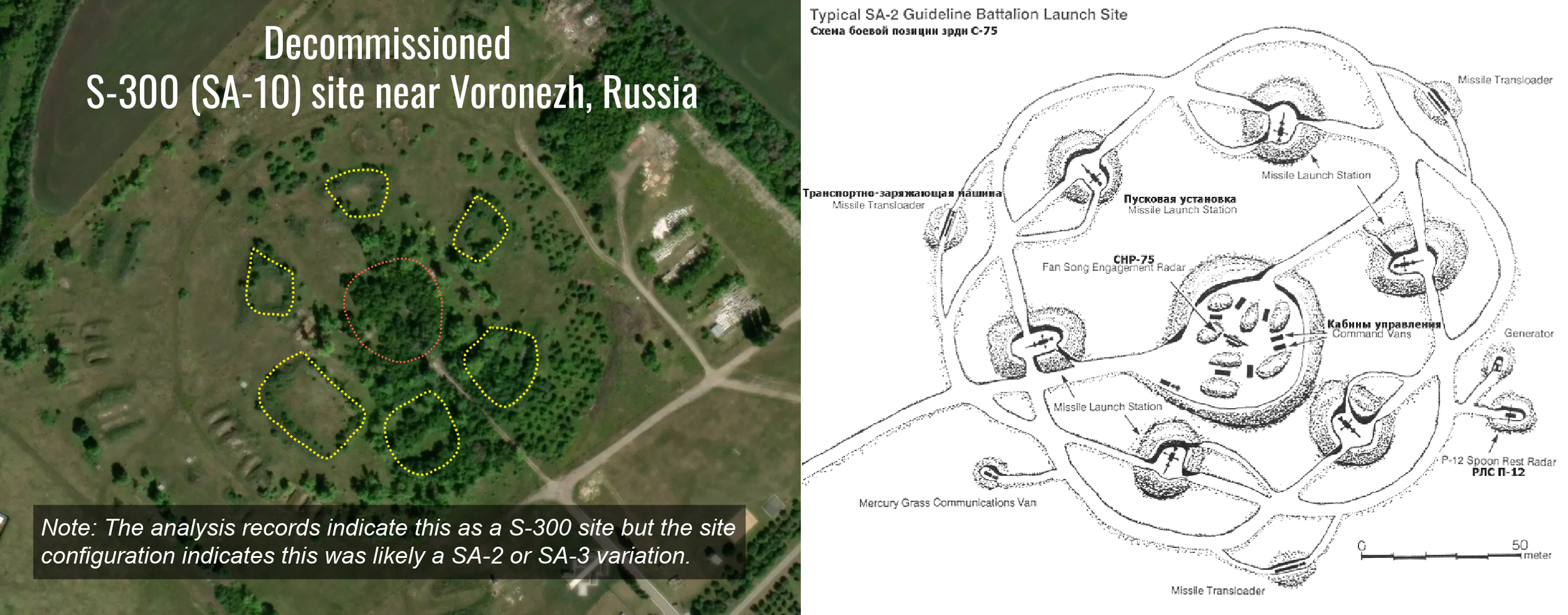
SA-2 Site Configuration take from Open Source Forums | Attribution Unknown
The Layered Cake: S-125, S-200, and S-300
The Soviet doctrine relied on overlapping layers, creating a "defense in depth" far more comprehensive than the linear "Silent Front" of NATO:
S-125 Neva (SA-3 Goa): Designed for low-altitude engagement, covering the gap under the S-75’s radar horizon.
S-200 Angara (SA-5 Gammon): The long-range hammer. These massive missiles, essentially unmanned rockets the size of a fighter jet, were deployed in static battalions to target high-value assets like AWACS or jamming aircraft at ranges up to 300km.
S-300 (SA-10 Grumble): The game changer. Introduced in the late 1970s, the S-300 introduced mobility and vertical launch capability, allowing the defense network to "shoot and scoot," making it far harder for NATO planners to suppress.
The Human Element: Errors, Heroism, and Fear
The hardware of the Soviet missile defense system was impressive, but the software—the human element—was where the fate of the world truly rested. The system was designed to be automated, but it was the override of that automation that saved the world.
1983: The Man Who Said No
On September 26, 1983, Lieutenant Colonel Stanislav Petrov was on duty at the Serpukhov-15 bunker, monitoring the "Oko" early warning satellite network. The sirens screamed. The system reported with "highest reliability" that the United States had launched five Minuteman ICBMs.
The protocol was clear: report the strike to the Kremlin. Given the tensions of 1983 (following the KAL 007 shootdown and the "Able Archer" exercises), a retaliatory launch was highly probable. The psychological pressure on Petrov was immense; he was a cog in a machine designed to facilitate war, not prevent it. Yet, he froze. He analyzed the data and relied on intuition: "Why would the US start a war with only five missiles?" He judged it a false alarm—a "computer error." He was right; the satellite had mistaken sunlight reflecting off high-altitude clouds for missile exhaust plumes. Petrov’s decision to disobey the machine is widely credited with preventing a nuclear exchange. He was reprimanded for poor documentation and retired in obscurity, a ghost in the machine who saved the world by doing nothing.
1987: The Teenager Who Defeated the PVO
If Petrov showed the system’s danger, Mathias Rust showed its incompetence. On May 28, 1987, Rust, a 19-year-old West German amateur pilot, flew a rented Cessna 172 from Helsinki straight into the heart of the Soviet Union.
He crossed the border near Estonia. The PVO radars detected him immediately. Missile batteries tracked him. Interceptors flew alongside him. Yet, no one fired. The system was paralyzed by rigid chains of command and the fear of shooting down another civilian plane after the KAL 007 disaster. There was confusion over whether the slow-moving blip was a flock of "migratory geese" or a weather anomaly. Rust flew hundreds of miles, unmolested, and landed on Vasilevsky Descent next to Red Square, taxiing to a stop near the Kremlin walls.
The "impenetrable" shield of the PVO Strany had been pierced by a teenager in a sport plane. The humiliation was absolute. It allowed Gorbachev to purge the hardline military leadership, firing the Minister of Defense and the head of the PVO, arguably accelerating the end of the Cold War. It exposed the PVO not as a monolith, but as a rigid, brittle bureaucracy unable to handle an asymmetric, non-military anomaly.
The Testing Grounds: Sary Shagan and the Ruins of Empire
To build these systems, the Soviets terraformed the earth. The Sary Shagan test site (Site 10), located on the desolate shores of Lake Balkhash in Kazakhstan, was the crucible of Soviet ABM technology.
Established in 1956, this closed military zone spanned thousands of square kilometers. It was here that the first non-nuclear intercept of a ballistic missile occurred in 1961. The town of Priozersk was built to house the scientists and officers—a secret city not found on any map, complete with theaters, schools, and parks, existing in a bubble of privilege and secrecy in the middle of the desert.
Today, Sary Shagan is a haunting monument to the collapse. While Russia still leases a portion for testing, vast sectors are abandoned. Urban explorers (Urbex) describe it as a "Stalker" zone: miles of shattered concrete, rusting radar dishes pointed eternally at the silent sky, and silos filled with brackish water. The "Terra-3" laser testing complex, once the subject of intense US fears about Soviet "death rays," lies in ruin. Scrappers have torn the copper cabling from the walls, and the "Balkhash-9" radar station is a burnt-out shell. The environmental legacy is equally toxic; the soil is laced with rocket fuel residues and PCBs from the electrical infrastructure.
The Arctic Frontier: The Frozen Front
The northern approach was the shortest route for US bombers and missiles. Consequently, the Arctic became a highly militarized zone. The PVO deployed unique assets here, specifically the Tu-128 "Fiddler"—a massive, long-range interceptor designed solely to patrol the empty wastes of the north.
This legacy continues today. Russia has remilitarized the Arctic, upgrading Soviet-era bases at Rogachevo (Novaya Zemlya) and Nagurskoye (Franz Josef Land).57 The MiG-31 "Foxhound," the successor to the MiG-25, operates from these bases. Capable of speeds near Mach 3, the MiG-31 is designed to hunt cruise missiles over the pole. Satellite imagery has revealed that while these bases are active, they face logistical challenges; hangars at Rogachevo, for example, are barely large enough to house the massive MiG-31s, suggesting that the infrastructure is still catching up to the strategic ambition.
Rust in the Taiga
The Soviet missile defense network was a paradox. It was a technological triumph that pushed the boundaries of physics and engineering, creating systems like the Don-2N and the S-300 that remain formidable today. Yet, it was also a monument to paranoia, a system that nearly triggered the very war it was meant to prevent (1983, 1995) and failed to stop a single Cessna (1987).
Our geospatial excavation of the Cold War—from the Concrete Archipelagos of the US to the Silent Front of Europe and now the Red Shield of the USSR—reveals a planet scarred by the geometry of fear. GIS data shows us the transition: The "Hen Houses" are largely gone or upgraded. The "Daryals" are rotting ruins, monuments to a fallen empire. The "Star of David" S-75 sites are overgrown with vegetation, their geometry visible only to satellites. But the core logic remains. The "Ring of Steel" has tightened but not broken. The Voronezh radars have replaced the Daryals, plugging the gaps left by Skrunda and Sevastopol.
In the forests of the Moscow region, the Don-2N pyramid still hums with power, its supercomputers calculating trajectories in the dark. And in the vast silence of the Kazakh steppe, the wind whistles through the skeletal remains of Sary Shagan, a requiem for the titans who once watched the sky. The Red Shield may have rusted, but its foundations are deep, a permanent scar on the geography of Eurasia.
-
Soviet Air Defence Forces - Wikipedia, accessed November 24, 2025, https://en.wikipedia.org/wiki/Soviet_Air_Defence_Forces
The Development of Soviet Air Defense Doctrine and Practice. - DTIC, accessed November 24, 2025, https://apps.dtic.mil/sti/tr/pdf/ADA166753.pdf
Russian and Chinese strategic missile defense: Doctrine, capabilities, and development, accessed November 24, 2025, https://www.atlanticcouncil.org/in-depth-research-reports/issue-brief/russian-and-chinese-strategic-missile-defense-doctrine-capabilities-and-development/
accessed November 24, 2025, https://www.researchgate.net/figure/Planned-coverage-of-the-Daryal-Pechora-radar-network_fig3_250890133#:~:text=The%20first%20early%20warning%20system,system%20was%20accepted%20for%20service.
Olenegorsk Radar Station - Wikipedia, accessed November 24, 2025, https://en.wikipedia.org/wiki/Olenegorsk_Radar_Station
Sary Shagan - Wikipedia, accessed November 24, 2025, https://en.wikipedia.org/wiki/Sary_Shagan
Russian Military Forces: Interactive Map, accessed November 24, 2025, https://gfsis.org.ge/maps/russian-military-forces
237. National Intelligence Estimate, NIE 11–3–61, July 11 - Historical Documents - Office of the Historian, accessed November 24, 2025, https://history.state.gov/historicaldocuments/frus1961-63v07-09mSupp/d237
A-135 anti-ballistic missile system - Wikipedia, accessed November 24, 2025, https://en.wikipedia.org/wiki/A-135_anti-ballistic_missile_system
Strategic air BalliStic MiSSile DefenSe - U.S. Army Center of Military History, accessed November 24, 2025, https://history.army.mil/Portals/143/Images/Publications/Publication%20By%20Title%20Images/H%20Pdf/BMDV1.pdf?ver=JTtAIFewLj8I5EkKnlYxYw%3D%3D
Defending the Kremlin: The First Generation of Soviet Strategic Air Defense Systems 1950-60 by Steven J. Zaloga, accessed November 24, 2025, http://bobrowen.com/nymas/defendingthekremlin.htm
SA-2 Surface-to-Air Missile > National Museum of the United States Air Force™ > Display, accessed November 24, 2025, https://www.nationalmuseum.af.mil/Visit/Museum-Exhibits/Fact-Sheets/Display/Article/196037/sa-2-surface-to-air-missile/
A-35 anti-ballistic missile system - Wikipedia, accessed November 24, 2025, https://en.wikipedia.org/wiki/A-35_anti-ballistic_missile_system
Russian Soviet Military Radars - AbeBooks, accessed November 24, 2025, https://www.abebooks.com/book-search/title/russian-soviet-military-radars/
Soviet/Russian SAM Site Configuration Part 2: S-300P/S-400 / SA-10/20/21, S-300V/SA-12, 2K11/SA-4, 2K12/SA-6, 9K37/317/SA-11/17 - Air Power Australia, accessed November 24, 2025, https://www.ausairpower.net/APA-Rus-SAM-Site-Configs-B.html
Daryal radar - Grokipedia, accessed November 24, 2025, https://grokipedia.com/page/Daryal_radar
The S-200 SAM System: A Site Analysis, accessed November 24, 2025, http://geimint.blogspot.com/2007/07/s-200-sam-system-site-analysis.html
The Russian Arctic Threat: Consequences of the Ukraine War - CSIS, accessed November 24, 2025, https://www.csis.org/analysis/russian-arctic-threat-consequences-ukraine-war
Dnestr radar - Wikipedia, accessed November 24, 2025, https://en.wikipedia.org/wiki/Dnestr_radar
History and the Current Status of the Russian Early-Warning System - Science & Global Security, accessed November 24, 2025, https://scienceandglobalsecurity.org/archive/sgs10podvig.pdf
Pechora Radar Station - Wikipedia, accessed November 24, 2025, https://en.wikipedia.org/wiki/Pechora_Radar_Station
The Norwegian Rocket Incident | Russian Roulette - A Close Call? | FRONTLINE - PBS, accessed November 24, 2025, https://www.pbs.org/wgbh/pages/frontline/shows/russia/closecall/
Norwegian rocket incident - Wikipedia, accessed November 24, 2025, https://en.wikipedia.org/wiki/Norwegian_rocket_incident
When Russian Radar Mistook a Norwegian Scientific Rocket for a U.S. Missile, the World Narrowly Avoided Nuclear War - Smithsonian Magazine, accessed November 24, 2025, https://www.smithsonianmag.com/smart-news/when-russian-radar-mistook-a-norwegian-scientific-rocket-for-a-us-missile-the-world-narrowly-avoided-nuclear-war-180985836/
Stanislav Petrov Incident - Nuclear Blast Simulator, accessed November 24, 2025, https://www.nuclearblastsimulator.com/history/events/stanislav-petrov-incident/
The History of Skrunda-1 - Archis, accessed November 24, 2025, https://archis.org/volume/the-history-of-skrunda-1/
Skrunda-1 – Secret & Closed Soviet Ghost Town in Latvia - Abandoned Spaces, accessed November 24, 2025, https://www.abandonedspaces.com/towns/skrunda.html
LATVIA: SKRUNDA: DEMOLITION OF 19 STOREY TOWER - YouTube, accessed November 24, 2025, https://www.youtube.com/watch?v=Yjy8L9fTobM
Inside Skrunda-1: Latvia's secret Soviet city turned ghost town - The Guardian, accessed November 24, 2025, https://www.theguardian.com/world/2015/oct/22/inside-skrunda-1-latvia-soviet-abandoned-ghost-town
No gaps in early-warning coverage as three radars to begin combat duty in 2017 - Blog, accessed November 24, 2025, https://russianforces.org/blog/2016/12/no_gaps_in_early-warning_cover.shtml
Daryal radar - Wikipedia, accessed November 24, 2025, https://en.wikipedia.org/wiki/Daryal_radar
Daryal-U radar in Mishelevka demolished - Blog - Russian strategic nuclear forces, accessed November 24, 2025, https://russianforces.org/blog/2011/06/daryal-u_radar_in_mishelevka_d.shtml
Secrets of radiolocation station Daryal-U - Arnika.org, accessed November 24, 2025, https://arnika.org/en/hotspots/kazakhstan/daryal
Abandoned Soviet radar in the Chernobyl Zone. : r/urbanexploration - Reddit, accessed November 24, 2025, https://www.reddit.com/r/urbanexploration/comments/kxhxva/abandoned_soviet_radar_in_the_chernobyl_zone/
Don-2N radar - Wikipedia, accessed November 24, 2025, https://en.wikipedia.org/wiki/Don-2N_radar
A-135 anti-ballistic missile system - Grokipedia, accessed November 24, 2025, https://grokipedia.com/page/A-135_anti-ballistic_missile_system
Defender of Moscow from an impact from orbit: how the unique A-135 missile defense system was created - ВПК.name, accessed November 24, 2025, https://vpk.name/en/976481_defender-of-moscow-from-an-impact-from-orbit-how-the-unique-a-135-missile-defense-system-was-created.html
Russia's Don-2N Radar Is an All-Seeing Monster - The National Interest, accessed November 24, 2025, https://nationalinterest.org/blog/buzz/russias-don-2n-radar-all-seeing-monster-bw
Old intelligence data on Moscow ABM interceptor sites - Russian strategic nuclear forces, accessed November 24, 2025, https://russianforces.org/blog/2006/03/old_intelligence_data_on_mosco.shtml
LOCATION OF GROUND-TO-AIR MISSILE LAUNCHING SITE AND A PROBABLE MISSILE ASSEMBLY FACILITY WEST OF MOSCOW - CIA, accessed November 24, 2025, https://www.cia.gov/readingroom/docs/CIA-RDP78T05439A000300350015-8.pdf
SA-2 Guideline Missile | National Air and Space Museum, accessed November 24, 2025, https://airandspace.si.edu/collection-objects/missile-surface-air-sa-2-guideline-model-sa-2b-mod-1/nasm_A19850424000
S-75 Dvina - Wikipedia, accessed November 24, 2025, https://en.wikipedia.org/wiki/S-75_Dvina
The S-75 SAM System: A Site Analysis, accessed November 24, 2025, http://geimint.blogspot.com/2007/07/s-75-sam-system-site-analysis.html
S-200 missile system - Wikipedia, accessed November 24, 2025, https://en.wikipedia.org/wiki/S-200_missile_system
1983 Soviet nuclear false alarm incident - Wikipedia, accessed November 24, 2025, https://en.wikipedia.org/wiki/1983_Soviet_nuclear_false_alarm_incident
The Man Who "Saved the World" Dies at 77 | Arms Control Association, accessed November 24, 2025, https://www.armscontrol.org/act/2017-10/news-briefs/man-who-saved-world-dies-77
The War of Nerves by Martin Sixsmith review – inside the cold war mind - The Guardian, accessed November 24, 2025, https://www.theguardian.com/books/2021/nov/26/the-war-of-nerves-by-martin-sixsmith-review-inside-the-cold-war-mind
25 Years After, Mathias Rust Remembers Historic Flight To Red Square - Radio Free Europe, accessed November 24, 2025, https://www.rferl.org/a/twenty-five-years-after-mathias-rust-remembers-historic-flight-to-red-square/24595709.html
The Rogue Cessna the Successfully Evaded the Entire Soviet Air Force, accessed November 24, 2025, https://sierrahotel.net/blogs/news/the-rogue-cessna-the-successfully-evaded-the-entire-soviet-air-force
The story of Mathias Rust, the German teenager who humiliated the Soviet War Machine by landing his Cessna 172 in Moscow's Red Square - The Aviation Geek Club, accessed November 24, 2025, https://theaviationgeekclub.com/the-story-of-mathias-rust-the-german-teenager-who-humiliated-the-soviet-war-machine-by-landing-his-cessna-172-in-moscows-red-square/
TIL in 1987, Mathias Rust, an 18 year old from West Germany with about 50 hours flying experience, illegally flew his light aircraft through Soviet airspace, bypassing their air defense systems, and landed near Red Square in Moscow. : r/todayilearned - Reddit, accessed November 24, 2025, https://www.reddit.com/r/todayilearned/comments/6kmfg6/til_in_1987_mathias_rust_an_18_year_old_from_west/
Sary-Shagan - Nuclear Threat Initiative (NTI), accessed November 24, 2025, https://www.nti.org/education-center/facilities/sary-shagan/
Saryshagan missile defense test site. Ballistic missile intercept. History. - AstronauticsNow.com, accessed November 24, 2025, http://www.astronauticsnow.com/ssh/index.html
Travel Guide to Priozersk & Sary-Shagan Polygon - Caravanistan, accessed November 24, 2025, https://caravanistan.com/kazakhstan/center/priozersk/
Old Abandoned Russian Soviet Military Bases - Urbex Lost Places Compilation - YouTube, accessed November 24, 2025, https://www.youtube.com/watch?v=sDmi2BcmRS8
Russian Defense Ministry Approves Five-Year Plan To Expand And Modernize Arctic Air Bases - TRADOC G2, accessed November 24, 2025, https://oe.tradoc.army.mil/product/russian-defense-ministry-approves-five-year-plan-to-expand-and-modernize-arctic-air-bases/
Russia's Military Capabilities in the Arctic - International Centre for Defence and Security, accessed November 24, 2025, https://icds.ee/en/russias-military-capabilities-in-the-arctic/
Russia's Northern Fleet Deploys Long-Range Interceptors to Remote Arctic Base - CSIS, accessed November 24, 2025, https://www.csis.org/analysis/russias-northern-fleet-deploys-long-range-interceptors-remote-arctic-base
Mikoyan MiG-31 - Wikipedia, accessed November 24, 2025, https://en.wikipedia.org/wiki/Mikoyan_MiG-31
Mukachevo Radar Station - Wikipedia, accessed November 24, 2025, https://en.wikipedia.org/wiki/Mukachevo_Radar_Station
Updated map of early-warning radar coverage - Blog - Russian strategic nuclear forces, accessed November 24, 2025, https://russianforces.org/blog/2007/07/updated_map_of_earlywarning_ra.shtml