
The Silent Front: Excavating the Nuclear Belts of Cold War Europe

The Cartography of the Invisible
If the Cold War defense of the North American continent was characterized by "Concrete Archipelagos", isolated islands of defense ringing major industrial metropolises like Chicago, Detroit, and Los Angeles, the defense of Western Europe was defined by a fundamentally different, and far more terrifying, geometry: The Belt. Viewed through the lens of modern geospatial data, the KML files preserved by digital archivists reveal not a series of disconnected circles, but a rigid, linear scar running from the gray waters of the North Sea to the granite peaks of the Alps. This was the "Nike Belt," a contiguous chain of high-altitude, nuclear-capable surface-to-air missile batteries designed to serve as the primary breakwater against the Soviet aerial tide.
While the American "rings" were designed for a last-ditch point defense of specific population centers, the European deployment was a theater-wide shield, a physical manifestation of the NATO doctrine of "Forward Defense." Here, the concept of the "front line" was not an abstraction or an ocean away. For the American custodial agents and their European counterparts stationed at these sites, the potential for apocalypse was a daily, tangible reality, measured in the flight time of a Tupolev bomber or the rotation of a radar dish. The KML files, when overlaid onto the verdant satellite imagery of a reunited Germany, show a landscape that was wired for self-destruction, a "Fortress Europe" where the defense of the land often necessitated its potential irradiation.
This report acts as a forensic investigation into this lost infrastructure. By overlaying the "archive missile defense KML", a digital palimpsest created by a dedicated community of hobbyists, veterans, and historians, onto the modern topography of Europe, we can excavate the physical and psychological landscape of the Cold War. This digital archaeology allows us to visit the ruins of sites like Oedingen, Wurmberg, and Glessen, where the moss-covered concrete of launch pads tells a story of technological hubris, alliance politics, and the terrifying logic of tactical nuclear warfare. We move from the pixelated coordinates of the digital map to the rusting reality of the forest floor, examining how the "Ring of Steel" transformed into a "Belt of Fire" when transposed to the European theater.
The analysis draws upon a disparate array of sources: the grassroots cartography of forums like Geschichtsspuren.de and Relikte, the oral histories of the US Army's 59th Ordnance Brigade, and the declassified orders of battle for NATO's Allied Tactical Air Forces. It reveals a system of immense complexity, where American "custodial agents" lived as armed jailers of nuclear warheads on foreign soil, guarding them against their own allies until the moment of "release." This is a journey into the forgotten geography of the Cold War, a mapping of the silence that once held the world's breath.
The Strategic Geography of the Central Front
The Strategic Imperative: Forward Defense vs. Depth
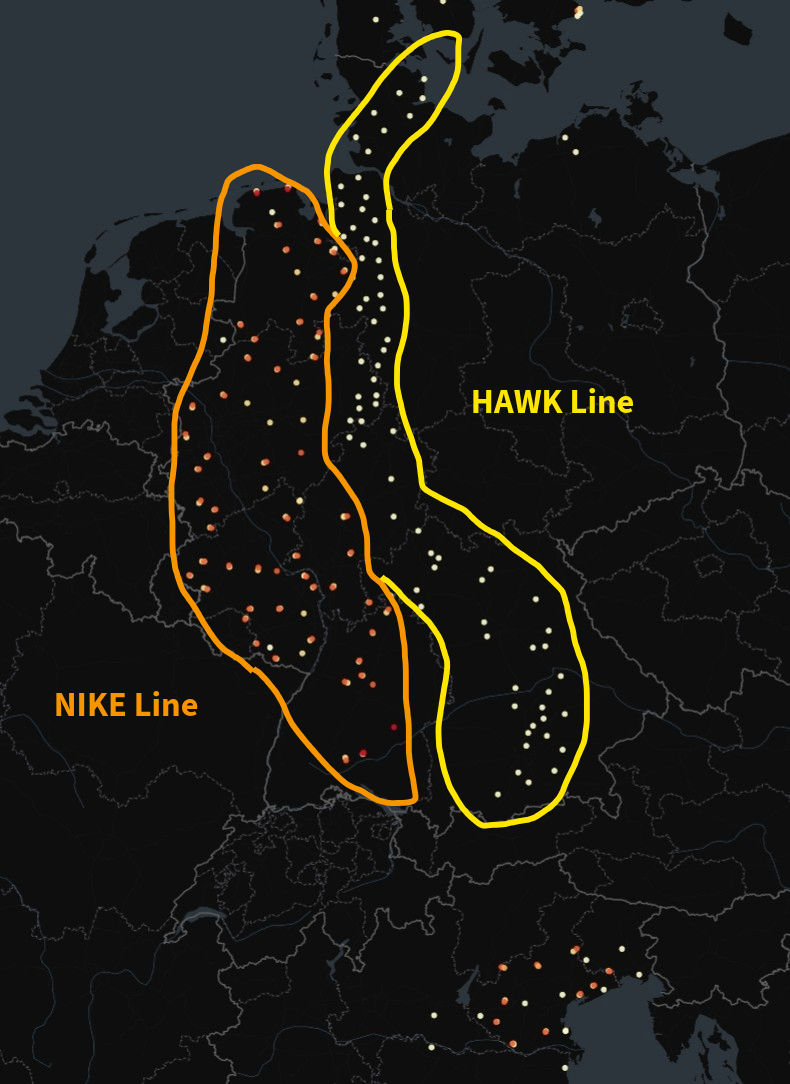
To understand the layout of Nike sites in Europe, one must first unlearn the logic of the American deployment. In the United States, the Nike Ajax and Hercules batteries were the last line of defense, situated in the backyards of the cities they protected. In West Germany, the Netherlands, Belgium, and Italy, they were the front line. The NATO strategy of "Forward Defense" dictated that the Warsaw Pact offensive must be stopped as close to the Inner German Border as possible to prevent the loss of West German territory and population centers. The political reality of the Federal Republic of Germany (FRG) demanded that its eastern frontier be defended, not traded for time. This strategic constraint birthed the "Belt" concept.
Rather than clustering defenses solely around high-value targets like the Ruhr Valley or Paris, NATO planners constructed a continuous integrated air defense system (NATINADS) running north-south through West Germany. This belt was structured in specific, overlapping layers, creating a "layer cake" of lethality designed to filter out Soviet air power before it could reach the Rhine crossings or the Channel ports.
The architecture of this belt was defined by two primary missile systems, arranged in parallel lines:
The HAWK Belt: Situated forward, approximately 15-20 kilometers behind the Forward Edge of the Battle Area (FEBA). These low-to-medium altitude missiles were the "infantry" of the air defense, designed to engage Soviet tactical fighters (like the Su-7 or MiG-21) and attack helicopters attempting to support a tank breakthrough.
The NIKE Belt: Positioned further to the rear, approximately 50-80 kilometers behind the border. These batteries were the "heavy artillery," designed to engage high-altitude bombers (like the Tu-16 Badger or Tu-95 Bear) and formation attacks with long-range, high-yield interceptors.
The KML files visualize this depth vividly. When loading the dataset into Google Earth, one sees a distinct "picket line" of orange markers (Nike sites) stretching across the map of West Germany, backed by the command and control nodes of the Allied Tactical Air Forces (ATAFs). Unlike the circular clusters in the US, this arrangement is a wall.
The Sector Division: 2nd and 4th ATAF
The KML data reveals a distinct bifurcation in the command structure of the belt, mirroring the geopolitical division of the NATO alliance itself. The defense of West Germany was split into two primary sectors, each with its own logistical tail and national flavor.
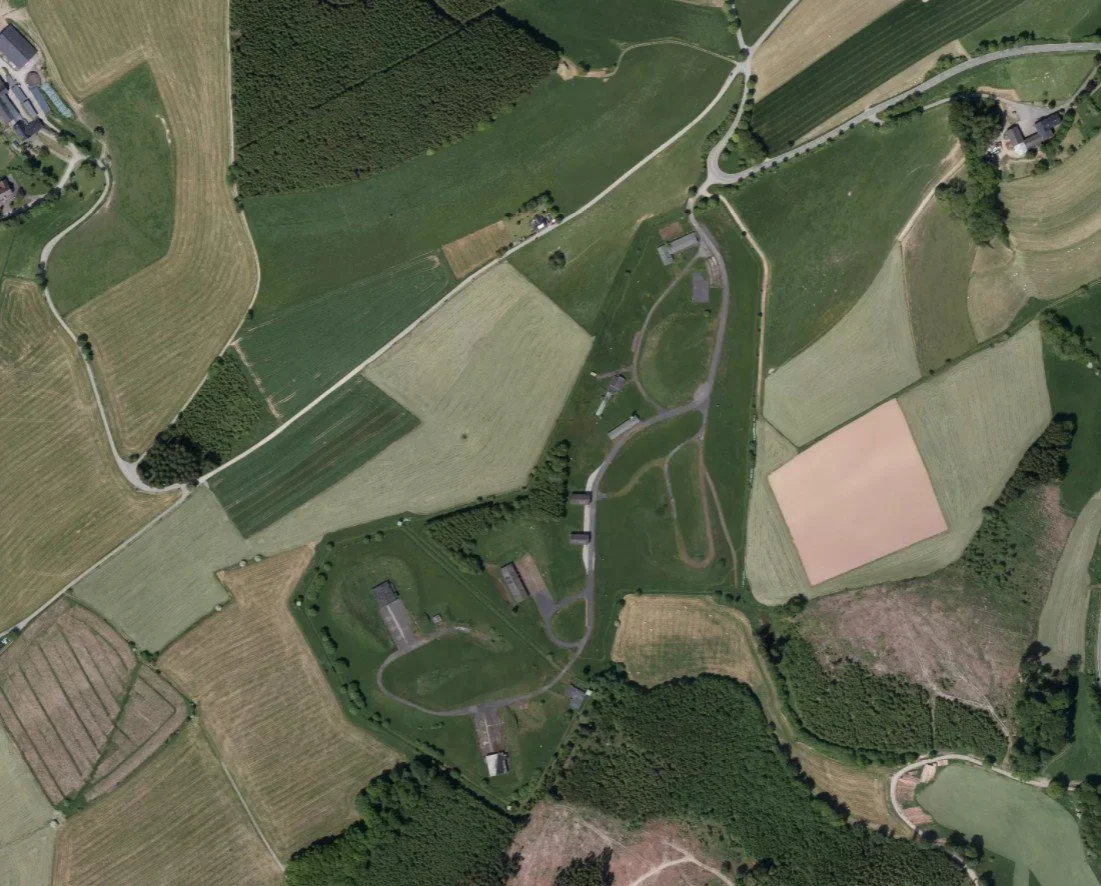
Old NIKE Site in Germany | Mapbox Imagery Baselayer
The Northern Sector (2nd ATAF): Covering the North German Plain, the classic invasion route for Soviet armor, this sector was a multinational patchwork. The British Army of the Rhine (BAOR), the Belgian Corps, the Dutch Corps, and the German Bundeswehr operated here. The Nike sites in this region show a high degree of integration. Dutch and Belgian units operated Nike Hercules batteries far forward in Germany, effectively fighting a "forward defense" of their own homelands on German soil. The KML markers for sites like Hesepe (Dutch) or Xanten (Belgian/German) indicate a complex logistical chain where supply lines stretched back across national borders.
The Southern Sector (4th ATAF): Covering the rugged terrain of Hesse, Rhineland-Palatinate, and Bavaria, this sector was dominated by the United States and Germany. Here, the "Belt" had to contend with complex topography. The Nike sites are not laid out in the flat geometric grids seen in the Midwest; they are perched on ridgelines and tucked into valleys. The Wurmberg site near Pforzheim 12 and the Oedingen site in the Sauerland 13 exemplify this terrain adaptation. The 4th ATAF region also protected the critical "Central Army Group" (CENTAG) rear area, containing the massive US logistics hubs and command centers like Heidelberg and Ramstein.
The Geospatial Signature of the "Belt"
Unlike the urban-integrated sites in the US, where a battery might sit across the street from a suburban high school or on a public beach, the European sites were often remote, carved into the dense forests of the Sauerland, the peaks of the Alps, or the heathlands of Lower Saxony. The geospatial analysis of these sites reveals a standard footprint adapted to rugged terrain and a higher threat environment.
The typical European Nike site retained the bifurcated layout of its American cousin, the Integrated Fire Control (IFC) area on high ground for radar visibility, and the Launcher Area (LA) at a lower elevation to avoid radar interference. However, the European sites often feature heavier fortification. The satellite imagery of sites like Wurmberg (Site D-3/71) or Oedingen (Site D-52) shows the distinct "double fence" perimeter of the Exclusion Area, often with additional guard towers, hardened bunkers, and defensive fighting positions that speak to the higher threat level of a ground attack by Spetsnaz forces, a threat that was virtually non-existent for a site in Kansas.
The table below illustrates the structural differences between the domestic US sites and the forward-deployed European sites as revealed by the KML and satellite data analysis.
| Feature | CONUS (USA) Deployment | European (NATO) Deployment |
|---|---|---|
| Primary Threat | Long-range Strategic Bombers | Tactical Aircraft, SRBMs, Massed Bomber Formations |
| Layout Geometry | Concentric Rings (Point Defense) | Linear Belt (Area/Forward Defense) |
| Perimeter Security | Light/Medium (fences, MPs) | Heavy (Double fences, guard towers, QRFs) |
| Warhead Custody | US Army (Organic) | US Army Custodial Detachments (Dual-Key) |
| Site Location | Urban/Suburban/Public Land | Remote/Forest/Ridgeline |
| Ownership | US Government | Host Nation (DE, NL, BE, IT) |
| Camouflage | Minimal (Visible to public) | High (Forested, screened) |
The Nuclear Custodians – The 59th Ordnance Brigade
The Paradox of Sovereignty and the "Dual-Key" Myth
The most profound difference between the American and European Nike deployments, and the one that generates the most tension in the veteran memoirs found in the archives, was the issue of ownership. In the United States, the Army owned the land, the missiles, and the warheads. In Europe, the missiles were often owned and operated by the host nation (Germany, Belgium, Netherlands, Italy), but the nuclear warheads, the W31 devices that gave the Hercules its terrifying lethality, remained by law in the strict custody of the United States.
This necessitated a complex operational dance known as the "Dual-Key" system. The term is a metaphor; usually, there was no literal simultaneous turning of keys by a German and an American officer to launch. Instead, it was a system of physical custody and electronic enabling codes. European crews manned the radars and the missile launchers. They could track the target, elevate the missile, and prepare it for flight. However, they could not arm it with its nuclear payload. The warhead was guarded by a small, elite detachment of American soldiers, typically a US Army Field Artillery Detachment (USAFAD) or an Army Artillery Detachment (USAAD), living on the foreign base.
The 59th Ordnance Brigade was the command responsible for this nuclear stockpile across Europe. It was, at its height, the largest brigade in the US Army, a sprawling logistical web responsible for thousands of nuclear weapons dispersed across hundreds of remote sites. The soldiers of the 59th were "Custodial Agents," young Americans thrust into isolated foreign garrisons with the singular responsibility of guarding the "special ammunition" against theft, sabotage, or unauthorized use by their own allies.
Life Behind the Double Fence: "Little Americas"
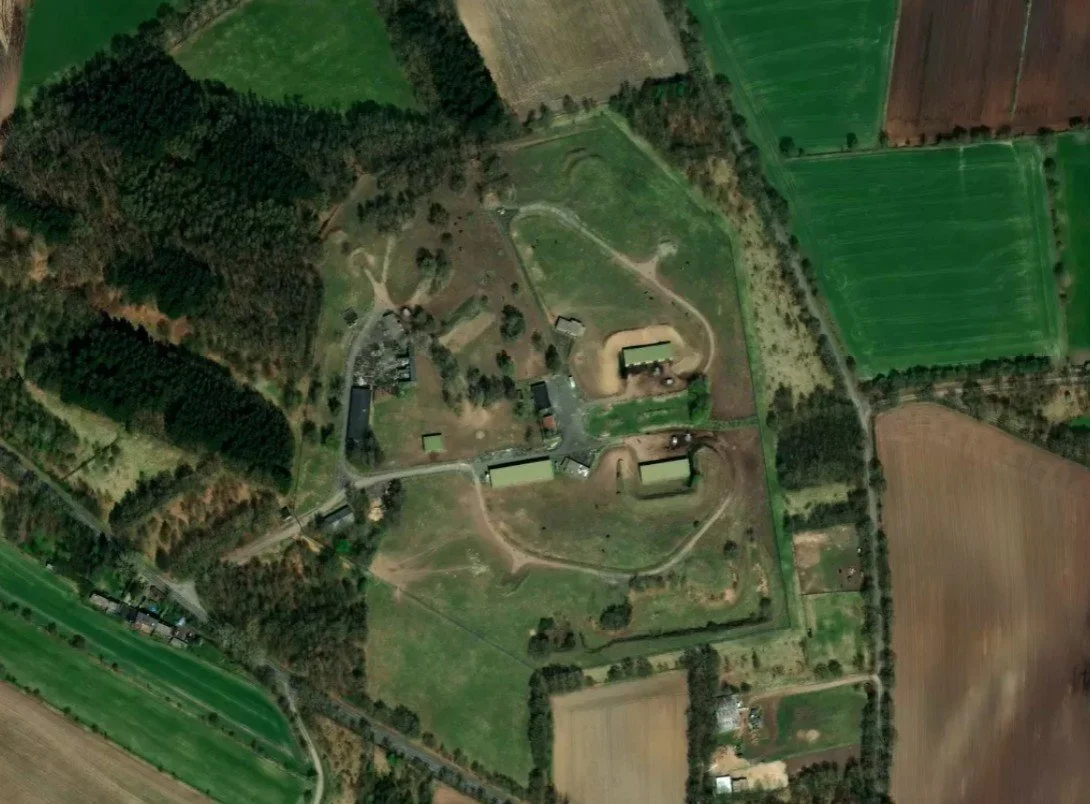
Old Hawk Site Near Kellinghusen
The memoirs of these custodial agents, painstakingly preserved in forums like usarmygermany.com and unit history sites, paint a picture of extreme psychological pressure mixed with crushing boredom. At a site like Kellinghusen (supported by the 13th USAFAD) or Düren, a team of young American GIs would live in a small, fenced-off enclave within the larger German or Belgian base. They were the "inner perimeter." The German conscripts guarded the outer fence; the Americans guarded the inner "Exclusion Area" where the nukes were stored.
The relationship was often fraught with a specific Cold War paranoia. American veterans recount incidents where the "host nation" forces were viewed with suspicion. One custodial agent described the surreal experience of guarding nuclear weapons against the very German soldiers who were supposed to fire them, tasked with preventing any access to the warheads until the release order came from the US President and NATO commanders. The "Two-Man Rule" was absolute and unrelenting. No one, not the detachment commander, not the highest-ranking German officer, could be alone with a warhead or the arming codes. This created a culture of mutual surveillance where privacy was nonexistent and trust was a procedural violation.
The stress was compounded by the "Team A / Team B" rotation schedules (often referred to as teams within a detachment, e.g., Team A at one location, Team B at another, or rotating shifts). Soldiers would spend days "downrange" in the bunkers, sleeping next to weapons capable of leveling a city, cut off from the outside world, waiting for an alarm that would signal the start of World War III. During high-tension periods like the Cuban Missile Crisis or the Able Archer 83 exercise, these teams would effectively live in the bunkers, the "hum of the electronics" serving as a constant reminder of the lethal potential at their fingertips.
The "Ghost" Units: 5th and 570th USAAG
The KML files often label sites with cryptic unit designations like "5th USAAG" or "570th USAAG." These were the US Army Artillery Groups that served as the headquarters for the scattered custodial detachments.
The 5th USAAG, headquartered in Soest, was known as the "Big Unit with the Big Heart," supporting German, Dutch, and Belgian units across Northern Germany. It managed a sprawling network of detachments, stretching the definition of a "group" to its limit.
The 570th USAAG, in Münster, managed the stockpile for the British Army of the Rhine and other northern allies.
These groups were the connective tissue of the nuclear belt. They managed the logistics of moving warheads from the massive depots (like Münster-Dieburg or Siegelsbach) out to the remote firing batteries. The KML reveals the "spiderweb" nature of this logistics: a central hub feeding a ring of widely dispersed launch sites, requiring convoys to travel miles of public roads, a security nightmare that kept Military Police awake at night. The "Special Ammunition Support Command" (SASCOM) patch worn by these troops became a symbol of this unique, high-stakes mission, a mission that required young men to act as the ultimate gatekeepers of the apocalypse.
Fortress Germany – A Tour of the Ruins
The Sauerland and the Rhine Defenses: Oedingen and Glessen
Zooming into the KML map of North Rhine-Westphalia, we find a dense cluster of sites defending the industrial heart of West Germany. This was the Sauerland sector, a region of rolling hills and forests that offered ideal concealment for the "shoot and scoot" tactics of mobile Hawk units, but also served as the hardened anchor for the static Nike sites.
Site Oedingen (D-52): This site, operated by the German Luftwaffe with a US custodial team (52nd USAAD, Team D), serves as a prime example of the "ruin" state of this history. Located on a high ridge, the site's launchers are now silent, but the infrastructure remains visible. Satellite imagery reveals the classic triple-magazine configuration, but unlike the flat concrete aprons of Chicago sites, Oedingen is terraced into the landscape. The KML data helps identify the specific layout: the IFC (radar) site sat on the peak for maximum line-of-sight, while the Launch Area was terraced into the slope below.
The US custodial agents here lived in a bizarre isolation, a "Little America" in the German woods, complete with their own PX and supply lines, yet utterly dependent on the German 22nd Missile Wing for their perimeter security. Today, the launch pits are overgrown, the blast berms softened by decades of erosion, and the site has become a pilgrimage point for "lost places" photographers who capture the melancholy of the decaying concrete.
Site Glessen (Nike-Stellung): Near Cologne, the Glessen site represents the "reclaimed" history. Once a key node in the defense of the capital region, it has partially reverted to nature. The KML marker for this site leads the modern researcher to a patch of forest where the rectangular scars of the launch pits are visible through the canopy, a "Lost Place" favored by urban explorers who document the peeling paint and rusting blast doors that once shielded megatons of explosive power. The contrast between the frantic readiness of the Cold War and the quiet reclamation of the forest is a recurring theme in the visual documentation of these sites.
The Southern Flank: Wurmberg and the Black Forest
Moving south into Baden-Württemberg, the terrain becomes more rugged, and the engineering challenges more acute.
Site Wurmberg (Pforzheim, D-3/71): This site was part of the 3rd Battalion, 71st Air Defense Artillery, a US Army unit. Here, the Americans were both the operators and the custodians. The site at Wurmberg is a haunting destination for the conflict archaeologist. The launch area, visible on satellite maps as a geometric intrusion into the agricultural fields, retains the berms and the concrete fueling pads where toxic hypergolic fuels were loaded into the Ajax and Hercules missiles.
Reports from explorers describe the eerie preservation of the site, the "crushed fuelling stand" and the "acid storage sheds" still standing. The "acid sheds" are a critical detail: the Nike Ajax used Inhibited Red Fuming Nitric Acid (IRFNA), a hypergolic fuel that was incredibly dangerous to handle. The presence of these sheds indicates the site's early history before the solid-fuel Hercules fully took over, or suggests the infrastructure was repurposed. This site was part of the "inner belt," protecting the Stuttgart area and the headquarters of EUCOM. The KML file places it in context with the surrounding HAWK batteries, visualizing the "high-low" mix of the air defense architecture.
The "Demolition Wall": A Hidden Layer
While the Nike sites looked up, another layer of the "Belt" looked down. The research reveals a massive, largely invisible network that complemented the air defense belt: the Wallmeister demolition chambers.
Snippet 37 references a dataset of over 4,600 "demolition chambers" (Sprengschächte) built into the roads and bridges of West Germany. These were pre-chambered shafts, often disguised as manhole covers, designed to be filled with explosives and detonated to create massive craters, slowing a Soviet tank advance. This "Demolition Wall" was the terrestrial equivalent of the Nike Belt.
The Geschichtsspuren.de community has mapped these with the same fervor as the missile sites. Integrating this data into our mental map of the Cold War reveals a terrifying totality of defense: a landscape where the sky was mined with nuclear missiles and the ground was mined with pre-planned craters. The Nike belt was not just an air defense line; it was part of a "total defense" doctrine that viewed the German landscape itself as a weapon to be expended in the delay of the Red Army.
The Alpine Redoubt – Base Tuono and the Art of Preservation
The Italian Connection: Logistics at Altitude
While Germany was the center of gravity, the Nike belt extended south across the Alps into Italy, guarding the Po Valley and the approaches from neutral Austria and Yugoslavia. The Italian deployment was unique in its alpine geography. Sites were perched on mountain passes, battling snow and ice as much as the Soviet threat. The KML files show a string of sites stretching across the northeast, the "backdoor" to NATO's southern flank.
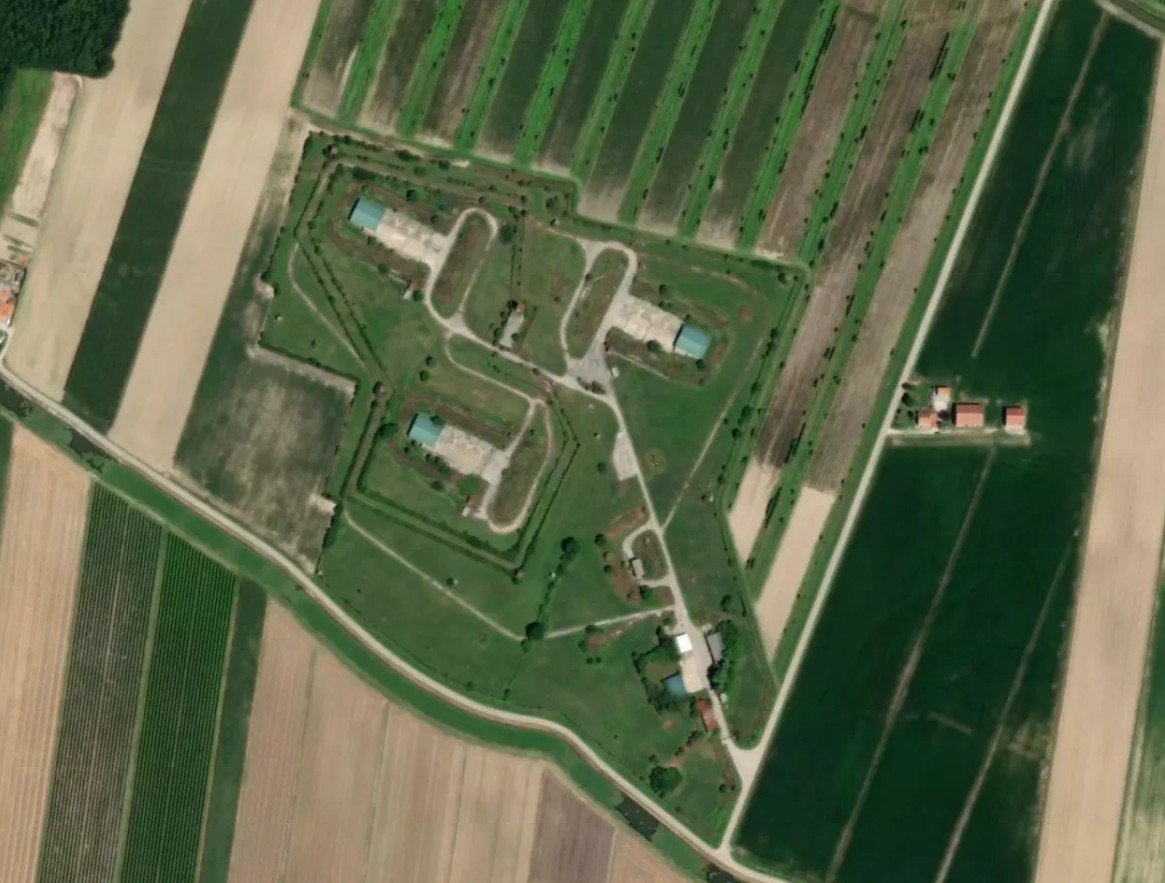
Old Italy HAWK Site
Base Tuono: The Rosetta Stone
Base Tuono (Passo Coe): This site is the "Rosetta Stone" for the European Nike history, much like Site SF-88 is for the US. Located at 1,543 meters (over 5,000 feet) above sea level, it was one of the highest missile bases in Europe. Unlike the rotting hulks in Germany, Base Tuono has been meticulously restored by the municipality of Folgaria and the Italian Air Force.
Base Tuono stands today as a museum, offering a visceral "living history" experience. Three Nike Hercules missiles stand erected on their launch pads, pointed eternally north-east. The radar vans, the control trailers, and the hangar have been restored to their operational condition. For the researcher using KML data, Base Tuono serves as a verification tool. By studying the layout of the restored site, the precise distance between the acquisition radar and the tracking radars, the orientation of the blast berms, the location of the "Section Panel" in the bunker, analysts can better interpret the crumbled ruins visible in satellite images of other, less-preserved sites in Turkey or Greece.
The atmosphere at Base Tuono is described as "evocative," preserving the "equilibrium of terror." It allows visitors to step into the "electronic wagons" where young men stared at scopes, waiting for the blip that would end the world. It bridges the gap between the abstract data of a map coordinate and the tangible reality of the Cold War.
The Digital Archaeology – Forums, KMLs, and the Hobbyist's Eye
The Architects of the Archive
The KML files that drive this investigation are not government products; they are the work of a distributed network of amateur historians and veterans. This "digital archaeology" is a grassroots phenomenon, relying on the passion of individuals to preserve a history that official channels often ignore or classify.
Ed Thelen: A name that appears in almost every citation regarding Nike history. His website serves as the central node for the community, aggregating memories, technical manuals, and location data. He is the "archivist-in-chief" of the Nike community.
Geschichtsspuren.de (formerly lostplaces.de): A German forum led by Michael Grube and others, dedicated to documenting the military history of Germany. Their work in identifying the "demolition chambers" and the precise locations of the Nike belt is crucial for understanding the "total defense" doctrine. They represent the "boots on the ground," visiting sites, photographing ruins, and correcting the map coordinates based on physical evidence.
Manfred Bischoff: Identified in the research as a contributor of aerial photography (e.g., the Gusborn site), Bischoff represents the intersection of art and archaeology. A renowned goldsmith by trade, his involvement highlights the diverse background of this community, people drawn to the aesthetic and historical power of these "lost places".
Planeman & "Bluffer's Guides": The research highlights the work of "Planeman," a forum user who creates detailed "Bluffer's Guides" to air defense networks. His KML files for "Fortress Russia" and other networks are masterpieces of Open Source Intelligence (OSINT), using satellite imagery to reverse-engineer the Soviet air defense layout. This provides a crucial "Red Team" perspective, allowing us to compare the NATO Nike belt with its Warsaw Pact counterparts.
The Methodology of Discovery
These hobbyists use a combination of declassified documents, veteran oral histories, and visual reconnaissance on Google Earth. They look for the "signatures":
The Geometric Triad: The three radar pads of the IFC.
The Triple Magazine: The three rectangular elevator doors of the Launch Area.
The Exclusion Fence: The double perimeter line that often remains as a crop mark or a treeline distinct from the surrounding forest.
This process is not just mapping; it is an act of preservation. As sites are demolished for renewable energy parks or housing developments, the KML file becomes the only record of their existence. The "digital ruin" persists even after the physical ruin is gone.
The Tactical Logic – Why the Belt?
The Physics of Interception: Formation Breaking
The layout revealed by the KML, the linear belt versus the circular ring, was dictated by the physics of the engagement. In the US, the goal was to shoot down a bomber before it released its payload over a city. In Europe, the goal was to break the formation before it could penetrate deep into NATO territory.
The Nike Hercules was a "formation breaker." Its nuclear warhead (the W31) was not designed to hit a single plane, but to detonate in the center of a bomber stream, using overpressure and radiation to destroy multiple aircraft at once. This grim calculus explains the density of the European sites. A single battery at Oedingen or Wurmberg wasn't just defending a point; it was denying a volume of airspace. The overlapping range rings visible in the KML created a "kill box" that extended from the surface to 100,000 feet.
The Friendly Fire Paradox
The KML maps also reveal the terrifying proximity of these engagements to friendly populations. A nuclear detonation by a Nike Hercules from Oedingen to intercept a Soviet formation would likely occur over West Germany itself. The fallout would rain down on the very villages the system was defending. This "friendly fire" paradox was the central tension of the European Cold War, the realization that defense might be indistinguishable from destruction. This reality likely contributed to the intense "pacifist" movements in Germany and the Netherlands in the 1980s, as the local population realized they lived in the "impact zone" of their own allies' weapons.
The Digital Afterlife – Preserving the Invisible
The Race Against Erasure
The "Archive Missile Defense KML" is not a static document; it is a living database that is constantly threatened by the very technology that enables it. As Google updates its satellite imagery, high-resolution "leaf-off" winter images (which reveal foundations clearly) are often replaced by "leaf-on" summer images that hide the ruins under a canopy of green. The hobbyists are in a race to capture and geotag these features before they disappear into the pixelated noise.
Furthermore, the physical erasure is accelerating. As Germany transitions to green energy, the elevated, wind-swept ridges that were perfect for Nike radars are now perfect for wind turbines. Many former IFC sites have been bulldozed to make way for windmills, their concrete crushed into roadbed. The KML file is often the only remaining evidence that a nuclear battery once stood there.
The Community of Memory
The forums that generate these KMLs are digital campfires for the Cold War veterans. Here, a former lieutenant from the 59th Ordnance Brigade can connect with a German conscript who guarded the outer perimeter of the same site forty years ago. They compare notes, correct map coordinates, and share photos of "Lost Places" explorations. This crowdsourced intelligence has corrected official history. Declassified lists of sites often contain errors, typos in coordinates, wrong town names. It is the "boots on the ground" knowledge of the veterans, cross-referenced with the "eyes in the sky" of the hobbyists, that has created the definitive map of the Nike Belt.
The Belt of Fire
The "Nike Belt" of Europe was a singular architectural achievement of the 20th century, a continuous, multinational machine composed of radar, steel, and plutonium, stretching across a continent. It was designed to be invisible to the public, a "silent front" that would only reveal itself in the moments before the end of the world.
Through the "archive missile defense KML," we can finally see this machine in its entirety. We can trace the logic of its geometry, the burden of its custodians, and the slow decay of its concrete bones. These sites are not just ruins; they are the archaeological footprint of a strategy that gambled the existence of civilization on the precision of a radar beam. They remind us that for forty years, the forests of Europe hid a power that could have turned the "Iron Curtain" into a wall of fire. As we click on the orange pushpins of the digital map, we are not just looking at coordinates; we are looking at the scars of a war that, miraculously, remained cold.
Today, as geopolitics shift once again, the ghostly outline of the Nike Belt seems less like a relic and more like a prophecy. In Europe, the "Sky Shield" initiative and the rapid deployment of Patriot batteries to the Eastern Flank suggest a return to the "Wall of Missiles" doctrine, reimagined for a new era of drone swarms and hypersonic threats. Meanwhile, in the Pacific, a similar "line in the sand" is being drawn along the First Island Chain. The recent deployment of the US Army's "Typhon" missile system to the Philippines and Japan mirrors the old Nike strategy: a forward-deployed picket line of islands and peninsulas, armed with long-range fires to contain a continental superpower. Just as the KML files of the 1960s reveal a static belt of defense across Germany, future historians may one day map the "Pacific Belt" of the 2020s, a new geometry of fear stretching from Okinawa to Manila, guarding the tenuous peace of the 21st century.
Appendix: Data Tables
| Site Name / ID | Location | Operator | Status | Notable Features |
|---|---|---|---|---|
| D-52 Oedingen | Sauerland, Germany | Luftwaffe / US Custody (52nd USAAD) | Abandoned / Ruin | High elevation, terraced layout, visible launch pits. |
| D-3/71 Wurmberg | Pforzheim, Germany | US Army (3/71 ADA) | Abandoned | Part of the "Inner Belt," fueling pads visible. |
| Base Tuono | Folgaria, Italy | Italian Air Force | Museum | Fully restored, missiles on launchers, "living history". |
| Glessen | Cologne, Germany | Luftwaffe | Ruin / Forest | "Lost Place" urbex site, reclaimed by vegetation. |
| Kellinghusen | Schleswig-Holstein | US Army (13th USAFAD) | Repurposed | Key nuclear storage for northern sector. |
| Düren | North Rhine-Westphalia | Belgian AF / US Custody | Repurposed | Supported Belgian Nike units, dense infrastructure. |
| Unit | Headquarters | Mission | Region |
|---|---|---|---|
| 59th Ordnance Brigade | Pirmasens | Command & Control of all US Army Nuclear Ammo in Europe | Theater-Wide |
| 5th USAAG | Soest | Support to German, Dutch, Belgian units | Northern Germany |
| 570th USAAG | Münster | Support to Northern Army Group (NORTHAG) allies | Northern Germany |
| 552nd USAAG | Sögel | Support to German Luftwaffe units | Northern Germany |
| 32nd AADCOM | Darmstadt | US Army Air Defense Command in Europe | Southern Germany |
-
The Concrete Archipelagos: A Geospatial Excavation of Project NIKE and the Architecture of American Nuclear Defense
Their Own Two Feet | Cato Institute, accessed November 24, 2025, https://www.cato.org/policy-analysis/their-own-two-feet
NATO's Future Conventional Defense Strategy in Central Europe: Theater Employment Doctrine for the Post-Cold War Era - RAND, accessed November 24, 2025, https://www.rand.org/content/dam/rand/pubs/reports/2007/R4084.pdf
AIRCENT Air Defense - USAREUR Units & Kasernes, 1945 - 1989, accessed November 24, 2025, https://www.usarmygermany.com/units/Air%20Defense/USAREUR_94th%20ADA%20Bde%201.htm
What's old is new again: How to boost NATO's air defenses in Europe, accessed November 24, 2025, https://www.defensenews.com/opinion/2023/12/27/whats-old-is-new-again-how-to-boost-natos-air-defenses-in-europe/
Airpower in 20th Century - Ministero della Difesa, accessed November 24, 2025, https://www.difesa.it/assets/allegati/44064/airpower_in_20th_century_nov11.pdf
U.S. Air and Ground Conventional Forces for NATO: Air Defense Issues - DTIC, accessed November 24, 2025, https://apps.dtic.mil/sti/tr/pdf/ADA452546.pdf
Second Allied Tactical Air Force - Wikipedia, accessed November 24, 2025, https://en.wikipedia.org/wiki/Second_Allied_Tactical_Air_Force
Germany - Ed Thelen's Nike Missile Web Site, accessed November 24, 2025, https://ed-thelen.org/loc-g.html
5th USAAG - USAREUR Units & Kasernes, 1945 - 1989, accessed November 24, 2025, https://www.usarmygermany.com/units/Ordnance/USAREUR_5th%20USAAG.htm
Fourth Allied Tactical Air Force - Wikipedia, accessed November 24, 2025, https://en.wikipedia.org/wiki/Fourth_Allied_Tactical_Air_Force
List of Nike missile sites - Wikipedia, accessed November 24, 2025, https://en.wikipedia.org/wiki/List_of_Nike_missile_sites
33+ Thousand Military Station Royalty-Free Images, Stock Photos & Pictures - Shutterstock, accessed November 24, 2025, https://www.shutterstock.com/search/military-station?page=19
Traces of the Cold War in Southwest Germany - SightRaider, accessed November 24, 2025, https://www.sightraider.com/traces-of-the-cold-war-in-southwest-germany/
Kernwaffen in Deutschland - Wikipedia, accessed November 24, 2025, https://de.wikipedia.org/wiki/Kernwaffen_in_Deutschland
NATO Batteries - Ed Thelen's Nike Missile Web Site, accessed November 24, 2025, https://www.ed-thelen.org/NATO-Batteries.html
Towards a French nuclear umbrella? Assessing the transition from US to French dual-key arrangements | European Journal of International Security - Cambridge University Press, accessed November 24, 2025, https://www.cambridge.org/core/product/1CC995BF85658BB2B3D2C68129B35968/core-reader
59th Ordnance Brigade - USAREUR Units & Kasernes, 1945 - 1989, accessed November 24, 2025, https://www.usarmygermany.com/units/ordnance/USAREUR_59thOrdBde%201.htm
59th Ordnance Brigade - Wikipedia, accessed November 24, 2025, https://en.wikipedia.org/wiki/59th_Ordnance_Brigade
59th Ordnance Brigade US Army, Europe - USAREUR Units & Kasernes, 1945 - 1989, accessed November 24, 2025, https://www.usarmygermany.com/units/Ordnance/USAREUR_59thOrdBde.htm
545th Ordnance Maintenence Company - MAM - US Army - Korean War Project Page 1, accessed November 24, 2025, https://www.koreanwar.org/html/units/545ord.htm
Cold War vets get the cold shoulder, accessed November 24, 2025, https://www.inhnews.com/coldwarvets
294th US Army Artillery Group - USAREUR Units & Kasernes, 1945 - 1989, accessed November 24, 2025, https://www.usarmygermany.com/units/Ordnance/USAREUR_294th%20USAAG.htm
Ajax - Ed Thelen's Nike Missile Web Site, accessed November 24, 2025, https://ed-thelen.org/missiles.html
Sources of Human Instability in the Handling of Nuclear Weapons - NCBI - NIH, accessed November 24, 2025, https://www.ncbi.nlm.nih.gov/books/NBK219146/
I guarded U.S. nuclear missiles in West Germany 1985-1989... 507th USAAD, 5th Group, 59th Ord Brigade--- Nike Hercules missiles. : r/IAmA - Reddit, accessed November 24, 2025, https://www.reddit.com/r/IAmA/comments/9o67d/i_guarded_us_nuclear_missiles_in_west_germany/
4th Allied Tactical Air Force - US Army in Germany, accessed November 24, 2025, https://www.usarmygermany.com/USAFE%20TACS%207.htm
570th U.S. Army Artillery Group - Matrix Games, accessed November 24, 2025, https://www1.matrixgames.com/forums/printable.asp?m=3511979
SASCOM - ARMY AND USAAF - U.S. Militaria Forum, accessed November 24, 2025, https://www.usmilitariaforum.com/forums/index.php?/topic/112680-sascom/
NIKE MISSILE BASES | Encyclopedia of Cleveland History, accessed November 24, 2025, https://case.edu/ech/articles/n/nike-missile-bases
From urban systems to sustainable competitive metropolitan regions, accessed November 24, 2025, https://www.ihs.nl/sites/corporate/files/From_urban_systems_to_sustainable_competitive_metropolitan_regions.pdf
Nike People, accessed November 24, 2025, https://www.ed-thelen.org/ppl-germany.html
CSM (R) Schroeder - NCO Worldwide, accessed November 24, 2025, https://www.ncoworldwide.army.mil/Portals/76/history/ref/oralhistory/csm_schroeder.pdf
38 Nike Missile Sites Royalty-Free Images, Stock Photos & Pictures - Shutterstock, accessed November 24, 2025, https://www.shutterstock.com/search/nike-missile-sites
accessed November 24, 2025, https://listings.lib.msu.edu/?i=109&p=cd421/TEXTS/FROWN/FROWN_G.TXT
Nike Stellung Griesheim bei Darmstadt - Seite 3 - geschichtsspuren.de - Forum, accessed November 24, 2025, https://www.geschichtsspuren.de/forum/viewtopic.php?t=5680&start=20
On Conflict and Risk - Elektronische Hochschulschriften der LMU München, accessed November 24, 2025, https://edoc.ub.uni-muenchen.de/34846/1/Schlepper_Marcel.pdf
Located near Passo Coe (1610 m), in the municipality of Folgaria (Trentino), it was one of the twelve missile bases of the Air Force deployed in Northern Italy in the sixties as part of NATO air defense system in southern Europe. - Base Tuono, accessed November 24, 2025, https://www.basetuono.it/en/the-base.html
Learn about Base Tuono at Passo Coe: history and curiosities of the Cold War - Hotel Al Prato | Tonezza del Cimone, accessed November 24, 2025, https://www.alprato.com/en/tuono-base.html
Base Tuono Does It Right - Vintage Aviation News, accessed November 24, 2025, https://vintageaviationnews.com/aviation-museum-news/base-tuono-does-it-right.html
Base Tuono - Azienda per il turismo Alpe Cimbra Folgaria Lavarone Luserna Vigolana S. cons. p. A., accessed November 24, 2025, https://www.alpecimbra.it/en/discover-alpe-cimbra/nature-and-culture/base-tuono/256-2837.html
Nike Site Locations & Status, accessed November 24, 2025, https://ed-thelen.org/loc.html
Ed Thelen's Nike Missile Web Site, accessed November 24, 2025, https://ed-thelen.org/
Special Weapons Depots USAREUR - US Army in Germany, accessed November 24, 2025, http://www.usarmygermany.com/units/armydepots/usareur_sw%20depots.htm
What was NEW on the US ARMY IN GERMANY SITE between January 1 - December 31, 2006 - USAREUR Units & Kasernes, 1945 - 1989, accessed November 24, 2025, https://www.usarmygermany.com/USAREUR_new6.htm
In Memory of Manfred Bischoff - Art Jewelry Forum, accessed November 24, 2025, https://artjewelryforum.org/articles/in-memory-of-manfred-bischoff/
Interactive Map of Fortress Russia - Air Defence Radar and Surface to Air Missile (SAM) Sites • Live Earth Monitoring & Educational Resources - ClimateViewer Maps, accessed November 24, 2025, https://climateviewer.org/history-and-science/government/maps/fortress-russia-air-defence-radar-sam-sites/
Wall in the Sky: The Untold Story of the Nike Nuclear Missile Shield, accessed November 24, 2025, https://www.ghostsofthebattlefield.org/articles/wall-of-in-the-sky-the-untold-story-of-the-nike-nuclear-missile-shield
Nukes in the Backyard – A brief history of Nike missiles - Oscar-Zero, accessed November 24, 2025, https://oscarzero.wordpress.com/2023/03/20/nukes-in-the-backyard-a-brief-history-of-nike-missiles/
The Nike Missile System: A Concise Historical Overview, accessed November 24, 2025, https://www.ed-thelen.org/Bender1.html