
Unlocking Prosperity: How a Military Ontology Can Build a More Resilient Economy
In the quiet, climate-controlled corridors of the Defense Intelligence Agency, a tool of immense power hums silently, its servers processing a world of complexity. It’s called the Modernized Integrated Database (MIDB), and it represents the absolute pinnacle of structured intelligence analysis. For decades, it has been the U.S. military’s knowledge canvas, mapping the intricate webs of global infrastructure to give strategists an unparalleled, three-dimensional understanding of the world. It’s a system designed to find critical vulnerabilities and predict the cascading effects of action. But what if this remarkable creation, born from the crucible of national security, could be repurposed to fuel an economic renaissance? What if the very logic that targets an adversary's weaknesses could be used to build our own strengths? How can we do it? The proposition is as audacious as it is transformative: the time has come to consider unleashing the genius of the MIDB framework upon the global economy by open sourcing its framework.
The Fragmented World of Economic Data
Today's business leaders and economic policymakers are navigating a treacherous, storm-tossed sea with what amounts to a shallow map. We are drowning in an ocean of data from so-called "Places libraries" like Google Maps and OpenStreetMap. We know where things are—the factories, the ports, the data centers, the corporate headquarters. But this geographical snapshot is deceptively, dangerously simple. It tells us the "what" but offers no real insight into the "how" or the "why." It's like having a list of all the parts of a modern jetliner without a single schematic to show how they connect.
This lack of relational intelligence leaves us perpetually reactive and profoundly vulnerable. A single container ship gets stuck in the Suez Canal, and suddenly the world's supply chains grind to a halt. A fire at a single, obscure chemical plant in Japan disrupts the production of a critical resin, and global auto manufacturing is thrown into chaos for months. These aren't failures of data; they are failures of imagination, an inability to see the hidden threads that tie our world together. We are data-rich but insight-poor, charting our course by looking at the stars while ignoring the complex currents moving beneath the surface.
The Illusion of Insight: Our Patchwork of Siloed Systems
Now, it would be disingenuous to claim that network analysis is a foreign concept to the private sector. On the contrary, brilliant minds in various industries have developed sophisticated models to understand their own specific ecosystems. A major investment bank has an incredibly detailed map of its counterparty risk, understanding how the failure of one institution could ripple through the financial system. A global logistics giant has a masterful model of shipping lanes, port capacities, and trucking routes to optimize its fleet. An energy provider has a comprehensive schematic of its power grid, modeling dependencies and potential points of failure.
But here lies the critical, and dangerous, flaw: these are all isolated silos of perspective. They are islands of deep understanding in a vast, uncharted ocean of interconnected risk. The financial model knows nothing of the power grid that its data centers depend on. The logistics model is blind to the geopolitical tensions that could close a critical strait or the labor disputes that could paralyze a key port. The energy grid analysis doesn't account for the supply chain vulnerabilities that could delay the delivery of a critical replacement transformer for months.
Each framework is a language spoken in only one country, with no translators available. There is no standardized, scalable ontology that connects these disparate worlds. A true crisis, however, rarely respects these artificial boundaries. A geopolitical event can trigger a financial shock, which in turn creates a logistics nightmare, which then leads to an energy crisis. Our current tools can only see the first domino fall within their own narrow lane; they are utterly blind to the cross-domain chain reaction that inevitably follows. This is not a failure of expertise, but a failure of architecture. We don't need another isolated, proprietary model. We need a common, foundational framework—a lingua franca for the entire interconnected system of human infrastructure.
The MIDB Difference: A Symphony of Systems
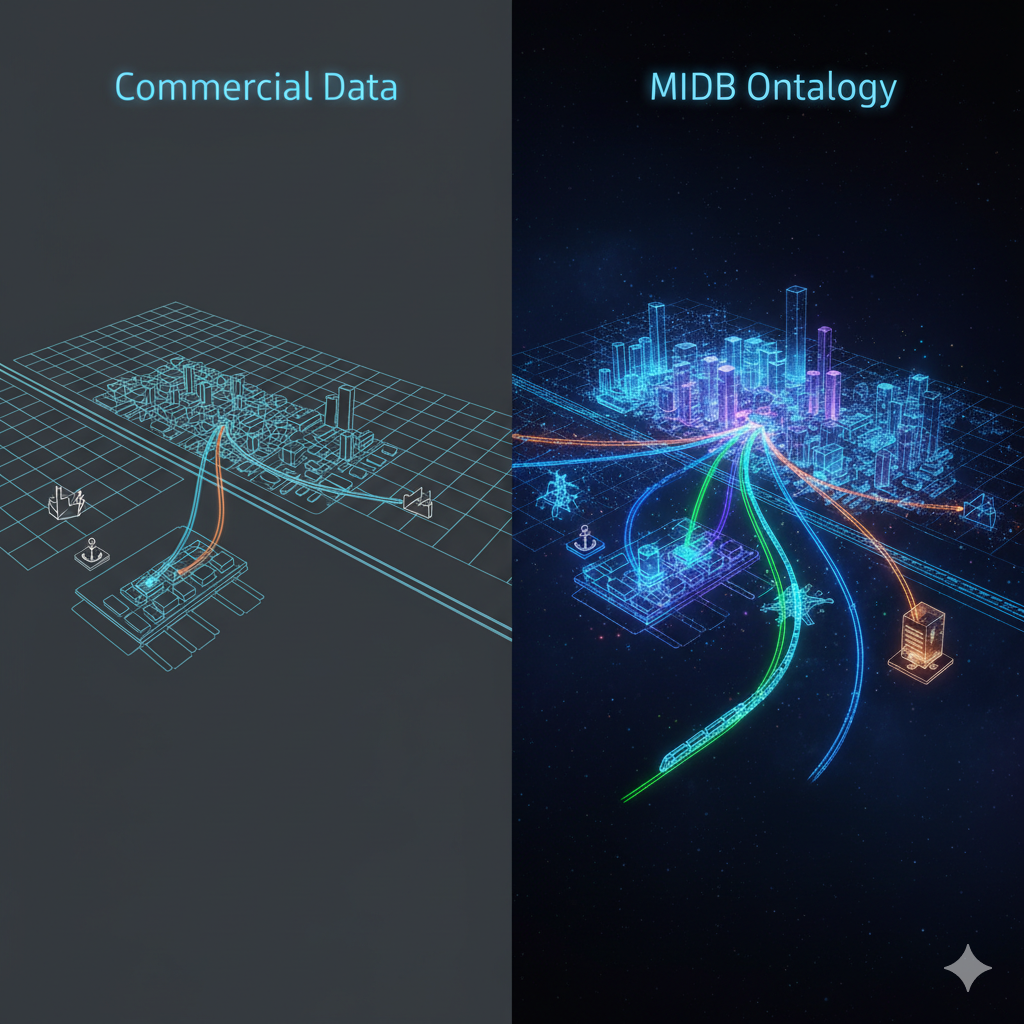
This is precisely where the MIDB framework moves from a military tool to a potential economic game-changer. It wasn't built to be a simple list or a static map; it was built to be a living, breathing symphony of systems. Forged by decades of rigorous military doctrine, its core strength lies in its "network ontology"—a sophisticated, multi-layered method of not just identifying facilities, equipment, and organizations, but meticulously defining the functional, logical, and even social relationships between them.
It’s a crucial distinction to make, and one often lost on those who have interacted with the system. Over the years, MIDB has at times earned a reputation for being cumbersome or difficult to use. However, this critique almost always stems from the various contracted software programs and user interfaces built to access the database, not from the database itself. It's essential to separate the user-facing application from the underlying architecture. The true genius of MIDB is not in any single piece of software, but in its foundational ontology—a meticulously crafted structure born from decades of real-world analytical tradecraft. This core design is the masterpiece, a testament to structured thinking that remains powerful and relevant, independent of any particular interface.
Imagine a major port. A commercial library sees a point on a map with a name and an address. The MIDB framework sees a complex, dynamic ecosystem. It maps the port's physical relationship to the specific rail lines and highways that feed it, but it goes deeper. It analyzes the capacity of the power grid that sustains its cranes and computers, the bandwidth of the communication networks that coordinate its logistics, and the stability of the financial institutions that underwrite its operations. It even layers in organizational data: which unions represent the longshoremen, what are their contract statuses, and a labor dispute impact throughput? It understands the hierarchy and the critical dependencies. This is the difference between seeing a single chess piece and understanding the entire three-dimensional board, including the psychology of the players.
Anatomy of a Critical Node: A Real-World Example
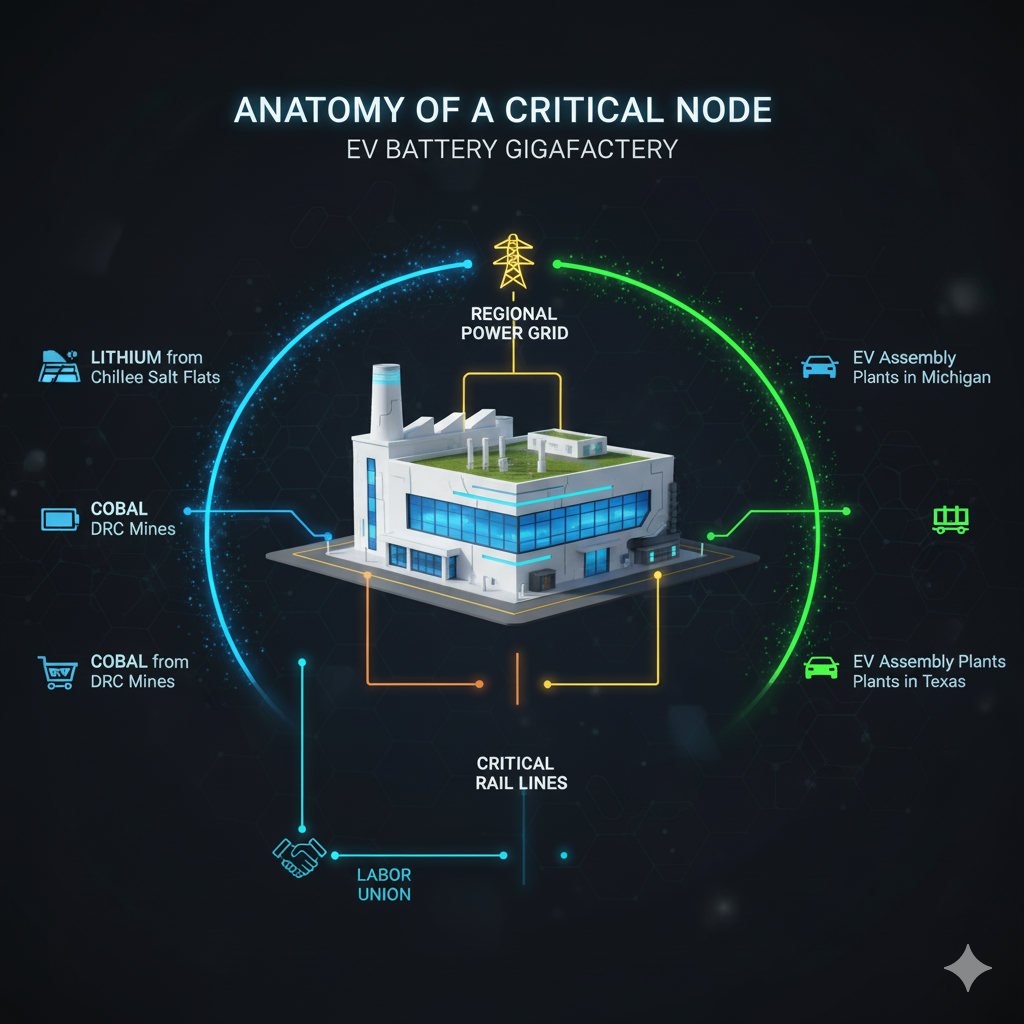
To understand the power of this ontology, let’s move beyond the abstract and consider a single, complex entity: a new EV Battery Gigafactory in the American Midwest. A standard "Places library" sees this as a single point on a map: a large building with an address or geocoordinate, an owner, and a stated purpose—producing batteries. This is Level 1 analysis. It’s useful, but it’s not insight. The MIDB network ontology begins where this fragmented shallow map ends. It deconstructs the gigafactory into a web of interconnected dependencies, creating a multi-layered, dynamic picture:
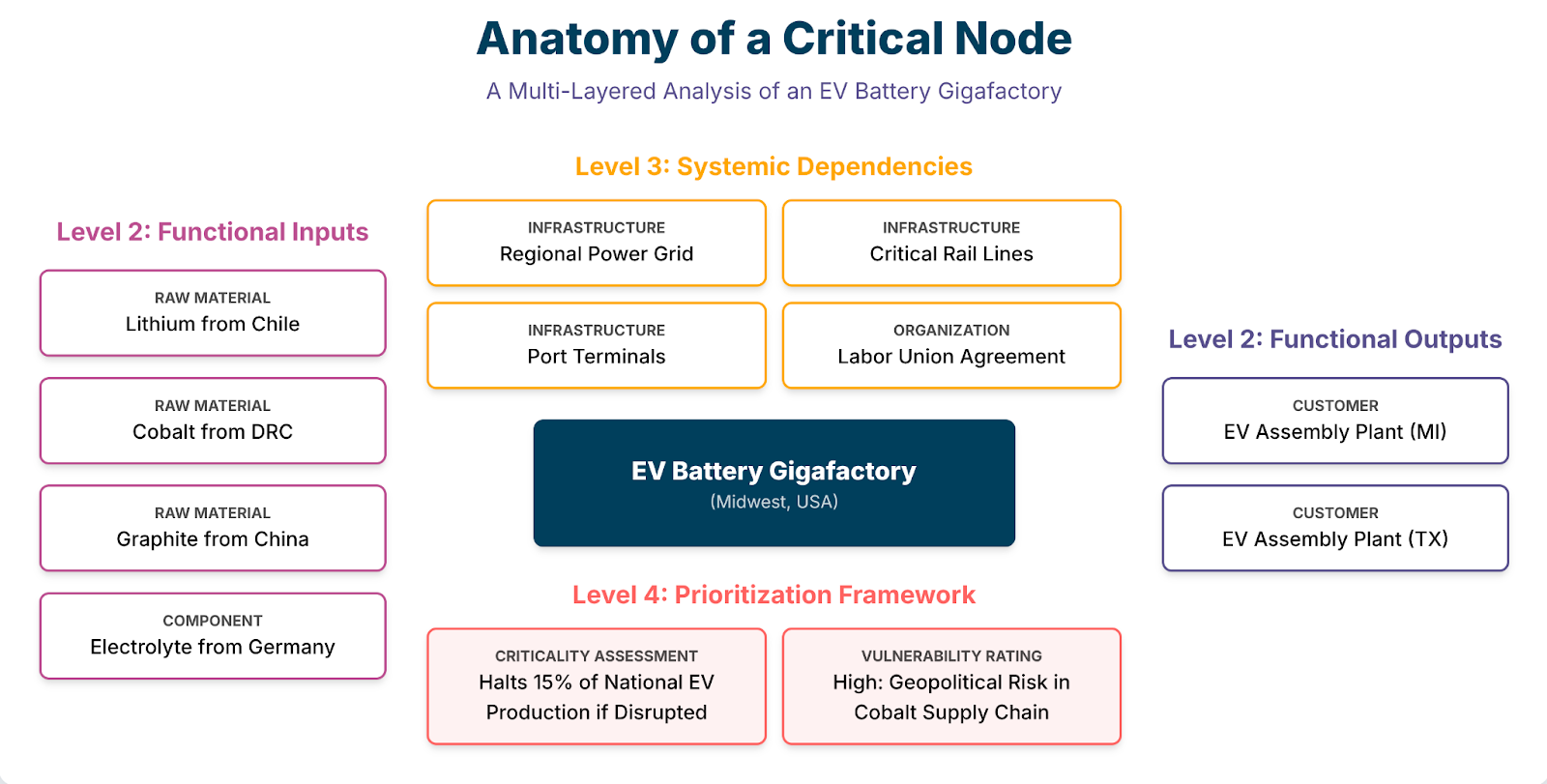
Level 2: Functional Relationships (The "How"). The framework first maps the direct, physical flows. It doesn't just know the factory needs lithium; it formally links the factory to the specific brine pools in Chile’s Atacama Desert that supply it. It links it to the specific cobalt mines in the DRC, the specific graphite processing plants in China, and the specific chemical suppliers in Germany that provide the electrolyte. It then maps the outputs, linking the factory to the specific EV assembly plants in Michigan and Texas that it contractually supplies. This is the direct supply chain.
Level 3: Systemic Dependencies (The "Invisible" How). Next, the ontology maps the systems that enable these functional relationships. The factory is linked to the specific high-voltage substation that powers it, and that substation is linked to the regional power grid. The raw materials are linked to the specific rail lines, port terminals, and trucking companies that move them. The factory's operations are linked to the specific labor union representing its workers and the expiration date of their collective bargaining agreement. This layer reveals hidden vulnerabilities: a single bridge failure on a critical rail line or a localized labor dispute could halt production as effectively as a lithium shortage.
Level 4: The Prioritization Framework (The "Why it Matters"). This is the final, crucial layer that is completely absent from commercial systems. The ontology allows an analyst to assess the factory's criticality. Because it is the sole supplier for two major EV assembly plants, its disruption would immediately halt 15% of the nation's EV production. This makes it a critical national node for meeting climate goals. Because its primary cobalt supplier is in a politically unstable region, its supply chain has a high vulnerability rating. By synthesizing these relationships, the framework assigns a value to the factory—not in dollars, but in systemic importance. It moves beyond knowing what a thing is to understanding what it means to the broader system.
This is the power of the ontology. It transforms a simple dot on a map into a living, breathing entity with a quantifiable level of importance and a predictable set of vulnerabilities. It is this deep, relational understanding—and the ability to prioritize—that is the missing ingredient in modern economic strategy.
Use Case: The Anatomy of a Supply Chain Crisis
Consider the recent semiconductor shortage, a crisis that cost the global economy hundreds of billions of dollars. A traditional analysis points to a confluence of unfortunate events: a factory fire, a shipping delay, a surge in demand. An MIDB-powered analysis would have seen the crisis not as a perfect storm, but as an inevitability baked into the system's architecture. It would have identified the critical chokepoints in the supply chain long before they failed.
By mapping the entire system—from the handful of obscure mines in conflict-prone regions that produce the necessary rare earth minerals, to the specialized chemical plants that process them, to the very few foundries in the world capable of fabricating the most advanced wafers—the framework would have highlighted the system's inherent fragility. It would have shown that seemingly unrelated events—a drought in Taiwan impacting water-intensive chip fabrication, a political skirmish in Africa affecting cobalt supplies, a new gaming console driving up demand—were all tugging at the same, dangerously thin thread. For a corporation, this isn't just analysis; it's the kind of strategic foresight that can mean the difference between market leadership and bankruptcy. For a nation, it's a matter of economic security.
Powering the AI Revolution with Structured Insight
The true game-changer, the leap into a new paradigm, is what happens when you pair this structured, relational framework with the raw computational power of artificial intelligence. AI is a brilliant but often undisciplined student. Feed it the flat, unstructured data from our current libraries, and it will find correlations, some useful, many spurious. It might conclude that ice cream sales cause shark attacks because both rise in the summer.
But feed it the rich, relational data of an MIDB-like framework, and you provide the context, the "scaffolding of reality," that AI needs to make meaningful inferences. You elevate AI from a mere data processor to a true strategic partner.
Use Case: Building a Resilient National Infrastructure
Let's say a government wants to invest $100 billion in making its energy grid more resilient to climate change and cyberattacks. Where does it start? Using an MIDB-powered AI, policymakers could run sophisticated, dynamic "what-if" scenarios. What happens if a key transformer station in the Southwest is taken offline by a record-breaking heatwave? The AI wouldn't just see a localized power outage. It would model the cascading, second- and third-order effects.
It would predict the immediate impact on the water treatment plants and pumping stations that rely on that power, forecasting potential water shortages in major cities. It would then model the downstream effects on hospitals forced onto limited backup generators, the communication networks that would be degraded, and the agricultural centers unable to power irrigation systems. It would even project the potential impact on the financial markets as businesses in the affected region suffer disruptions. This "system of systems" approach allows for surgical, high-impact investments, shoring up the most critical vulnerabilities to ensure the entire national ecosystem remains robust. It moves beyond prediction to prescription.
The Unbeatable Head Start: Why Industry Can't Build This Alone
Faced with this clear need for a unified framework, the logical question arises: why can't industry simply build its own? The answer is a matter of time, complexity, and consensus. To recreate a cross-domain ontology with the depth and rigor of MIDB from scratch would be a Sisyphean task, likely taking decades and costing billions.
First, one must overcome the monumental challenge of standardization. Getting the financial, energy, logistics, and manufacturing sectors—each with its own lexicon, priorities, and proprietary systems—to agree on a universal set of definitions and relationships would be an unprecedented feat of corporate diplomacy. It would be a years-long battle against institutional inertia and competing interests before a single line of code could be written.
Second, the MIDB's ontology is not the product of a theoretical design committee. It is a battle-hardened framework, forged and refined over half a century by thousands of analysts working on real-world problems. Every category, every relationship, every hierarchical rule has been tested, debated, and honed against the unforgiving reality of global events. This accumulated intellectual capital—the countless lessons learned from crises averted and intelligence failures analyzed—is an invaluable asset that simply cannot be replicated in a lab or a boardroom.
Repurposing the MIDB framework isn't about taking a shortcut; it's about leveraging an irreplaceable national asset. It offers the chance to bypass decades of painful and expensive research and development, and to deploy a trusted, mature system that can begin delivering transformative economic insights almost immediately. The choice is between starting a marathon from scratch or accepting a 25-mile head start.
A Proven Blueprint for Innovation: The GPS and Landsat Precedents
This proposal to open-source a government framework is not a leap into the unknown; it follows a well-established and incredibly successful blueprint. History has repeatedly shown that when the government transitions a powerful, data-centric technology from a restricted asset to a public good, it catalyzes an explosion of economic growth and innovation.
The most potent example is the Global Positioning System (GPS). Originally a purely military tool with its most accurate signals encrypted, the decision in 2000 to make high-precision GPS freely available to the public was a watershed moment. It didn't just improve navigation; it created entire industries from scratch. Ride-sharing, precision agriculture, global logistics management, and countless location-based mobile applications—trillion-dollar markets—were all built on the foundation of this open government framework.
Similarly, the Landsat program provides a powerful model. For years, its invaluable satellite imagery was sold at a high cost, limiting its use. When the U.S. government made the entire data archive free and open in 2008, it democratized access to Earth observation. This policy fueled the growth of new businesses in agriculture, climate science, and resource management, creating immense value by transforming raw data into actionable intelligence.
In both cases, the government did not need to build the end-user applications. It simply provided the foundational framework—the reliable, standardized, high-quality data stream—and trusted the ingenuity of the private sector to do the rest. Open-sourcing the MIDB ontology is a direct parallel. It is not about releasing sensitive data, but about providing the "GPS for our economic infrastructure"—a common, reliable framework upon which a new generation of analytical tools and resilient systems can be built.
The Ultimate Economic Stimulus: Open-Source the Framework
The power of this analytical framework is too vast and too vital to remain locked away behind walls. The United States now has a historic opportunity to supercharge its own economy and that of its allies by open-sourcing the MIDB framework. To be clear, this does not mean releasing a single byte of sensitive data. It means sharing the blueprint, the ontology, the very intellectual architecture that makes MIDB so powerful. It means giving our brightest minds the schematics for a better engine.
By providing this framework as a public good, we could ignite a Cambrian explosion of innovation. Imagine startups creating new tools for "just-in-time" manufacturing that are resilient to shocks. Picture financial institutions developing sophisticated risk models that can price in systemic supply chain vulnerabilities. Envision urban planners designing smarter, more resilient cities by understanding the complex interplay between transportation, energy, and communication systems. The possibilities are boundless. It would be a force multiplier for our entire economy, creating a new generation of businesses and a new era of economic foresight.
Guiding a HIFLD Open Replacement
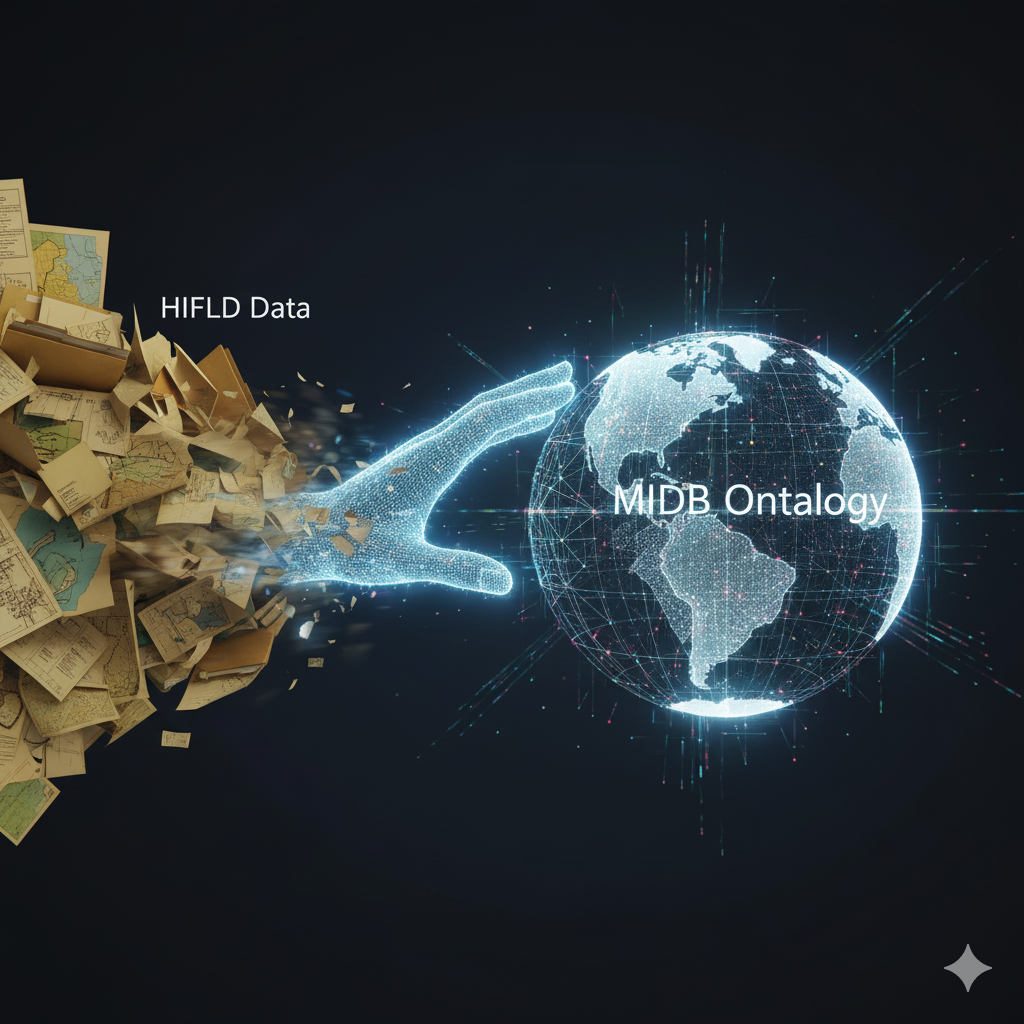
This vision for a new economic engine has a direct and powerful domestic application: it provides the perfect intellectual blueprint for building a true replacement for the Homeland Infrastructure Foundation-Level Data (HIFLD) program.
For years, HIFLD has served as a critical, if passive, repository of asset data—a vital catalog of our nation’s infrastructure "nouns." But in an era of cascading, cross-domain crises, a static catalog is no longer sufficient. We need a dynamic engine that understands the "verbs" and "conjunctions" that link these assets together.
The Public Sector "Tradecraft" Shift The solution lies not in declassifying military targets, but in open-sourcing the military’s data tradecraft. The true value of the MIDB is not just the database itself, but the rigorous framework, workflow, and manuals that govern how records are created. It is the disciplined process that forces an analyst to define not just what an object is, but how it functions and what it relies upon.
By releasing this "operating manual" for infrastructure—the schema, the relationship standards, and the validation workflows—we can build "HIFLD Open." This would not be another data portal; it would be a living model of U.S. infrastructure built on professional-grade standards.
Consider a real-world energy and logistics scenario: a hurricane bearing down on the Gulf Coast.
The Static View (Current State): A traditional HIFLD query provides a map showing the location of hospitals, fuel depots, and electrical substations in the storm’s path.
The Dynamic View (HIFLD Open): Powered by the MIDB tradecraft, the system creates a dependency graph. It reveals that "Hospital A" relies on a generator, which relies on "Depot B." Crucially, because the workflow required the analyst to log load-ratings, the system instantly flags that the only bridge connecting them is rated for 15 tons, while the required fuel trucks weigh 20 tons.
By adopting this ontological discipline, we export the military's best habit—systems thinking—to the civilian world. This transforms domestic infrastructure management from a reactive, asset-based exercise into a proactive, systems-based strategy. This is the foundational layer of resilience upon which the broader economic prosperity envisioned in this document can be built.
A New Vision for a Complex World
The Modernized Integrated Database is more than just a military tool; it's a testament to the power of structured, systems-level thinking. It's a key that can unlock a deeper, more profound understanding of the complex human infrastructure that underpins our modern world. For too long, we have navigated this complexity with tools that are no longer fit for purpose. It’s time to upgrade our maps. It’s time to take the key that was forged for strategic advantage on the battlefield and use it to build a more resilient and prosperous future for us all.