


GEOSPATIAL FRONTIERS
A Publication by Project Geospatial
LOOKING BEYOND
THE MAP
Geospatial Frontiers, a new publication from Project Geospatial, brings together leading voices and experts from across the geospatial ecosystem to tackle the industry's most pressing challenges. Through in-depth articles and discussions, Geospatial Frontiers aims to explore innovative solutions and spark critical conversations that will shape the future of geospatial technology and its applications.
Contributing Authors






The New Battlespace: How Geospatial AI, Outdated Intelligence, and the Illusion of Oversight Are Reshaping Military Targeting
In this critical analysis of the new algorithmic battlespace, we explore how Geospatial AI and scaling failures are driving catastrophic military targeting errors. Prompted by the tragic civilian strike in Minab, Iran, this article dissects the fatal intersection of Defense Intelligence Agency (DIA) database rot, the outdated Modernized Integrated Database (MIDB), and automated kill chains. Discover how the military's aggressive push for AI target generation has fundamentally broken the "human-in-the-loop" safeguard, reducing traditional intelligence vetting to an illusion of oversight. By examining the psychological toll of cognitive offloading and automated bureaucracy, we reveal why overwhelming human analysts with algorithmic output doesn't just risk mass civilian casualties and fratricide, it weaponizes administrative failure.
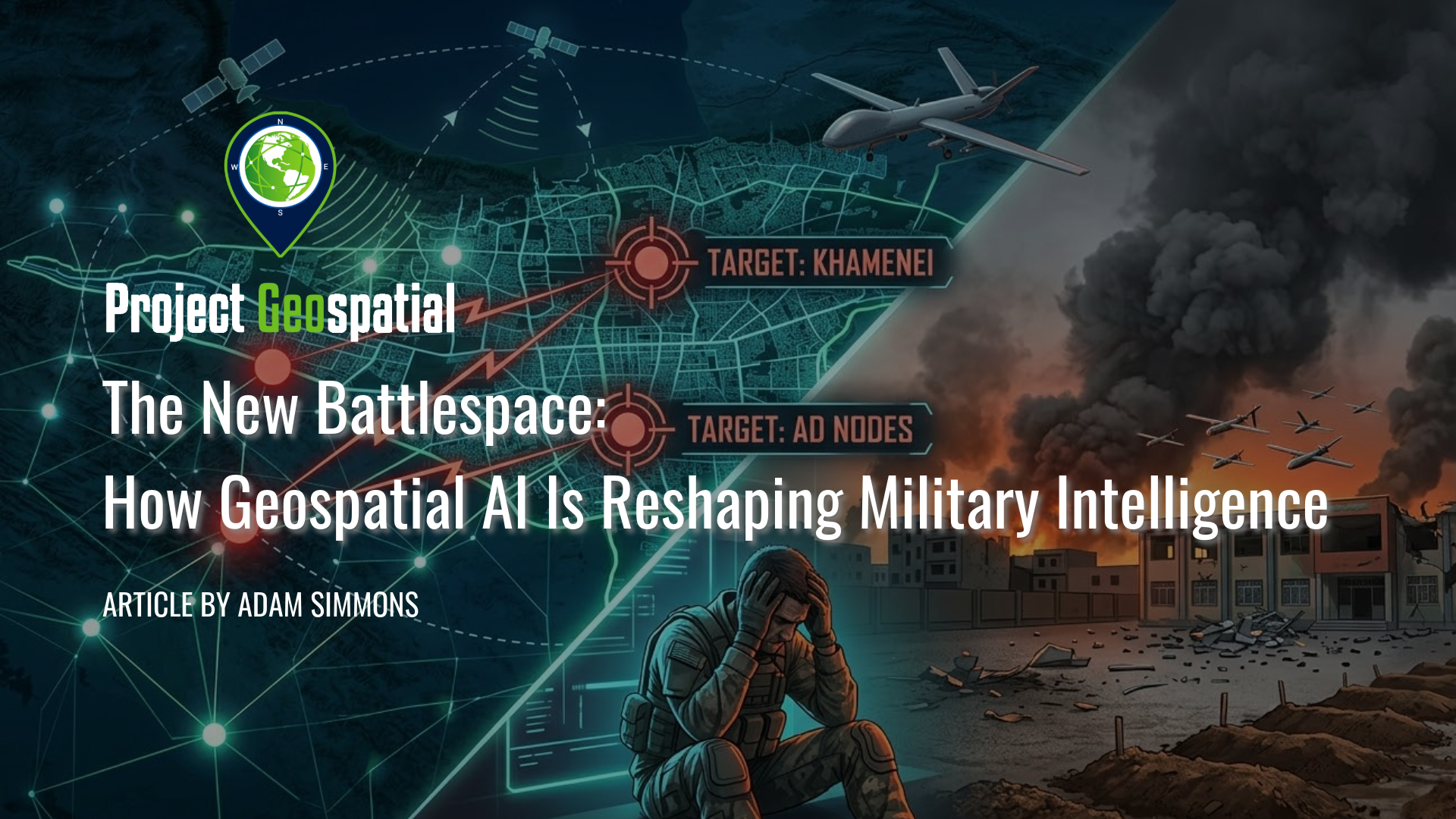
The New Battlespace: How Geospatial AI Is Reshaping Military Intelligence
The 2026 conflict in Iran marks a terrifying turning point in military history: the birth of the algorithmic battlespace. Through Operation Epic Fury, the United States and Israel have deployed a "kill web" driven by Geospatial AI, compressing decision-making from weeks to mere seconds. While systems like Project Maven and autonomous drone swarms offer unprecedented tactical precision, the human cost remains devastatingly high, evidenced by the tragic Minab school bombing and the growing psychological toll on remote operators. As Silicon Valley giants like Anthropic and Palantir clash over the ethics of AI-driven warfare, the world faces a fractured global economy and a new reality where machine-speed violence outpaces human thought.

The Artificial Intelligence and Machine Learning Imperative: Filtering the Noise
Today's intelligence, surveillance, and reconnaissance (ISR) community faces a critical crisis: analysts are drowning in exponential volumes of sensor data from the expanding Internet of Battle Things (IoBT), leading to severe cognitive overload and missed threats in contested environments. The imperative solution is the rapid integration of Artificial Intelligence (AI) and Machine Learning (ML) to filter noise and automate multi-source sensor fusion. This article explores how leveraging edge processing and AI-driven workflows—exemplified by DARPA programs and innovations from BAE Systems, Esri, and Palantir—can transform overwhelmed analysts into agile decision-makers, securing information dominance against increasingly sophisticated adversaries.