

GEOSPATIAL FRONTIERS
A Publication by Project Geospatial
LOOKING BEYOND
THE MAP
Geospatial Frontiers, a new publication from Project Geospatial, brings together leading voices and experts from across the geospatial ecosystem to tackle the industry's most pressing challenges. Through in-depth articles and discussions, Geospatial Frontiers aims to explore innovative solutions and spark critical conversations that will shape the future of geospatial technology and its applications.
Contributing Authors






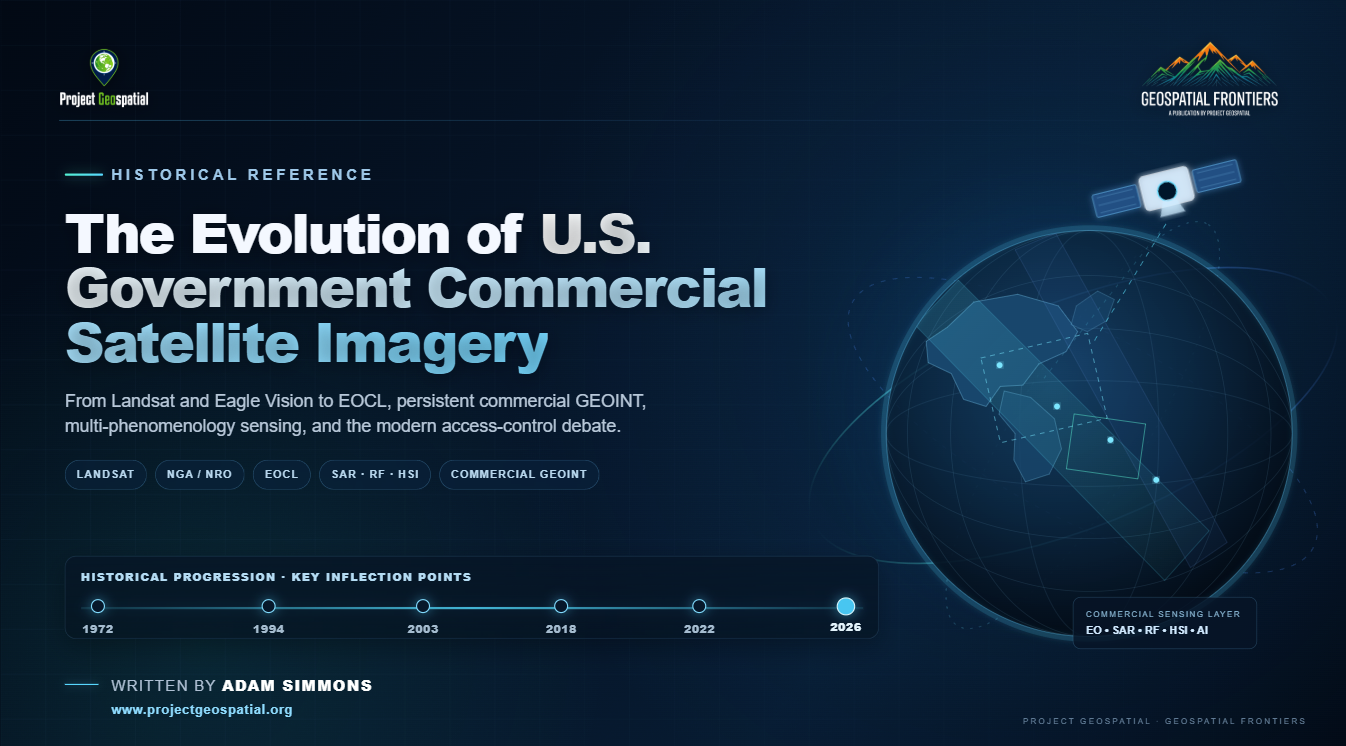
The Evolution of Commercial Satellite Imagery in the U.S. Government
Commercial satellite imagery has evolved from a tightly controlled national-security capability into a foundational layer of the modern U.S. geospatial intelligence architecture. This historical overview traces that transformation from Landsat, EOSAT, Eagle Vision, and the early commercialization experiments through ClearView, NextView, EnhancedView, EOCL, and today’s expanding commercial sensing ecosystem of optical imagery, SAR, hyperspectral, radio frequency, AI, and analytics. It also examines the policymakers, intelligence leaders, scientists, companies, and acquisition strategies that helped build the government-commercial partnership—and the emerging 2026 debate over access, managed distribution, national security, and how the United States governs an increasingly global and commercially driven GEOINT environment.
Strategic Analysis of the 2026 National Security Science and Technology Strategy: Implications for the Geospatial Enterprise
The 2026 National Security Science and Technology Strategy (NSSTS) is fundamentally reshaping the commercial and defense geospatial industries. As the U.S. government prioritizes techno-strategic competition and battlefield dominance, geospatial firms are positioned to benefit from massive new funding mandates and agile procurement vehicles like the National Geospatial-Intelligence Agency's Luno contracts. However, these unprecedented economic tailwinds are accompanied by a complex regulatory minefield. From the rising demand for AI-driven analytics and unclassified proliferated low-Earth orbit (pLEO) satellite architectures to the severe data decoupling mandates of the Department of Justice's Data Security Program, discover how the new NSSTS forces the geospatial sector to adapt to an aggressive new era of national security.

Integrating Commercial and Government Software for GEOINT Superiority: A Strategic Framework for Congress and Senior DoW/IC Leaders
The GOTS Dilemma: Is the DoW Finally Ready for a Commercial-First Reality? Read Keith Barber's unfiltered white paper on the systemic failures of government software acquisition (GOTS) and the urgent need for the Department of War (DoW) to embrace a commercial-first (COTS) strategy. Barber argues that duplicating commercial tech is a strategic risk, hindering lethality and speed in the geospatial intelligence ecosystem. Dive into the full analysis and our exclusive "So What" breakdown to understand how Secretary Hegseth's new directives could reshape the future of GEOINT and defense contracting below.
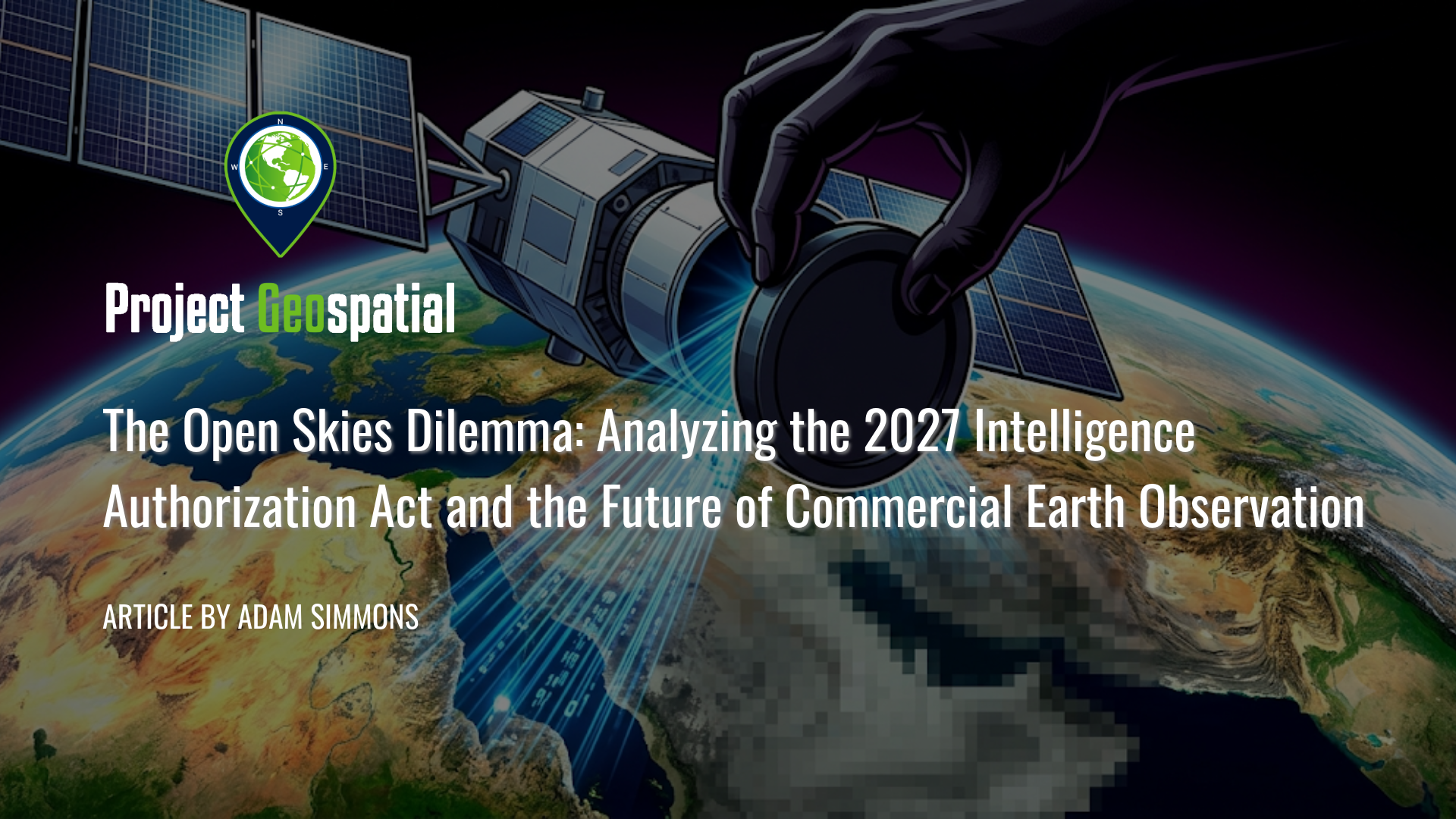
The Open Skies Dilemma: Analyzing the 2027 Intelligence Authorization Act and the Future of Commercial Earth Observation
The 2027 Intelligence Authorization Act (H.R. 9624) aims to mandate strict blackouts on U.S. commercial satellite imagery in the name of national security. However, in an era of global orbital abundance, this proposed government censorship threatens to cripple open-source intelligence (OSINT), betray the democratic spirit of the First Amendment, and cede America's Earth observation dominance to foreign competitors. Discover why weaponizing federal contracts to force "orbital blindness" is a profound strategic and moral miscalculation.

Nation at a Crossroads: FY2026 Budget Proposal Threatens to Dismantle U.S. Geospatial Supremacy, Risking Economic and Infrastructural Integrity
A stark vision for America's fiscal future now casts an ominous shadow, as the proposed Fiscal Year 2026 budget threatens a veritable demolition of non-defense federal capabilities, launching an unprecedented assault on the agencies underpinning our nation's world-leading geospatial infrastructure with a staggering $163 billion targeted for removal from base non-defense spending . This plan strikes at the heart of essential government functions, and even as it calls for "unprecedented increases for defense" , the National Geospatial-Intelligence Agency (NGA) faces a deep paradox: its direct appropriations may rise, but devastating cuts to civilian partners like NOAA, NASA, and USGS threaten to hamstring its operational effectiveness, potentially forcing NGA to divert its own increased budget to backfill widening data gaps and maintain "GEOINT Supremacy" with a critically weakened foundational support system. The reverberations are already palpable, and as the geospatial community prepares for the annual GEOINT Symposium in St. Louis, all eyes will be on leaders like NGA Director Vice Admiral Frank Whitworth and Director of National Intelligence Tulsi Gabbard, as an industry on edge desperately seeks clarity and a beacon of confidence to navigate these profoundly troubled times.
Open Source Geospatial Takes Center Stage for Resilience at FedGeoDay 2025
FedGeoDay 2025, held April 22nd in Washington D.C., was a packed and energized convergence of over 200 geospatial experts dedicated to a vital mission: building resilience through open source tools and data. Project Geospatial's coverage of the event revealed a community deeply committed to collaboration, showcasing everything from NASA's critical Earth observation data applications and foundational government datasets like USGS's 3DAP to the complexities of AI reliability, the dynamics of open data initiatives like OpenStreetMap and Overture Maps, and the necessity of robust cybersecurity. The day underscored the immense potential of open geospatial solutions in facing increasing challenges and the collective effort required to harness their power for societal benefit. The palpable energy and high turnout signaled a community ready to tackle complex problems together, leveraging open platforms for a more resilient future.