


GEOSPATIAL FRONTIERS
A Publication by Project Geospatial
LOOKING BEYOND
THE MAP
Geospatial Frontiers, a new publication from Project Geospatial, brings together leading voices and experts from across the geospatial ecosystem to tackle the industry's most pressing challenges. Through in-depth articles and discussions, Geospatial Frontiers aims to explore innovative solutions and spark critical conversations that will shape the future of geospatial technology and its applications.
Contributing Authors






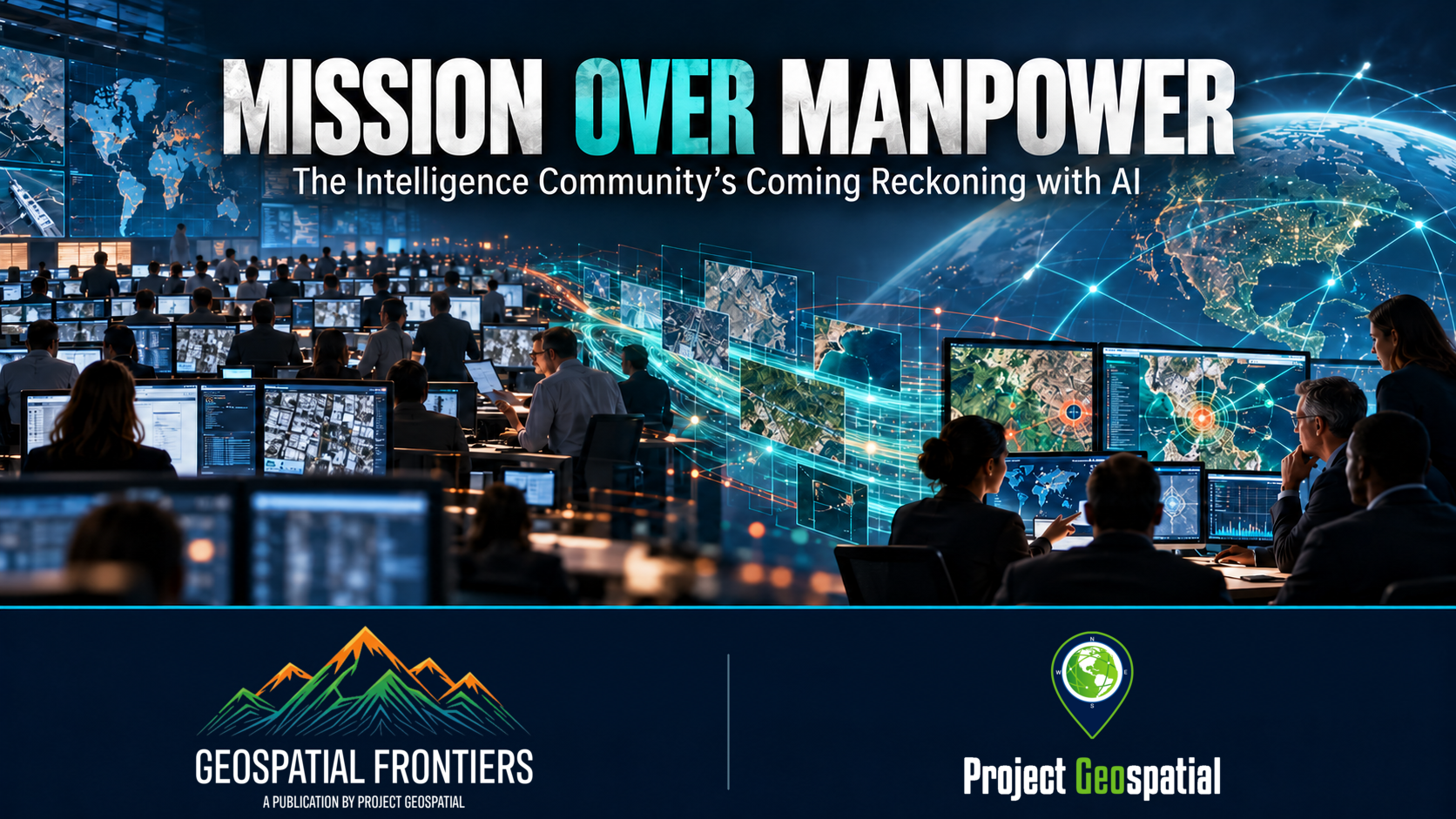
Mission Over Manpower: The Intelligence Community's Coming Reckoning with AI
Artificial intelligence is forcing a reckoning across the U.S. Intelligence Community, challenging decades of workforce expansion built around growing intelligence collection and data demands. Drawing on firsthand GEOINT experience and a recent USGIF Mission Focus discussion, Adam Simmons examines how the intelligence lifecycle has evolved into a manpower-intensive architecture of analysts, production teams, quality-control layers, and organizational handoffs. From NGA and the military services to combatant commands and national intelligence agencies, AI threatens to fundamentally reshape analytical roles, institutional tradecraft, and the economics of intelligence production. Over the next five to ten years, can the Intelligence Community prioritize mission effectiveness, accountability, and taxpayer stewardship while confronting the uncomfortable reality that a more capable intelligence enterprise may require substantially fewer analysts?

The Evolution of Commercial Satellite Imagery in the U.S. Government
Commercial satellite imagery has evolved from a tightly controlled national-security capability into a foundational layer of the modern U.S. geospatial intelligence architecture. This historical overview traces that transformation from Landsat, EOSAT, Eagle Vision, and the early commercialization experiments through ClearView, NextView, EnhancedView, EOCL, and today’s expanding commercial sensing ecosystem of optical imagery, SAR, hyperspectral, radio frequency, AI, and analytics. It also examines the policymakers, intelligence leaders, scientists, companies, and acquisition strategies that helped build the government-commercial partnership—and the emerging 2026 debate over access, managed distribution, national security, and how the United States governs an increasingly global and commercially driven GEOINT environment.