
Elevation and Friction 2026: A Comprehensive Narrative of the Colorado Front Range Geospatial and Space Tech Ecosystem
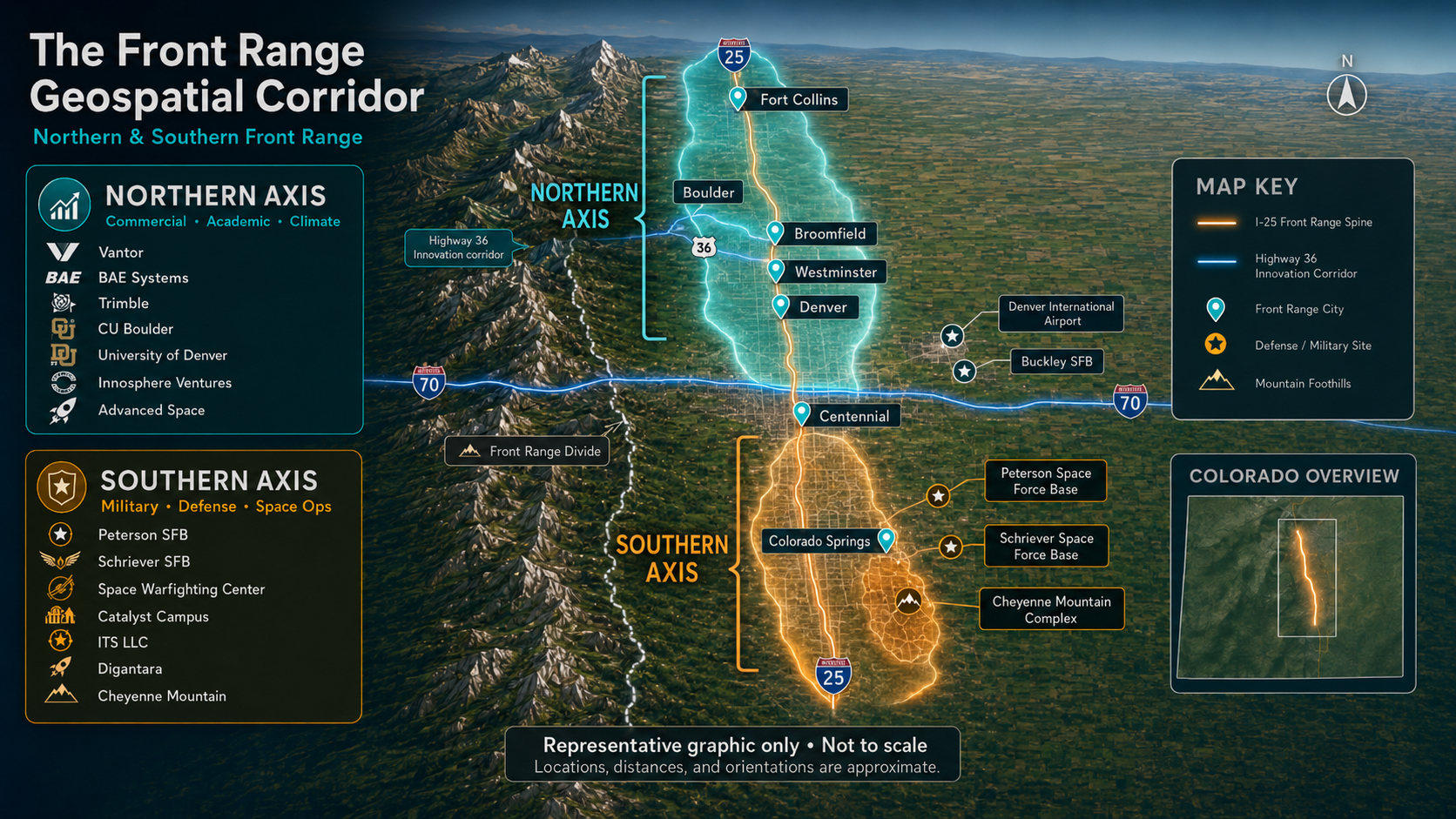
Stretching across the high-altitude valleys of the Front Range, Colorado’s geospatial and defense corridor has established itself as a premier global hub for location science, remote sensing, and orbital intelligence. Along the critical Highway 36 corridor connecting Denver with Westminster, Broomfield, and Boulder, thousands of spatial analysts, software engineers, and data scientists are driving breakthrough innovations in commercial Earth observation and tactical space intelligence. Unlike regional models built around a single, massive federal footprint, such as the centralized investments anchoring Midwestern technology hubs like St. Louis, Colorado has pioneered a highly diversified, private-sector-led ecosystem that is sprawling, decentralized, and commercially resilient.
This market-driven approach has elevated Colorado to the nation's second-largest space economy, supporting a robust network of more than 2,000 aerospace and defense enterprises. Together, these organizations employ over 55,000 specialized professionals directly, while sustaining an additional 184,000 indirect jobs. Over the past five years, the state's private aerospace and defense sector has expanded by a remarkable 26.3%, fueled by a cumulative $15 billion in private equity, venture funding, and federal contract awards. In terms of capital investment directed toward space-based technologies and remote sensing applications, the Denver-Aurora-Lakewood metropolitan area ranks second nationally, cementing its status as an essential engine for national defense and environmental monitoring.
THE FRONT RANGE GEOSPATIAL CORRIDOR
Northern Axis: Commercial, Academic, Climate
Westminster, Boulder, Broomfield, Fort Collins
Vantor (Maxar), BAE, Trimble, CU Boulder, DU
Southern Axis: National Security & Space Command
Colorado Springs (Peterson SFB, Schriever SFB)
Space Warfighting Center, Catalyst Campus, ITS LLC
Yet, beneath this polished narrative of high-growth technology lies a series of complex cultural, geographic, and economic challenges. The Front Range geospatial corridor operates as a divided giant, separated by a physical distance of 70 miles and a deep institutional gap. In the north, Boulder and Westminster focus heavily on commercial Earth observation, climate monitoring, and venture-backed software systems. In the south, Colorado Springs operates in a highly classified, military-centric orbit, anchored by five active defense installations and hardened Cold War legacies.
At the same time, the region is facing acute socio-economic pressures. A severe housing crisis is driving up costs and pricing out young talent, while a tightening workforce deficit is forcing corporate giants and defense contractors to scramble for cleared engineering labor. As the Front Range navigates this period of high-velocity growth, its regional leaders must confront a fundamental question: Can this high-altitude ecosystem bridge its internal divisions and support its workforce, or will its momentum be stalled by its own economic friction?
The Historic Bedrock: From Cold War Silos to Lunar Orbits
The modern dominance of the Front Range in location science and space systems is deeply tied to its historical defense infrastructure. This legacy is preserved at Weld County’s Missile Site Park, located just an hour's drive north of Denver. Here, Ken Robinson, the site's dedicated caretaker, guides visitors through the underground concrete corridors of a decommissioned Atlas E intercontinental ballistic missile site. Active during the height of the Cold War and decommissioned in 1965, these underground bunkers were built to withstand nuclear strikes. They housed massive missiles carrying 4.4-megaton warheads, operated out of F.E. Warren Air Force Base.
"This of course is the entrance to the site," Robinson explains during his guided tours of the facility, pointing toward the long concrete corridors that connect the command center with the missile maintenance bay. "We are walking the whole length of an Atlas missile. This was a dangerous and scary time in our nation's history."
While these decommissioned silos are now used for commercial storage, county utility yards, or historic tourism, the underlying geographic demand for secure, high-altitude communications and aerospace defense has remained. This geographic advantage is anchored by the Cheyenne Mountain Complex in El Paso County, an underground bunker blasted into 693,000 tons of solid granite. Established in 1966 as the combat operations center for the North American Aerospace Defense Command (NORAD), this highly secure facility pioneered the automated, real-time evaluation of aerospace surveillance data.
THE EVOLUTION OF SPATIAL INGENUITY
Legacy Foundation: Defense & Cold War
Atlas E ICBM Silos (Weld/Larimer Counties)
Cheyenne Mountain Complex NORAD Combat Ops
Modern Era: Global & Lunar Frontier
Advanced Space, Vantor, Space Force Headquarters
CAPSTONE lunar satellite mission control
This historic defense infrastructure laid the foundation for Colorado's transition into a commercial space and geospatial powerhouse. Westminster, once known for its dairy farms and cattle ranches, has transformed into a high-tech hub housing some of the brightest minds in spatial intelligence. This transition is led by Advanced Space, a Westminster-based company founded in a Boulder condo loft in 2011 with a mission to enable sustainable space exploration, development, and settlement. Now employing over one hundred specialists off Interstate 25 and 120th Avenue, Advanced Space designs, simulates, and operates complex space missions directly from its Westminster facilities.
Advanced Space is famous for operating the CAPSTONE satellite (Cislunar Autonomous Positioning System Technology Operations and Navigation Experiment). This microwave-sized spacecraft, orbiting the moon for three years, was the first commercially owned satellite to operate at the moon and the first part of NASA's Artemis program. CAPSTONE served as a critical pathfinder, proving that a near-rectilinear halo orbit could be achieved to lay the groundwork for NASA's future astronaut-housing space station.
"We weren’t billionaires, so we couldn’t afford to start building rockets," says Brad Cheetham, co-founder, CEO, and president of Advanced Space. "Instead, we focused on building orbits and tools and providing value in other ways." Discussing Colorado’s low-profile tech success, Cheetham remarks, "Aerospace is the best-kept secret in Colorado. We need to make it less of a secret".
The Commercial Axis: Vantor, BAE Systems, and Trimble
The northern corridor of the Front Range serves as the commercial brain of the regional ecosystem. This axis is anchored by major corporate mergers, acquisitions, and strategic consolidations that have fundamentally altered the landscape of spatial intelligence.
At the center of this commercial core is Vantor, the Westminster-based spatial intelligence giant formerly known as Maxar Intelligence. Following its $6.4 billion acquisition by the private equity firm Advent International in 2023, Maxar was split into two business units. Maxar Space Infrastructure moved its headquarters to Silicon Valley, while Maxar Intelligence remained in Westminster and rebranded as Vantor, signaling its evolution from a traditional satellite imagery provider into an end-to-end spatial intelligence company.
Vantor’s regional footprint was strengthened in June 2026 through a major partnership with BAE Systems Space & Mission Systems. BAE Systems established its local presence in February 2024 through the $5.5 billion acquisition of Ball Aerospace and Technologies Corporation, creating its new Space & Mission Systems business unit headquartered in Broomfield. Under the June 2026 agreement, BAE Systems will manufacture, integrate, and test the satellite buses for Vantor’s upcoming Vantage 20 cm-class imaging satellites.
"We are entering a new era of imaging satellite production that is based on a long and successful history of delivering space vehicles for Vantor programs," says Brad Shogrin, Vice President at BAE Systems.
Matt Jenkins, Chief Space Systems Officer at Vantor, echoes this sentiment: "As demand accelerates for more responsive space-based intelligence, we're investing in expanding our constellation capabilities to strengthen the spatial foundation that represents our living digital twin of Earth."
This commercial activity is further supported by BAE Systems’ massive regional footprint, which includes nearly 2 million square feet of development, manufacturing, and test space across Boulder, Broomfield, and Westminster. The Westminster campus spans nearly 800,000 square feet and is optimized for high-volume tactical product manufacturing. The Broomfield headquarters was recently expanded to include a state-of-the-art payload development facility, a cleanroom, and a Mission Support Center that provides post-launch support for deep-space and civilian science missions.
THE NORTHERN COMMERCIAL LOOP
Trimble Inc.
Hardware & Spatial InfrastructureBroomfield (HQ), Boulder, Westminster
2,000,000+ sq ft footprint
Vantor
Formerly Maxar IntelligenceWestminster Headquarters
20 cm-class Earth imaging & tactical spatial analytics
Just down the road in Westminster, Trimble Inc. anchors the geomatics, mapping, and asset-tracking sectors of the ecosystem. Trimble relocated its global headquarters from Sunnyvale, California, to Westminster in late 2022, bringing a massive portfolio of hardware, software, and SaaS solutions to the local market. Now an S&P 500 component with $3.59 billion in annual revenue and 11,500 employees globally, Trimble integrates advanced sensors, cloud computing, and artificial intelligence into construction, agriculture, forestry, and transportation workflows. Trimble’s partnership with NVIDIA to provide model data for the Omniverse RTX viewers, alongside its integration of Spot, Boston Dynamics’ robotic dog, into construction workflows, demonstrates how the northern axis merges spatial modeling with advanced automation.
This synergy between mapping data and machine intelligence marks a profound structural shift as the Front Range pivots toward a GeoAI-first paradigm. The velocity of this transition is starkly visible in local adoption metrics, with Boulder County leading the state with a 43.7% generative AI diffusion rate , followed closely by Broomfield at 38.8% , Denver at 34.4% , and El Paso County at 34.2%. To sustain this competitive edge and address the management gaps within this rapidly evolving sector, the World Geospatial Industry Council is launching the world's first professional Doctorate of Geospatial Leadership in Summer 2027. Developed in partnership with Clark University and the University of Southern California, this online, cohort-based program is specifically designed to arm mid-career executives with the precise technical and leadership competencies needed to command automated, spatial intelligence enterprises.
The following table provides a structured overview of the major commercial and industrial anchors that dominate the northern Front Range corridor:
| Company / Anchor Name | Core Area of Specialization | Scale & Segment | Regional Footprint & Core Activities |
|---|---|---|---|
| Advanced Space | Mission planning, orbital design, and autonomous spacecraft operations. | Mid-Sized Enterprise | Headquartered in Westminster; operates NASA's lunar CAPSTONE pathfinder satellite. |
| BAE Systems Space & Mission Systems | Spacecraft, payload development, and tactical hardware manufacturing. | Multinational Defense | Headquartered in Broomfield, with massive campuses in Boulder and Westminster. |
| L3Harris Technologies | Electro-optical/infrared payloads, space antennas, and environmental sensing. | Public Defense Contractor | Payload engineering facilities in Boulder and Lafayette; develops geospatial processing software. |
| Lockheed Martin | Manned spacecraft (Orion), satellites, and deep-space military platforms. | Prime Contractor | Major campuses in Littleton, Boulder, and Colorado Springs. |
| Northrop Grumman | Aerospace structures, tactical satellites, and defense technologies. | S&P 100 Prime | Major operating locations in Boulder, Westminster, and Aurora (Buckley corridor). |
| Raytheon Technologies (RTX) | Ground-system architectures, mission management, and spatial analytics. | Public Defense Aerospace | Massive workforce concentrations in Aurora and Westminster; manages satellite data pipelines. |
| Sierra Space | Spaceplanes (Dream Chaser), commercial space stations, and infrastructure. | High-Growth Private Prime | Headquartered in Louisville; operates testing, design, and assembly operations along US-36. |
| Spire Global | Maritime, aviation, and weather tracking via proprietary CubeSat constellation. | Public Space-Data Provider | Maintains a major satellite operations, software engineering, and data science hub in Boulder. |
| Trimble Inc. | Geomatics, mapping, surveying software, and industrial automation. | Public (S&P 500) | Headquartered in Westminster; manages advanced software-hardware integrations. |
| United Launch Alliance (ULA) | Orbital launch vehicles (Vulcan, Atlas), space transportation, and operations. | Joint Venture | Headquartered in Centennial; houses baseline system engineering and launch mission control. |
| Ursa Major | Advanced rocket engines and hypersonic propulsion systems. | Venture-Backed Growth | Headquartered in Berthoud; designs, manufactures, and tests 3D-printed rocket engines locally. |
| Vantor (Formerly Maxar Intelligence) | High-resolution satellite imagery and end-to-end spatial analytics. | Private Equity Enterprise | Headquartered in Westminster; specializes in 20 cm-class Earth observation systems. |
| York Space Systems | Rapid-delivery small satellite manufacturing and constellation operations. | Mid-Market High-Growth | Headquartered in Denver; manufactures standardized, low-cost spacecraft platforms. |
The Classified Shield: Colorado Springs and Space Defense
While the northern Front Range drives commercial technology, the southern axis in El Paso County serves as the nation’s shield. Centered in Colorado Springs, this classified defense and military aerospace corridor contributes an estimated $3.1 billion to the local economy annually. Colorado Springs is home to five major military installations, including Peterson Space Force Base and Fort Carson, along with the United States Space Force headquarters and the historic Cheyenne Mountain Complex.
The Epicenter of Space Defense: Command and Control Anchors
The operational backbone of this military corridor relies on a dense, interconnected network of space command installations. t the forefront, Peterson Space Force Base and Schriever Space Force Base function as primary hubs for baseline military infrastructure, command and control, and specialized space operations. This defensive network is anchored by the Cheyenne Mountain Complex, a combat operations facility blasted into 693,000 tons of solid granite that historically pioneered the real-time, automated evaluation of aerospace surveillance data for NORAD. Alongside Buckley Space Force Base, these critical installations form an unyielding national security matrix, transforming the Front Range from a regional tech cluster into the premier global engine for tactical space intelligence and orbital defense.
The strategic architecture of this defense hub was further strengthened through the establishment of the Space Warfighting Center (SWC) by the Aerospace Corporation in 2022. Located at Getting Heights in Colorado Springs, the SWC is a highly secure facility designed specifically for modeling, simulation, and wargaming in a contested space domain. The SWC hosts collaborative space defense exercises with military and government partners at the highest classification levels, utilizing high-fidelity physical modeling to evaluate advanced space battle constructs.
This robust military presence has triggered a significant influx of foreign and domestic investment, with private companies actively scaling their operations to be closer to their primary Department of Defense customers. In February 2025, Indian space surveillance and intelligence firm Digantara announced plans to invest $35 million to establish its first U.S. base in Colorado Springs. The company is building a state-of-the-art Satellite Assembly, Integration, and Testing (AIT) facility to manufacture its patented space-to-space tracking payloads locally, catering directly to the intelligence, surveillance, and reconnaissance (ISR) needs of U.S. defense agencies.
"Colorado stands at the heart of the U.S. aerospace-defense ecosystem, making it the perfect base for Digantara," says Anirudh Sharma, CEO of Digantara. "Here, we aim to collaborate with the U.S. aerospace and defense community locally, advancing global space security through innovation and partnership."
THE SOUTHERN MILITARY AXIS
Military Bases
Peterson & Schriever SFBBase infrastructure supporting global operations
Command & Control (C2), US Space Force Strategic Assets
Space Warfighting Center
Tactical Operations (SWC)Modeling, advanced orbital simulation, and hardware-in-the-loop tracking
High-security wargaming and space domain threat response
Catalyst Campus
Commercial Tech Innovation HubSatellite AIT Facility installation
Infrastructure growth adding 500+ new tactical aerospace engineering jobs
Concurrently, Colorado Springs-based defense contractors are experiencing explosive growth. ITS, LLC (also known as Infinity Technology Services or ITS Aerospace), a minority-owned, certified Service-Disabled Veteran-Owned Small Business founded in 2017, announced a major $7.05 million expansion of its corporate headquarters. Led by President and CEO Hassan Campbell, an Air Force Academy graduate, ITS is creating 500 new high-paying aerospace, cybersecurity, and software engineering jobs in Colorado Springs with an average annual salary of $130,482, nearly double the county average.
"I came to Colorado Springs in 1997 to go to the Air Force Academy, and after my service, I thought no better way to give back to the veteran community than to create an environment that really values the commitment and sacrifice they've made," says Campbell, noting that 76% of his team are veterans. Commenting on his company's national defense mission, he adds, "They’re not only good jobs, they’re jobs we can feel good about in terms of the mission-driven goals we have here".
The following table provides a detailed breakdown of the primary defense, space operations, and military contracting systems that define the southern Front Range axis:
| Organization / Company | Mission & Specialization | Scale & Segment | Regional Footprint & Key Assets |
|---|---|---|---|
| Boecore | Missile defense, space operations command, cyber security, and enterprise software. | Mid-Market Defense | Headquartered in Colorado Springs; primary contractor supporting USSF and MDA. |
| Braxton Technologies (Parsons) | Spacecraft ground control systems, command & control (C2), and telemetry. | Prime Subsidiary | Significant software engineering and integration labs in Colorado Springs. |
| Digantara | Space situational awareness and space-to-space orbital tracking. | International Space Surveillance | $35 million satellite assembly and integration facility in Colorado Springs. |
| ITS, LLC | Cybersecurity, Systems Engineering, Space Ops, and Command & Control. | Veteran-Owned SDVOSB | Corporate headquarters and secure software facilities in Colorado Springs. |
| Kratos Space & Missile Defense | Satellite ground systems, RF signal monitoring, and telemetry tracking (TT&C). | Public Defense Provider | Multi-facility campus in Colorado Springs supporting Space Force orbital networks. |
| L3Harris Technologies | Space superiority assets, payload integration, and command system maintenance. | Public Defense Prime | Colorado Springs hub focused on tactical space control and situational awareness. |
| LinQuest Corporation | Space systems engineering, operational training, and military satellite communications. | Private Defense Partner | Massive engineering services presence in Colorado Springs supporting Space Operations Command (SpOC). |
| Lockheed Martin (C2BMC Hub) | Command, Control, Battle Management, and Communications engineering. | Prime Contractor | Colorado Springs campus dedicated heavily to MDA wargaming, C2BMC, and USSF programs. |
| Northrop Grumman Space Systems | Missile defense modeling, operational logistics, and tactical space support. | S&P 100 Defense Prime | Massive engineering workforce in Colorado Springs supporting Schriever SFB and Peterson SFB. |
| Sanborn Map Company | Transforming spatial data into highly detailed 2D/3D maps and elevation models. | Advanced Commercial Mapping | Production and software center located in Colorado Springs. |
| Space Warfighting Center (SWC) | Modeling, physics-based simulation, and space battle wargaming. | Government FFRDC | Multi-building secure facility located at Getting Heights, Colorado Springs. |
| Trace3 Gov / Bluestaq | Advanced cybersecurity, data management, and enterprise tech solutions. | High-Growth Defense Tech | Expanding operations and SCIF footprints in the Pikes Peak region. |
The Capital Engine: Startups, Climate Sensing, and Commercialization
A primary differentiator between the mature Colorado ecosystem and the transitional St. Louis market is the sheer scale and velocity of commercial start-up capital. In 2025, Colorado startups raised a staggering $7.46 billion in venture capital investments, marking the second-highest funding year on record. Unlike other states where capital is consolidated inside a single dominant city, Colorado’s venture capital is dynamically distributed. Denver startups secured $2.2 billion, while the smaller, research-dense community of Boulder pulled in $2.1 billion.
Crucially, 78% of all statewide venture capital deal activity is concentrated in growth industries, including SaaS, clean technology, climate technology, quantum systems, and aerospace. This capital-rich environment has allowed local companies to scale rapidly. Enveda Biosciences, a biotechnology firm based in a Boulder lab, achieved coveted "unicorn" status in 2025 following a $150 million Series D funding round.
Rather than relying on a top-down, managed civic hierarchy, Colorado’s startup engine is powered by a highly decentralized network of accelerators, research universities, and specialized industry groups:
Innosphere Ventures and the Earth and Space Systems Accelerator
Headquartered in Fort Collins, Innosphere Ventures combines incubation and acceleration, bypassing rigid, short-term cohort structures in favor of rolling admissions, flexible timelines, and physical dry and wet laboratory rentals. Innosphere has supported over 200 companies, with its alumni raising more than $1 billion in follow-on capital.
In 2025, Innosphere launched the Earth and Space Systems Accelerator, welcoming 14 startups into an eight-month program running through May 2026. Innosphere also leads the National Science Foundation (NSF) ASCEND Engine initiative. This program provides critical translation grants to commercialize breakthrough Earth-sensing technologies, such as Colorado State University's RADSENSE Project, which utilizes deep learning to forecast wildfire smoke in real-time.
This collaborative model illustrates how the Northern Axis treats environmental tracking not merely as a civic responsibility, but as a primary commercial data market. By utilizing the National Science Foundation's ASCEND Engine initiative, regional accelerators are able to provide critical translation grants that convert complex academic research directly into viable commercial software. Programs like the RADSENSE Project demonstrate that integrating deep learning with remote sensing instrumentation creates immediate economic and operational value. By funding the commercialization of real-time predictive models for atmospheric anomalies and wildfire smoke behavior, the Front Range startup pipeline effectively bridges the gap between high-altitude laboratory data and actionable commercial intelligence.
The commercial climate data pipeline is structurally reinforced by a dense concentration of world-class federal research complexes anchored in Boulder, most notably the National Oceanic and Atmospheric Administration (NOAA) and the National Center for Atmospheric Research. These institutions function as massive operational anchors for the northern corridor's remote sensing ecosystem, ingesting petabytes of continuous orbital telemetry and environmental sensor feeds to model global atmospheric dynamics and space weather. By serving as primary open-access data repositories and collaborative laboratories, they provide the raw informational fuel and specialized atmospheric data scientists that local climate-tech startups and aerospace giants rely upon to innovate downstream tracking applications.
THE COLORADO STARTUP VENTURE PIPELINE
Academic & Research Foundations
Talent & IP GenerationCU Boulder Smead Aerospace (RSESS Program)
University of Denver GIS Labs
Incubation & Acceleration
Ecosystem Go-To-Market SupportInnosphere Ventures: Earth & Space Systems
Catalyst Accelerator (Space Force / AFRL)
Step One 2 Launch: Aerospace-defense tech hub
Institutional Capital Deployment
Scale & Market ExpansionRaised by Colorado startups in 2025
Concentrated directly in deep-tech growth sectors
The Catalyst Accelerator and the TAP Lab Project Apollo
Located at the Catalyst Campus for Technology and Innovation in Colorado Springs, this 90-day, non-equity-taking accelerator is funded by the Air Force Research Laboratory Space Vehicles Directorate and the U.S. Space Force. It connects deep-tech startups directly to the military procurement pipeline, feeding commercial technologies into the Space Domain Awareness Tools, Applications, and Processing (SDA TAP) Lab's Project Apollo.
This federal integration was expanded through an OEDIT grant in June 2024 to accelerate the transition of space battle management software into the National Space Defense Center. In tandem, the Space Force's Commercial Space Office (COMSO) manages a digital "Front Door" platform to streamline communication and lower the bureaucratic barriers that historically prevented commercial vendors from bidding on defense contracts.
Step One 2 Launch and Infrastructure-Ready Spaces
In Centennial, private enterprise is actively addressing the physical constraints of scaling early-stage hardware. Step One 2 Launch recently opened a 22,000-square-foot "command center" on South Tucson Way. Co-founded by entrepreneur Kenneth Guyer, this shared engineering space provides small startups, makers, and inventors with highly specialized infrastructure. The facility features anti-static flooring, assembly benches, specialized tool kits, and hot desks. This shared environment is designed to help small businesses survive the costly transition from an initial software-hardware concept to a flight-ready physical product, acting as a critical supplier pipeline for massive regional prime contractors like Lockheed Martin and United Launch Alliance.
Academic Engines and Workforce Specialization
The state’s research universities feed this capital engine with a continuous flow of intellectual property and trained labor. CU Boulder’s Smead Department of Aerospace Engineering Sciences focuses heavily on its Remote Sensing, Earth and Space Sciences (RSESS) specialization. This program blends instrumentation, physical data analysis, and astrodynamics to train the next generation of remote sensing scientists. CU Boulder ranks first nationally for university-based startup creation, launching 35 new startups in 2025 alone and generating a massive $8 billion in economic impact.
Meanwhile, the University of Denver’s GIS Labs provide deep-level technical training in Global Navigation Satellite Systems (GNSS), digital image processing, and drone-based mapping. Extending this academic matrix, the Colorado School of Mines in Golden injects a highly specialized focus on advanced geological remote sensing, subterranean mapping, and space resources exploration. Mines uniquely bridges the gap between traditional earth sciences and orbital intelligence, training specialists to apply complex spatial data to critical mineral discovery, civil engineering, and planetary surface mapping. This academic anchor operates in close functional alignment with the United States Geological Survey, which houses its National Geospatial Technical Operations Center in Lakewood. As the federal entity responsible for managing The National Map and the 3D Elevation Program, the United States Geological Survey acts as a foundational data producer for the entire regional ecosystem, anchoring Colorado's baseline spatial infrastructure and fostering deep collaborative data pipelines with local universities and private enterprises alike.
To bridge the management gap identified within this rapidly scaling sector, the World Geospatial Industry Council (WGIC), led by Executive Director Aaron Addison, announced the launch of the world's first professional Doctorate of Geospatial Leadership (DGEO). Set to debut in Summer 2027 in partnership with Clark University and USC, the online, cohort-based program is designed to equip mid-career managers with the precise technical and executive skills required to lead "GeoAI-first" enterprises.
The following table details the primary startup accelerators and business development programs that support the commercialization pipeline across the Front Range:
| Program / Hub | Primary Target & Specialization | Equity / Fee Structure | Key Initiatives & Focus Areas |
|---|---|---|---|
| Advanced Industries Accelerator (OEDIT) | Early-stage aerospace, geospatial, energy, and advanced manufacturing companies. | 0% Equity (State Grant) | Direct commercialization grants up to $250,000 to help startups scale hardware and algorithms. |
| Ascent Deep Tech | Commercializing physical sciences, robotics, and clean energy from universities. | 0% Equity (University) | 4-month program designed specifically for CU-affiliated research and spinoffs. |
| Catalyst Accelerator | Defense, space operations, cybersecurity, and dual-use systems. | 0% Equity (Non-Dilutive) | 90-day program feeding technologies into Space Force and AFRL TAP Lab. |
| Innosphere Ventures | Science, cleantech, earth systems, and space-based hardware. | Seed Capital / Varies | Earth and Space Systems Accelerator; leads NSF ASCEND deep-tech commercialization. |
| NREL Innovation Incubator (IN2) | Cleantech, microgrids, and spatial energy mapping applications. | 0% Equity (By Invitation) | Multi-million dollar incubator validating clean-tech hardware in partnership with Golden labs. |
| Rocky Mountain Cleantech Initiative | Spatial environmental analytics, forestry tracking, and climate monitoring systems. | 0% Equity (Mentorship) | Located in Fort Collins; bridges academic research into commercial forestry/wildfire warning tools. |
| Rural Jump-Start Program | Advanced aerospace, forestry, and manufacturing nodes in distressed counties. | Tax Incentives & Grants | Polis-led initiative decentralizing aerospace corridors to regions like Fremont and Mesa counties. |
| SDA TAP Lab (Project Apollo) | Operational space domain awareness software and spatial telemetry data. | Gov Sponsored Pathway | Integrates unclassified commercial software and geospatial pipelines into military operations. |
| Space Commerce Program (Space Foundation) | Space technologies, downstream satellite data SaaS, and dual-use capabilities. | 0% Equity (Cohort) | Based in Colorado Springs; trains entrepreneurs to successfully secure federal space contracts. |
| Step One 2 Launch (SO2L) | Small hardware makers, aerospace suppliers, and advanced manufacturing. | Membership Fee | 22,000 sq ft command center featuring anti-static flooring and assembly benches. |
| Techstars Boulder | SaaS, enterprise software, and commercial internet technologies. | 6% Equity ($120k Seed) | 13-week intensive program focused on fast-paced, high-growth commercial scaling. |
| Venture Partners at CU Boulder | Academic researchers, remote sensing instrumentation, and quantum spinouts. | 0% Equity (Tech Transfer) | Organizes "Destination Startup" to bridge lab breakthroughs with premier venture capitalists. |
The structural density of the Front Range innovation engine is vividly reflected in the world-class industry gatherings that regularly anchor themselves along the corridor. Crucially, the region’s event footprint mirrors its internal geographic dynamics, balancing heavy, defense-centric procurement summits in the south with sprawling, commercial automation conventions in the northern metropolitan core. Rather than serving as passive backdrops, these international summits function as the vital physical town squares where the corridor’s distinct institutional spheres converge. By drawing tens of thousands of international delegates, intelligence officials, and commercial tech executives directly to the region, this rotating event calendar cements the Front Range as the premier global epicenter for cross-sector capital deployment, high-profile technology rollouts, and geospatial consensus-building.
| Event Name | Primary Segment & Focus | Key Themes & Ecosystem Draw | Primary Front Range Venue Anchor |
|---|---|---|---|
| Space Symposium | Defense & Global Aerospace Primes | International space policy, military procurement pipelines, and dual-use commercial partnerships via the Space Force Commercial Space Office. | The Broadmoor, Colorado Springs |
| GeoWeek | Commercial Geomatics & Automation | Large-scale 3D mapping, commercial drone workflows, AEC (Architecture, Engineering, Construction) asset tracking, and built-environment digital twins. | Colorado Convention Center, Denver |
| GEOINT Symposium | National Security & Spatial Intel | High-resolution remote sensing, classified satellite analytics, national intelligence workflows, and defense-sponsored GeoAI applications. | Denver / Colorado Springs (Rotating Host) |
| Space Commerce Program Workshops | Startup Scaling & Contracting | Transitioning downstream satellite data into commercial SaaS products, securing venture capital, and navigating small-business defense bidding. | Space Foundation Discovery Center, Colorado Springs |
The Friction of Success: Housing Strains, Workforce Deficits, and the Regional Divide
The rapid growth of the Colorado Front Range is accompanied by significant socio-economic strains. While the region’s intellectual and capital assets are formidable, the physical and economic landscape is experiencing a severe housing and talent crisis that threatens its long-term viability.
The single greatest domestic threat to Colorado’s future is the cost of housing. The median sale price of a home in Colorado has roughly doubled over the past decade, and the state now ranks as the eighth most unaffordable in the nation. Within Denver’s core tech neighborhoods, the median home price stabilized at a high of $584,000 to $658,000, while average rents reached approximately $1,880 to $2,000 per month.
This pricing pressure has triggered a severe housing cost burden, affecting more than 760,000 households across the state. Over 51% of all renters in Colorado are officially classified as cost-burdened, spending more than 30% of their gross income on housing. Even homeownership provides little protection, with 31% of mortgaged homeowners facing identical cost burdens.
THE TALENT AND COST-OF-LIVING SQUEEZE
Housing Affordability Crisis
Macro Economic HeadwindsColorado ranks as the 8th most expensive state in the U.S.
Denver metro median home price indexes between $584k – $658k
Workforce & Talent Pipeline
Demographic Cliff Risks29% of current engineers across regional sectors are age 55 or older
76% of aerospace firms report severe difficulty hiring cleared engineers
Ecosystem Fragility
Long-term Compounding ImpactAccelerating brain drain of early-career and young engineers migrating to lower-cost tech regions
Aggregated economic friction to re-hire and train lost industry engineering assets
This economic reality hits the essential workforce hard, particularly educators, researchers, and young, entry-level engineers who form the foundation of the technology pipeline. "By and large, educators across all four corners of the state cannot afford to live where they work," warns Amie Baca-Oehlert, President of the Colorado Education Association, highlighting how the high cost of living erodes community stability and limits regional retention.
This affordability gap is further exacerbated by a generational workforce transition within the aerospace and defense sectors. According to the Aerospace Industries Association, approximately 60% of the nationwide aerospace workforce is expected to reach retirement age over the next ten years, a shift that is hit especially hard in Colorado’s graying talent pool. Today, 29% of the state's aerospace and defense workforce is 55 or older, and 76% of aerospace companies report sustained, severe difficulties in hiring qualified engineers.
Attrition rates in these industries have reached nearly 15%, more than double the national average, driven by intense competition and an aging workforce. Because many of these positions require highly specialized skills and active security clearances, replacing a single mid-sized aerospace company's lost engineering capability can reach a staggering $300 million to $330 million when productivity loss and program disruptions are calculated.
This demographic cliff represents an acute operational risk, yet the region possesses a unique counterweight in its concentrated veteran population. While seventy-six percent of local aerospace firms report severe, sustained difficulties in hiring cleared talent, defense contractors operating in the southern corridor are successfully leveraging the local military footprint as an essential talent bridge. For instance, at firms like Colorado Springs-based Infinity Technology Services, the local workforce pipeline is deliberately anchored in the veteran community, with veterans comprising seventy-six percent of the total company payroll. By actively transitioning military personnel directly into high-paying cybersecurity and software roles, these defense enterprises are actively blunting the impact of the graying workforce while simultaneously infusing their programs with highly cleared, mission-driven labor.
Furthermore, "Colorado is above average, but the average hides the story". The state's impressive economic metrics mask a stark regional and spatial divide. While the Front Range urban corridor has experienced rapid technology diffusion, with Boulder leading the state at a 43.7% AI user share, followed closely by Broomfield at 38.8%, rural and economically distressed counties are largely left out.
This has prompted state-level interventions, such as Governor Jared Polis's Rural Jump-Start Program, which offers tax holidays and launch grants to attract advanced research and aerospace firms like Narravity, Inc. into distressed areas like Fremont County. Yet, within the primary technology corridor, a deep geographical and cultural divide persists:
The Cost-of-Living Chasm
Colorado Springs remains roughly 7% to 14% cheaper overall than Denver, with median home prices sitting significantly lower at $450,000 to $557,000. This lower cost of living gives the southern defense corridor a distinct edge in recruiting mid-level talent and veterans, as a standard salary stretches much further in the Pikes Peak region than in Denver or Boulder. However, this price gap is narrowing, and Colorado Springs faces its own acute shortage of larger, family-sized affordable rental units.
The Cultural and Institutional Divide
While Colorado Springs has built a highly integrated defense, space systems, and cybersecurity manufacturing cluster around its military installations, it remains culturally and operationally distinct from the northern commercial and academic corridor. The northern corridor, spanning Denver, Westminster, and Boulder, is characterized by open-source collaborations, climate and environmental monitoring initiatives, and flexible hybrid venture environments.
In contrast, the southern corridor operates in a highly classified, risk-averse, and mission-first defense environment. This "Front Range Divide" creates systemic friction, as cutting-edge AI, machine learning, and commercial software innovations developed in Boulder or Denver struggle to cross into the classified, defense-acquisition circles of Colorado Springs.
The following table aggregates the primary cost-of-living and demographic metrics that illustrate this widening socioeconomic divide:
| Metric Category | Denver Metropolitan Core | Colorado Springs Axis | Statewide Baseline / Rural Gaps |
|---|---|---|---|
| Median Home Price (2026) | $584,500 – $658,871 | $449,995 – $557,240 | State median doubled in 10 years |
| Average Apartment Rent | ~$1,880 – $2,000 / month | ~$1,550 – $1,820 / month | 51% of CO renters cost-burdened |
| Median Household Income | ~$103,055 | ~$83,215 | Wide urban-to-rural disparity |
| Generative AI Diffusion | 34.4% (Denver) 43.7% (Boulder) |
34.2% (El Paso County) | 32.3% statewide average |
| Aerospace Workforce Metrics | Focused on Earth observation & SaaS. | Strong military and veteran base. | 29% of workforce is age 55+ |
Nuanced Conclusions and Actionable Recommendations
The Colorado Front Range geospatial and space technology ecosystem represents a formidable, high-velocity model of commercialization and defense execution. When contrasted with the St. Louis geospatial ecosystem, a powerful structural paradox emerges:
THE ECOSYSTEM STRUCTURAL PARADOX
St. Louis Hub
“The Shell Without a Core”Centered on the massive NGA West ($1.7B) facility & foundational GeoSTL backbone.
Impeccable, top-tier physical infrastructure and highly effective institutional marketing machinery.
Colorado Front Range
“The Core Without a Shell”Sprawling $15 Billion commercial, academic, aerospace, and national defense corridor.
Massive startup ecosystem powered by a roaring $7.4B in Venture Capital financing infrastructure.
St. Louis has successfully built impressive physical monuments and organized a highly centralized civic coordination backbone via GeoSTL, yet it continues to struggle with regional fragmentation and an uphill battle to attract actual, on-the-ground commercial payrolls. St. Louis has built the stage, but the commercial actors have yet to arrive.
Denver, conversely, has built an incredibly rich, self-sustaining commercial garden that is overflowing with private capital, scaling startups, and massive corporate integrations. However, Denver’s garden is growing so rapidly that its soil is eroding. The region has built a $15 billion commercial and defense powerhouse, but it is increasingly struggling to physically house its workers, find cleared engineering labor, and integrate its northern and southern axis.
To sustain its national leadership and prevent its decentralized clusters from fracturing, Colorado's regional leaders and economic developers must execute a series of targeted, long-term strategic reforms:
Address the Housing Affordability Crisis via Workforce Housing Partnerships
The state government and municipal leaders must recognize that housing costs are a direct threat to Colorado’s future and a national security liability for the aerospace-defense industrial base. Rather than relying on traditional multi-family housing models, the state should pioneer dedicated "workforce housing" initiatives, leveraging resources outside of low-income housing tax credits (LIHTC) to target the "missing middle", specifically families and young professionals earning between 80% and 120% of the area median income (AMI).
This can be achieved by:
Creating state-backed land trusts specifically zoned for high-density, transit-oriented development near major aerospace corridors, including the U.S. 36 and I-25 Denver South corridors.
Incentivizing modular, factory-built housing manufacturing within Colorado to reduce construction timelines and materials waste, passing the direct cost savings down to home buyers and renters.
Offering local property tax abatements for developers who reserve a significant percentage of units for middle-income employees working in advanced technology, education, and public safety sectors.
Bridge the Front Range Divide with Joint Commercial-Defense Initiatives
The cultural and operational chasm between the northern commercial/academic axis and the southern defense axis must be systematically bridged. The Colorado Space Coalition and the Metro Denver Economic Development Corporation should launch a formal "Front Range Integration Initiative" designed to actively translate commercial software breakthroughs into military operations :
Establish joint "Sandbox Innovation Challenges" co-hosted by the Space Force Commercial Space Office (COMSO) in Colorado Springs and commercial research hubs in Denver and Boulder. These challenges should present specific defense problems, such as real-time satellite telemetry analysis or predictive orbital mapping, allowing commercial software startups to build unclassified prototypes under pre-defined intellectual property agreements.
Create a regional "Cleared Talent Exchange," allowing commercial software engineers in Boulder or Denver to work on defense projects part-time in unclassified facilities, bypassing traditional security clearance delays while actively upskilling the defense sector’s digital capabilities.
Expand Non-Traditional Talent Pipelines to Address the Engineering Shortage
With 60% of the aerospace workforce expected to retire within the next decade, Colorado cannot rely solely on traditional out-of-state recruitment or legacy engineering pipelines. The state must double down on proactive, non-traditional talent initiatives :
Scale up specialized apprenticeship programs, such as the Colorado Workforce Development Council's tactical plans, to transition local veterans and mid-career professionals from non-technical backgrounds into high-paying, entry-level technician and cybersecurity roles.
Actively support and fund the expansion of the World Geospatial Industry Council’s Doctorate of Geospatial Leadership (DGEO) across Colorado’s university systems. By sponsoring local mid-career professionals to pursue this advanced degree, the region can build a much-needed pipeline of executive-ready leaders capable of managing highly complex, GeoAI-first enterprises.
Partner with the Space Foundation Center for Innovation & Education and institutions like UCCS to establish localized, accelerated training programs for specialized, high-demand skills, including remote sensing, astrodynamics, and hyperspectral data analysis.
In final analysis, the summary verdict on the Front Range geospatial corridor is that of an unrivaled, market-driven powerhouse that has successfully shifted the center of gravity for global location science. By supporting more than 2,000 aerospace and defense enterprises and securing a massive $15 billion in cumulative capital and contract awards, this decentralized ecosystem has achieved a level of commercial resilience and private-sector velocity that stands in stark contrast to other national geospatial hubs. Unlike the heavily institutional, top-down federal footprint anchoring Washington D.C., the specialized military satellite focus seen in Tampa and Miami, or the centralized, civic-led coordination infrastructure of the St. Louis model , Colorado has engineered a complete, self-sustaining spatial intelligence lifecycle driven dynamically by private capital. This lifecycle spans seamlessly from the subterranean mapping and cartographic baselines in Golden and Lakewood to the automated GeoAI innovations driving commercial Earth observation along Highway 36 and the classified tactical shields guarding Colorado Springs. Yet, the ultimate lesson of this landscape is that the very velocity of its success has generated intense socio-economic friction. Colorado’s long-term global supremacy will not be determined by its ability to attract venture funding or launch pathfinder satellites , but by the proactive execution of structural reforms to house its critical workforce , bridge its 70-mile institutional divide , and aggressively cultivate non-traditional talent pipelines. If regional leaders can collectively mitigate these domestic strains , the Denver Front Range will not only secure its status as the nation's second-largest space economy , but it will stand as the definitive, unyielding blueprint for the future of global commercial and tactical space intelligence.
-
Life in Colorado | BAE Systems, accessed July 6, 2026, https://jobs.baesystems.com/global/en/life-in-colorado
BAE to build imagery satellites for Vantor – BizWest, accessed July 6, 2026, https://bizwest.com/2026/06/25/bae-to-build-imagery-satellites-for-vantor/
Five Ways Colorado's Aerospace Industry is Out of This World, accessed July 6, 2026, https://oedit.colorado.gov/blog-post/five-ways-colorados-aerospace-industry-is-out-of-this-world
The State of the St. Louis Geospatial Ecosystem 2026
Aerospace & Defense | Colorado Springs Chamber & EDC, accessed July 6, 2026, https://coloradospringschamberedc.com/economic-development/target-sectors/aerospace-defense/
Innosphere Colorado Space Tech Ecosystem - SpaceFinland, accessed July 6, 2026, https://spacefinland.fi/documents/60305973/237729250/Freeman_Innosphere_Colorado_Space_Tech_Ecosystem_SBF_230425.pdf/5080a127-830d-4186-be6a-ae1ec739f0c0?t=1745491906044
Denver vs Colorado Springs: 2026 Relocation Guide - The Nelson Team, accessed July 6, 2026, https://denverlivinghomes.com/denver-vs-colorado-springs/
Remote Sensing, Earth & Space Sciences - University of Colorado Boulder, accessed July 6, 2026, https://www.colorado.edu/aerospace/academics/graduates/focus-areas/remote-sensing-earth-space-sciences
Welcome To Our Orbit: Take Off in Colorado Springs, accessed July 6, 2026, https://coloradospringschamberedc.com/orbit/
Addressing Talent Shortages by Promoting Equity in Colorado, accessed July 6, 2026, https://cwdc.colorado.gov/blog-post/addressing-talent-shortages-by-promoting-equity-in-colorado
Workforce Challenges Prove a Headwind to the Growing Aerospace and Defense Industry, accessed July 6, 2026, https://www.aia-aerospace.org/news/workforce-challenges-prove-a-headwind-to-the-growing-aerospace-and-defense-industry/
Overcoming the aerospace and defense talent shortage | Cielo, accessed July 6, 2026, https://www.cielotalent.com/resources/articles/how-to-navigate-the-aerospace-and-defense-talent-crisis/
SUMMARY: COLORADO'S AFFORDABLE HOUSING CRISIS:, accessed July 6, 2026, https://www.coloradocoalition.org/sites/default/files/2023-04/Summary3Pager_COAffordableHousingCrisis.pdf
Discover Colorado: Tour a missile silo - YouTube, accessed July 6, 2026, https://www.youtube.com/watch?v=bT1-NTOAEuM
Atlas missile sites | Colorado Department of Public Health and Environment, accessed July 6, 2026, https://cdphe.colorado.gov/hm/atlas-missile-sites
Cheyenne Mountain Complex - North American Aerospace Defense Command (NORAD), accessed July 6, 2026, https://www.norad.mil/Newsroom/Fact-Sheets/Article-View/Article/578775/cheyenne-mountain-complex/
Cheyenne Mountain Complex - Wikipedia, accessed July 6, 2026, https://en.wikipedia.org/wiki/Cheyenne_Mountain_Complex
News Flash • Westminster, CO • CivicEngage, accessed July 6, 2026, https://www.westminsterco.gov/CivicAlerts.asp?AID=19756&ARC=19693
CU Boulder grads launch startups to change the future of aerospace ..., accessed July 6, 2026, https://www.colorado.edu/aerospace/2023/10/09/cu-boulder-grads-launch-startups-change-future-aerospace
Learn About 19 Aerospace Companies in Colorado | Indeed.com, accessed July 6, 2026, https://www.indeed.com/career-advice/finding-a-job/aerospace-companies-in-colorado
BAE Systems Completes Acquisition of Ball Aerospace, accessed July 6, 2026, https://www.baesystems.com/en-us/article/bae-systems-completes-acquisition-of-ball--aerospace
Trimble Inc. - Wikipedia, accessed July 6, 2026, https://en.wikipedia.org/wiki/Trimble_Inc.
Trimble | Solutions for Construction, Geospatial, Transportation & More | Trimble, accessed July 6, 2026, https://www.trimble.com/
A Step-by-Step Ascent: Colorado's Leading Role in Space Innovation, accessed July 6, 2026, https://oedit.colorado.gov/blog-post/a-step-by-step-ascent-colorados-leading-role-in-space-innovation
Colorado Aerospace Business Center - Aerospace Industrial Space in Colorado Springs | Colorado Aerospace Business Center, accessed July 6, 2026, https://www.aerospacebusinesscenter.com/
Space Warfighting Center: Colorado Springs | The Aerospace Corporation, accessed July 6, 2026, https://aerospace.org/fact-sheet/space-warfighting-center-colorado-springs
The Symbiotic Relationship Between Aerospace Manufacturers and Military Bases, accessed July 6, 2026, https://www.tradeandindustrydev.com/industry/aerospace-defense/symbiotic-relationship-between-aerospace-35981
Growing Colorado's Leading Aerospace Industry: Gov. Polis ..., accessed July 6, 2026, https://governor.test.colorado.gov/news/growing-colorados-leading-aerospace-industry-gov-polis-announces-digantara-expansion-colorado
ITS Expands in Colorado Springs, Creating 500 New Aerospace and Defense Jobs, accessed July 6, 2026, https://governor.test.colorado.gov/news/its-expands-colorado-springs-creating-500-new-aerospace-and-defense-jobs
About | ITS - ITS Aerospace, accessed July 6, 2026, https://www.itsaerospace.com/about
ITS, LLC | Himalayas, accessed July 6, 2026, https://himalayas.app/companies/its-llc
IT company expands into Colorado Springs, adding 500 jobs - YouTube, accessed July 6, 2026, https://www.youtube.com/watch?v=9leTM0nVT8Y
Local Entrepreneurs Honored at Legacy of the Peak Small Business Awards - Colorado Springs Chamber & EDC, accessed July 6, 2026, https://coloradospringschamberedc.com/local-entrepreneurs-honored-at-legacy-of-the-peak-small-business-awards/
ITS, accessed July 6, 2026, https://itspublicsite.azurewebsites.net/
Geospatial Intelligence Jobs, Employment in Colorado Springs, CO | Indeed, accessed July 6, 2026, https://www.indeed.com/q-geospatial-intelligence-l-colorado-springs,-co-jobs.html
10 Best Startup Accelerators in Colorado ($7.5B VC Market) in 2026 ..., accessed July 6, 2026, https://www.peony.ink/blog/accelerators-colorado
Colorado Venture Capital Report 2025 - Innosphere, accessed July 6, 2026, https://innosphere.org/news/colorado-venture-capital-report-2025
Where tech & science startups come to grow. - Innosphere, accessed July 6, 2026, https://innosphere.org/accelerator
Geographic Information Systems Labs | College of Natural Sciences & Mathematics, accessed July 6, 2026, https://science.du.edu/gis-labs
Seven Companies Join Catalyst Accelerator's Space Domain Awareness Cohort, accessed July 6, 2026, https://catalystcampus.org/seven-companies-join-catalyst-accelerators-space-domain-awareness-cohort/
Work to grow aerospace industry ongoing in Denver South and ..., accessed July 6, 2026, https://www.cbsnews.com/colorado/news/aerospace-industry-arapahoe-county-growing-colorado/
Innovation Services - Catalyst Campus, accessed July 6, 2026, https://catalystcampus.org/innovationservices/
Catalyst Campus for Technology and Innovation Wins OEDIT Grant to advance technologies for Space Systems Command, accessed July 6, 2026, https://catalystcampus.org/catalyst-campus-for-technology-and-innovation-wins-oedit-grant-to-advance-technologies-for-space-systems-command/
Space Force Front Door accelerates commercial partnerships with robust presence at Space Symposium > Space Systems Command > Newsroom, accessed July 6, 2026, https://www.ssc.spaceforce.mil/Newsroom/Article/4482034/space-force-front-door-accelerates-commercial-partnerships-with-robust-presence
WGIC and University Partners Announce World's First Professional Doctorate in Geospatial Leadership, accessed July 6, 2026, https://wgicouncil.org/executive-doctor-geospatial-leadership-wgic-clark-usc/
The Denver Foundation urges action on housing crisis, accessed July 6, 2026, https://denverfoundation.org/2024/01/the-denver-foundation-urges-action-on-housing-crisis/
Cost of Living Comparison: Colorado Springs vs. Denver - 5 Star Moving & Storage, accessed July 6, 2026, https://www.5starmovingandstorage.com/cost-of-living-comparison-colorado-springs-vs-denver/
Denver's Dynamic Talent Market | Acara Solutions, accessed July 6, 2026, https://acarasolutions.com/blog/recruiting/denvers-dynamic-talent-market/
Housing Affordability Crisis 2025 - Mile High United Way, accessed July 6, 2026, https://unitedwaydenver.org/wp-content/uploads/2025/06/Housing-Affordability-Crisis-Report-2025.pdf
The Aerospace Industry Is Taking Off What It Means for Employers and the Workforce, accessed July 6, 2026, https://www.rolinc.com/2025/03/28/the-aerospace-industry-is-taking-off-%F0%9F%9A%80-what-it-means-for-employers-and-the-workforce/
Colorado's AI Diffusion Map: Urban Leaders, Rural Gaps in 2026 | Windows Forum, accessed July 6, 2026, https://windowsforum.com/threads/colorados-ai-diffusion-map-urban-leaders-rural-gaps-in-2026.435021/
New Aerospace Company Launches in Fremont County with Support from the Rural Jump-Start Program | Colorado Governor Jared Polis, accessed July 6, 2026, https://governorsoffice.colorado.gov/governor/news/new-aerospace-company-launches-fremont-county-support-rural-jump-start-program
Colorado's Affordable Housing Crisis - J.P. Morgan, accessed July 6, 2026, https://www.jpmorgan.com/insights/real-estate/community-development-banking/colorados-affordable-housing-crisis
Colorado Space Coalition Supports NDAA Industry Provisions ..., accessed July 6, 2026, https://denverchamber.org/colorado-space-coalition-supports-ndaa-industry-provisions-urges-sbir-sttr-renewal/
Tactical Workforce Plans - Colorado Workforce Development Council, accessed July 6, 2026, https://cwdc.colorado.gov/tactical-workforce-plans
NASA working out of Colorado Springs to bring space technology to Earth - YouTube, accessed July 6, 2026, https://www.youtube.com/watch?v=B47OCBBwy9I