


GEOSPATIAL FRONTIERS
A Publication by Project Geospatial
LOOKING BEYOND
THE MAP
Geospatial Frontiers, a new publication from Project Geospatial, brings together leading voices and experts from across the geospatial ecosystem to tackle the industry's most pressing challenges. Through in-depth articles and discussions, Geospatial Frontiers aims to explore innovative solutions and spark critical conversations that will shape the future of geospatial technology and its applications.
Contributing Authors






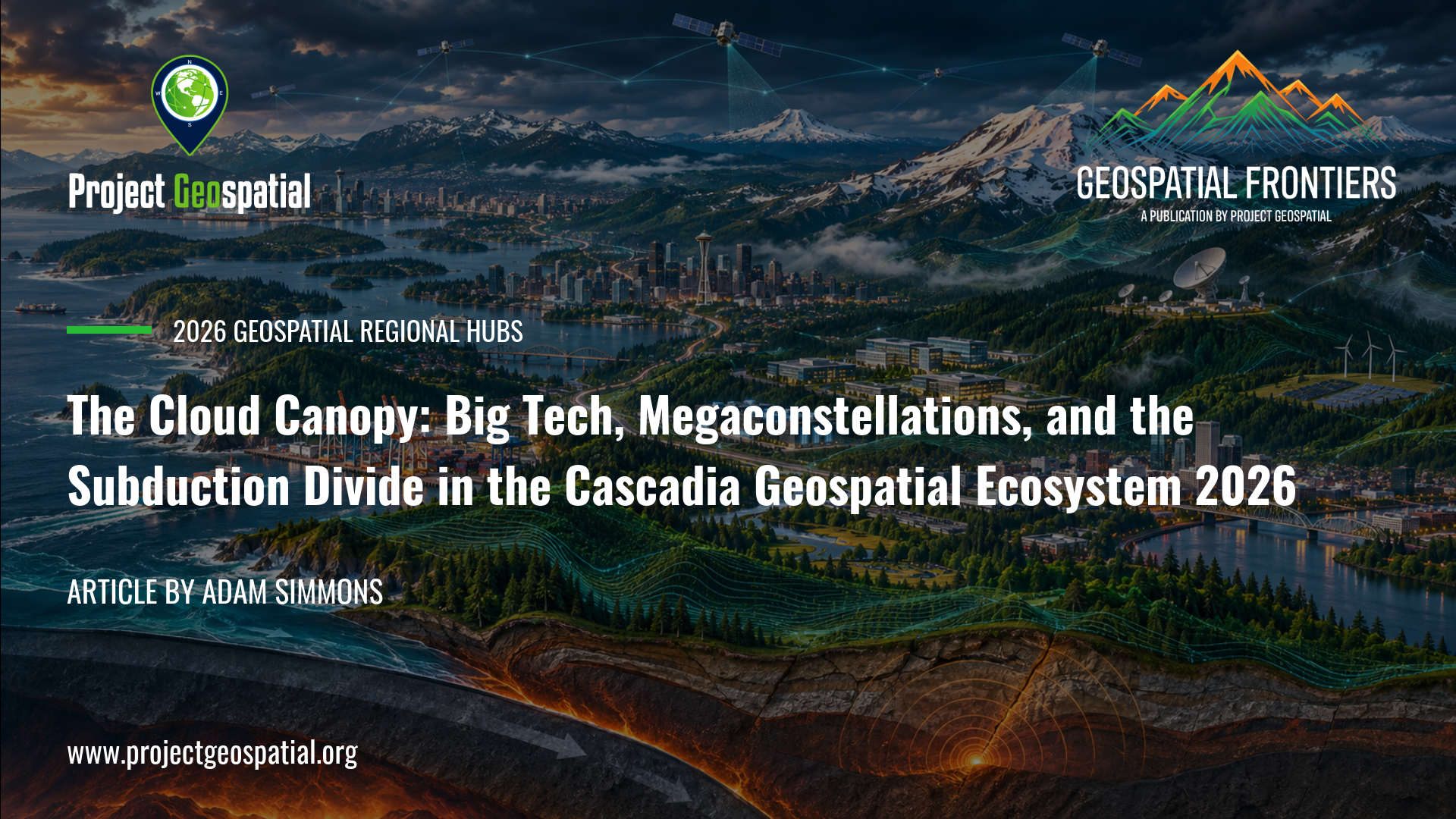
The Cloud Canopy: Big Tech, Megaconstellations, and the Subduction Divide in the Cascadia Geospatial Ecosystem 2026
The Pacific Northwest has emerged as one of North America's most influential geospatial economic hubs, connecting the technology and industrial ecosystems of Washington, Oregon, and British Columbia. From Microsoft's cloud computing infrastructure and Amazon Leo's satellite manufacturing to commercial Earth observation, precision forestry, maritime intelligence, and seismic hazard mapping, the Cascadia corridor represents a powerful convergence of spatial technologies and regional industries. In the sixth installment of Geospatial Frontiers' Geospatial Economic Hubs series, Adam Simmons examines the companies, institutions, investments, and economic forces shaping Cascadia's geospatial economy, exploring its competitive advantages, cross-border dependencies, structural challenges, and long-term potential in the global geospatial industry.

The Silicon Terrain: A Federation of Geospatial Economies in California 2026
California’s geospatial ecosystem is less a single regional hub than a federation of specialized economies spanning enterprise GIS, Earth observation, spatial AI, aerospace, national-security space, environmental monitoring, public-sector operations, and research. From Redlands and Silicon Valley to El Segundo, Santa Barbara, Sacramento, Pasadena, San Diego, and the Central Valley, this 2026 analysis maps the institutions, companies, technologies, and structural friction shaping one of the most complete geospatial economies in the world.

Deconstructing the "AI for Good" Pitch: What St. Louis's New AI Center Means for the Region
St. Louis is betting that access to advanced AI compute can help turn its growing geospatial and technology ecosystem into a more competitive engine for commercial innovation. The new Spirit of St. Louis AI Innovation Center brings together GeoSTL, regional institutions, nonprofits, and major technology companies to provide startups and researchers with infrastructure they could rarely afford on their own. But the “AI for Good” pitch also raises important questions about governance, corporate influence, civic access, national security applications, and whether subsidized compute will ultimately translate into new companies, private investment, and permanent high-paying jobs for the region. This analysis examines the trade-offs behind the Center and the metrics that will determine whether it becomes meaningful economic infrastructure or simply another ambitious regional initiative.